

Everyone Assumes You'll Sell the House
Downsizing in retirement gets treated as an obvious move, and it often is not. The house is bigger than you need. The stairs are there. Your kids mention it at Thanksgiving. But the money you think is sitting in the house is not the money that lands in your account after a sale, a purchase, and a move. Before you call an agent, work out how many years the smaller place takes to pay you back.
You have heard the case from a financial advisor, from a neighbor who already went, and from at least one adult child who worries about your driveway in January. Too much house. Rattling around. Think of the equity.
And you might want to go. Plenty of people do and end up glad they did. But notice what the advice never includes: a number. Nobody tells you what the move costs end to end, what the new place costs to hold every month, or how many years you would have to live there before the second number beats the first. They tell you the house is too big, which you already knew.
That gap is where the regret gets made. Not in deciding to move, but in deciding on a feeling about square footage when this is one of the largest cash transactions left in your life.
Why This Decision Is Harder Than the Advice Admits
The choice is hard because the house does two jobs and only one of them shows up in dollars. It holds your costs: the tax bill, the insurance, the roof, the furnace. It also holds who is ten minutes away, which pharmacy knows your name, the room the grandchildren sleep in, and thirty years of reaching for a light switch in the dark. Advice that prices the first job and ignores the second sounds decisive while answering half the question.
Most people your age also want to stay. AARP's 2024 Home and Community Preferences survey found that 75% of adults aged 50 and older said they want to live in their current home for as long as possible. That is what people say they want, not what they all manage, but it means the constant pressure to downsize runs against the preference of three in four of them. That does not make staying correct. It does mean wanting to stay is not a sentimental weakness you need to talk yourself out of.
You have probably already tried the small version. Cleared the basement. Closed off a bedroom. Got a quote for a stair rail and left it on the counter. None of it settled anything, because the question was never really about clutter. It is about whether the house still earns its keep, and nobody has given you a way to check. That is a planning question before it is a property question, which is why it belongs alongside the rest of how you lay out this stretch of life.
Downsizing in Retirement Is a Spending Decision, Not a Saving One
Here is the part the advice skips. Moving costs money now and saves money later, which makes it an investment with a payback period rather than a way to free up cash. The costs are knowable this week. The savings are a guess until you price a specific property. So the real question is not whether the new place is cheaper. It is how many years of being cheaper it takes to repay what the move cost.
Start with the round trip, because both ends charge you. Freddie Mac's seller guidance puts fees and taxes at 2% to 4% of the sale price on top of the agent commission, which the same guide gives as a wide 3% to 8%. On the buying side, Freddie Mac puts typical closing costs at 2% to 5% of the purchase price. Those are broad budgeting ranges, so use them for a floor and a ceiling, not a quote. Commission in particular is negotiable, and there is no national rate you can assume. Since the National Association of Realtors practice changes took effect in August 2024, covered listing services may no longer display offers of buyer-agent compensation, and a buyer working with an agent generally signs a written agreement setting that compensation before touring homes. A seller can still agree to cover some or all of it. Take your number from the agreement in front of you.
Then the truck. Move.org estimates roughly $7,600 for a full-service local move under 100 miles and $9,140 or more beyond that. Your own quote will turn on the size of the house, the month, and the distance.
Run those ranges against a real trade. Sell a $450,000 house, buy a $300,000 one, and the sticker gap is $150,000. The transaction itself takes somewhere between about $28,500 and $69,000 of that before the movers load a single box. Then come the costs nobody budgets: window treatments for windows a different size, a dining table that fits, the closet system, and the first repair the inspection missed.
The arithmetic is worst exactly where downsizing gets pitched hardest, which is the paid-off house. Harvard's Joint Center for Housing Studies reported in Housing America's Older Adults 2023 that in 2022, 41% of homeowners aged 65 to 79 carried a mortgage, meaning 59% did not, and among homeowners 80 and older 31% carried one, meaning 69% did not. If you are in that mortgage-free majority, your monthly housing cost already sits near its floor: taxes, insurance, utilities, upkeep. A smaller place does not remove those lines. It replaces them with slightly smaller ones, sometimes plus a condo fee. The saving is the gap between two already-small numbers, and that gap has to repay a five-figure transaction.
So here is our position, plainly. Downsizing is a life decision that sometimes pays. It is not a financial move that happens to change your life. Get that backwards and you can buy yourself an expensive lateral move.
Run the Break-Even Before You Call an Agent
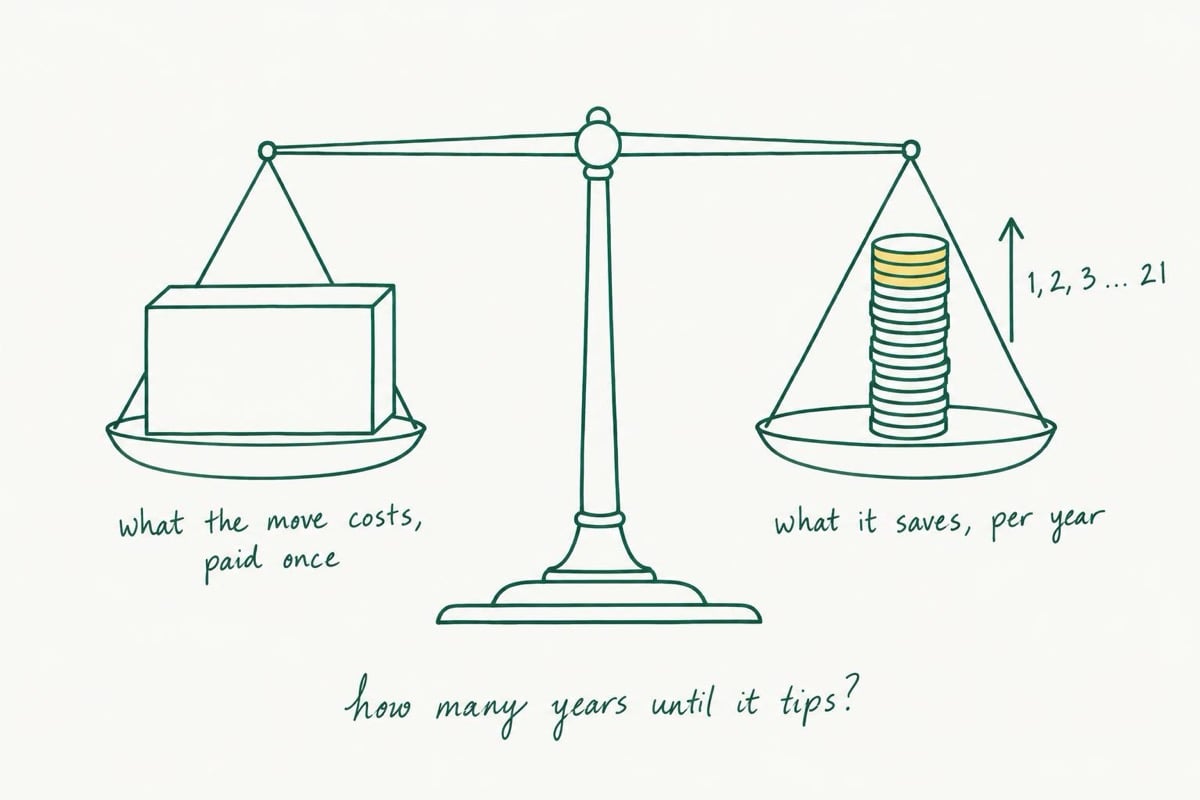
The break-even is one division problem and it fits on a single sheet of paper. Add up everything the move costs once. Add up what the new place saves each year. Divide the first by the second. That is how many years the move needs before it pays you anything, and you hold it against how long you actually intend to live there. Four steps, and the fourth is the one people skip.
Step 1: write the one-time cost, and write it high. List sale costs, purchase costs, the moving quote, and setup. Use the top of the published ranges rather than the bottom, so that a surprise costs you nothing you had not already planned for. Two lines people leave out: the repairs a buyer's inspection will force on a house built in the 1970s, and the furniture that will not fit. Get an actual quote for your actual address instead of using a national estimate.
Step 2: write the annual carrying cost of both houses, side by side. Six lines each. Property tax, insurance, HOA or condo fee, utilities, routine maintenance, and any mortgage payment. Skip the maintenance rules of thumb and pull your own last three years of repair spending, which you already have in a bank statement. For the property you are considering, get the current tax bill and the actual monthly HOA fee, because that is where a cheaper home quietly stops being cheaper. If the move requires taking on any mortgage at all, price it at today's rate, not the one you are sitting on. This is the same two-column habit that keeps any household's finances honest, applied to the biggest line on the page.
Step 3: divide. One-time cost divided by annual saving equals years to break even. A $40,000 move that saves $3,000 a year takes more than 13 years to repay itself. A $40,000 move that saves $9,000 a year takes under five. Same decision, opposite answers, and you cannot tell which one you are in by looking at the houses.
Step 4: price the column that is not money. Write the non-financial ledger in both directions, honestly. Against the move: who is currently within twenty minutes, the doctor you have seen for a decade, the card game, the choir, the room the grandchildren sleep in. For the move: stairs you already avoid, a yard that eats every Saturday, a town you are only still in out of habit. If the break-even comes in at fifteen years, the move has to win this column outright, because it is not going to win on money. That means being specific about what you want this decade to hold, not just what you want to stop maintaining.
What the Math Looks Like on Two Houses
Two households get the same advice and reach opposite answers. The figures below are illustrative, built to show the shape of the calculation rather than to predict your market, so run yours with real quotes and real tax bills. What flips the outcome is not how much smaller the new place is. It is how much the current house actually costs to hold, and how much of the sale price the transaction eats on the way through.
The paid-off house, where the move loses. A couple in their late sixties own a four-bedroom outside a midwestern city, no mortgage, worth about $340,000. Their own records put the carrying cost near $9,600 a year across taxes, insurance, utilities, and repairs. The two-bedroom condo they like lists at $255,000 and carries about $7,400 a year once the HOA fee is counted. Annual saving: $2,200. One-time cost, using the middle of the published ranges plus a local move: roughly $47,000. Break-even: about 21 years. They are 68. The condo is not a bad condo. The math is simply telling them this move is being bought, not earned, and they should decide whether it is worth the price.
The expensive market, where the move wins. A woman in her early seventies owns a house in a high-cost coastal metro, bought decades ago, worth about $1.1 million. Carrying cost runs near $28,000 a year. She moves to a single-level place twenty minutes from her daughter for $600,000, carrying about $12,000. Annual saving: $16,000. One-time cost including a long-distance move and replacing furniture: roughly $130,000. Break-even: about eight years, and she intends to be there longer than that. Much of the gain on a long-held home may also fall inside the federal exclusion. The IRS allows up to $250,000 of gain to be excluded for an eligible individual and up to $500,000 for most eligible married couples filing jointly, generally requiring two years of ownership and use as a main home during the five years before the sale, with further rules and exceptions that are worth checking with a tax professional.
Notice what actually moved the answer. Not bedrooms. The spread between two carrying costs, which is set mostly by the market you are selling into, and the share of the sale price the round trip consumes.
"But the House Is Too Much for Me Now"
That is the strongest reason to move, and it is the one most often solved the expensive way. If the problem is the lawn, the gutters, the stairs, or the third floor nobody has entered since 2019, price fixing those first. Get quotes for a stair lift, a lawn service and a cleaner twice a month, add their annual total to what the current house already costs to hold, and run step 3 again with that larger number.
That is the honest comparison: the patched house against the new one, not the house you resent against the condo you toured on a nice afternoon. Sometimes the patch still loses. You cannot know which without running it.
Some problems cannot be patched, and you should say so out loud. Care needs that the layout cannot meet. A roof and a furnace due in the same decade. Being two hours from anyone you would call at three in the morning. Those are real reasons to move, and none of them is a money reason, which is fine as long as you are not defending them with a spreadsheet that does not hold up. If the house has simply come to feel like it belongs to a life that already ended, put that on the list too, and be specific about what you would be starting over into.
One more thing worth being straight about. Plenty of older Americans really do end up in smaller, less valuable homes: Banks and colleagues traced that pattern in US household data running through 2006, published in Economica. But a smaller house and money in hand are two different outcomes, and only one of them is guaranteed. The space comes off the day you move. What is left over depends entirely on the two columns.
The One Page to Write This Week
Downsizing in retirement becomes a decision the moment it becomes two columns. Take an evening this week and write them: everything the move costs once, and what each house costs to hold per year. Get one real moving quote. Pull the actual tax bill and HOA fee for one property you would seriously consider. Then divide. That single number tells you whether you are looking at a financial case or a preference you are about to pay for.
If the break-even lands inside your realistic horizon, go build the rest of the argument. If it lands past your horizon, you may still move, and you will be doing it deliberately, for reasons worth what they cost. Either way you will be holding the number nobody at Thanksgiving is going to hand you.
It is the same move as a plain audit of where your time and money currently go, pointed at the biggest line on the page.