
Three filled notebooks sit on the shelf and a fourth is open in front of you. Somewhere in them is the number your client said out loud on a Tuesday in March, the name of the plumber your neighbor swore by, and an outline you wrote on a train that was better than anything you have written since.
You know all of it is in there. You cannot get to any of it.
So the notebook keeps taking writing and gives nothing back. It has turned into a write-only device: excellent at the moment of capture, useless the moment you need something out again. Most people respond by buying a nicer notebook, which changes nothing, or by starting a fifth one, which makes it worse.
A Japanese notebook organization system fixes the second half of that problem, the getting-out half, and it does it with about four seconds of work per page.
Why a notebook fills up and stops being useful
A paper notebook fails at retrieval for one structural reason: you write in the order things happen and you need things back in the order they matter. Pages go in by date. Questions arrive by topic. Nothing in a bound book connects the two, so the only search tool you have is flipping. Past forty or fifty pages, flipping stops being search and becomes archaeology.
Every popular fix tries to solve this at capture time, which is the worst possible moment. A notebook per project means you never have the right one in your bag. Tabs assume you knew your categories in January. Colored pens require a decision while someone is still talking. Rewriting everything into an app each evening is a second job, and it is the first thing to go in a bad week.
None of that is a discipline failure. Those systems ask you to sort while you are still listening. Capture has to stay stupid and fast, or it does not happen at all. If your notebook is mostly a dumping ground for a crowded head, that is fine, and our guide to feeling too overwhelmed to start is the better read. The sorting belongs somewhere else: after the fact, at the page edge.
What a Japanese notebook organization system actually is
Search the phrase and two different things come back. One is a set of Japanese planners and notebook systems you can buy. The other is a page-edge indexing trick that circulates without a clear source. The products are verifiable; the folklore around the trick is not, and we are going to be straight about which is which.
The products are real and worth knowing. Hobonichi publishes the Hobonichi Techo, a planner family built around a daily page format. [1] MIDORI presents TRAVELER'S notebook as a leather cover whose contents you change out with dedicated refills, so the cover stays and the paper inside rotates. [2] Two different answers to the same question, and both take a position most Western planners avoid: the format is fixed, and you commit to it.
The page-edge index is the other half. We went looking for its origin and could not verify one, so we are not going to hand you a story about a centuries-old practice. What follows is LifeHack's own build. It takes the fixed-format, one-book stance those products share and adds a retrieval layer that costs almost nothing to maintain.
Here is the definition we would give: a Japanese notebook organization system runs one notebook as a single chronological stream and moves all the sorting to the page edge and the back pages, so nothing has to be decided while you write.
Capture stays dumb. Retrieval gets structure. The two never compete for the same moment.
Build it in twenty minutes
You need your current notebook, a pen, and one marker or highlighter. Do not buy anything yet. The setup below is ours, and it is deliberately small, because the version you actually maintain beats the version you admire.
1. Number the pages. Bottom outer corner, every page, front to back. Twenty minutes with something on in the background. This single step is what makes an index possible, and it is the step everyone skips.
2. Pick four marks, not ten. Four categories that cover most of what you write. Ours are Work, Money and admin, People, and Ideas. Yours might be Clients, Health, House, Study. Four is the limit for a reason: at six you start hesitating over which one a page is, and hesitation at capture time is the thing we are removing. If a fifth category keeps demanding a slot, that subject probably deserves its own notebook.
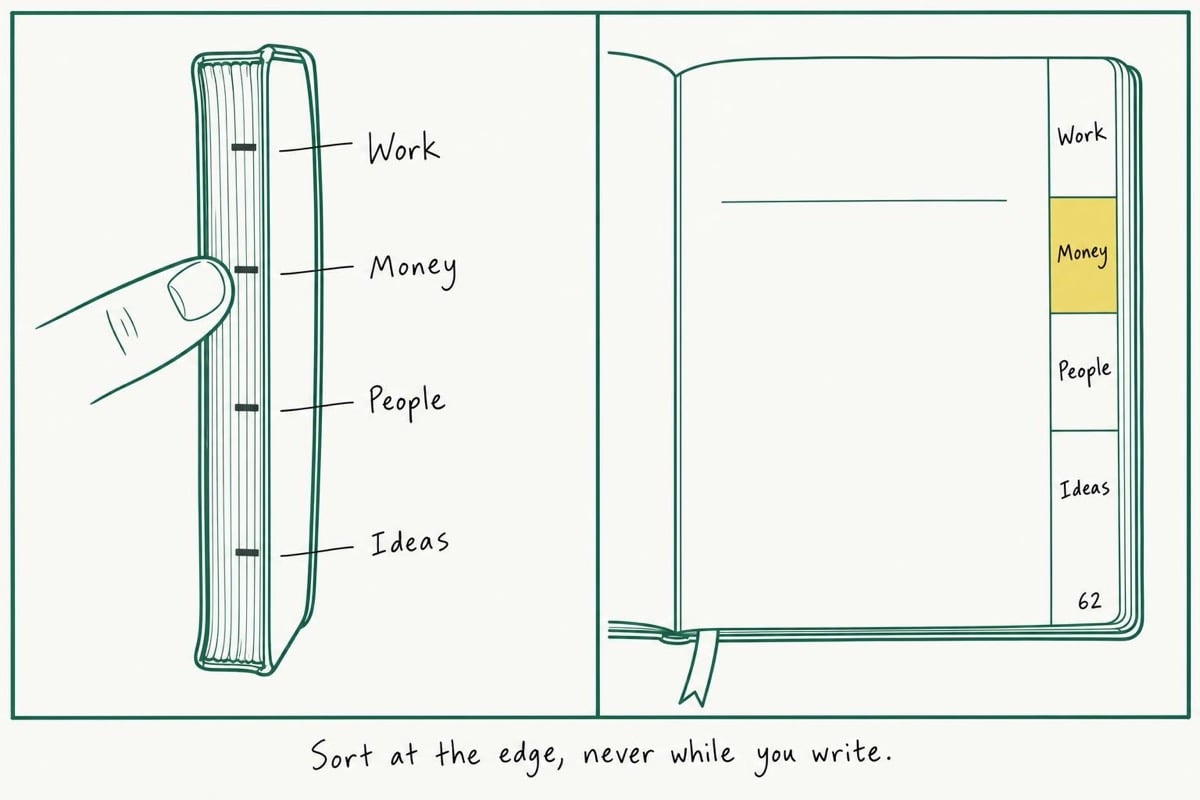
3. Draw the edge column. On each page, leave a narrow strip down the outer margin, maybe half an inch wide, divided top to bottom into four bands. Band one is Work, band two is Money, band three is People, band four is Ideas. When a page is mostly about one of them, fill that band with the marker and run the ink right off the edge of the paper.
Close the book and look at the page edges. Every Work page shows a dash at the same height. They stack into a visible stripe. To find your work pages you no longer open the book at all; you thumb the stripe.
4. Keep the back index. Reserve the last two pages. One line per entry: date, three to six words, page number. Mar 4 - Hoffman call, pricing - p.62. Write the line when you close the page, not in a weekly cleanup you will skip. It takes four seconds and it is the whole system.
5. Five minutes on Friday. Open the index, add the lines you missed, and circle anything still open. Copy the circled items onto the next fresh page. That is the entire maintenance cost, and it is what separates this from the index you started in a bullet journal and abandoned in week three.
When the notebook fills, photograph the two index pages before shelving it, and name the file with the date range. That is your archive. Habit stacking is the easiest way to make the Friday pass stick: attach it to something you already do without thinking, like the end of your last meeting of the week.
A week inside the system
Take a hypothetical reader, Dana, who runs two projects at work and handles most of the household admin. Monday she takes call notes: attendees across the top, decisions down the page, action items in small square boxes she can tick, open questions marked with a question mark in the margin. Work band filled, index line written, done in four seconds.
Wednesday she writes half a page of ideas for a side project on the train. Ideas band. Thursday a plumber quotes her a number over the phone and she writes it on the next available page, which happens to sit between two pages of client notes. Money band. She does not reorganize anything. The notebook stays chronological, which is the only order she can maintain while living her actual week.
Three weeks later the plumber calls back and disputes the figure. Dana closes the book, looks at the Money stripe, sees four dashes, and opens the second one. Ten seconds, maybe fifteen. Under the old arrangement that number was gone and she would have taken his word for it.
The retrieval you cannot do with a stripe alone is the one where you remember a topic but not a category. That is what the index is for. Forty lines of handwriting scan in under a minute; two hundred pages do not. The two tools cover different failures, which is why you want both and why neither is enough alone.
One more thing worth copying from Dana's meeting pages: the square box. A task with an empty box beside it is visibly unfinished from six feet away. When you flip past that page in two weeks, the open box does the reminding without you having to read a word. If you also run a task list, how to prioritize what is actually on it matters more than where you write it down.
One notebook, or a refillable system?
Choose by how your work is shaped, not by what looks good on a desk. If most of what you capture is time-shaped, meetings and calls and daily notes, a bound notebook plus the edge index is enough, and the chronological order is a feature. If your work is project-shaped and you need to physically regroup pages by client after the fact, a ring or refillable system earns its price.
That is the split the Japanese options make clear. The Hobonichi Techo is built around a daily page, which suits a life that runs on dates. [1] TRAVELER'S notebook is a cover with swappable refills, which suits someone who wants one carrier and changing contents. [2] A plain ring binder with dividers does the regrouping job for a fraction of the money and none of the pleasure.
Here is the part the shopping results will not tell you: buying either one does not give you a system. The index does. We would rather see you run this in a three-dollar notebook for two months and then spend the money, than start with the nice one and abandon it in March. The gear is not the constraint. It never is. That is the same trap busy versus productive describes in a different costume.
Why not just use your phone?
Because the two tools are good at opposite things, and most people are using the wrong one for capture. Digital wins search outright. Full-text search across five years beats any hand-kept index, and nothing on paper competes with that. Paper wins the three seconds before the writing starts: no unlock, no app choice, no notification landing in the middle of your thought.
You will find a great many confident claims online about handwriting and memory. We went looking for numbers we could stand behind and did not find them, so we are not going to run that argument at you. The case for paper here is narrower and duller: it is about capture friction, not brain chemistry.
The rule we would use is a split. Capture and think on paper. Move a line into digital only when it crosses one of three thresholds: someone else needs it, it has a deadline, or you have looked it up more than twice. Everything else stays where it landed. Anything you are tracking daily and numerically, like reps or spending, belongs in an app from the start, and habit tracking tools do that better than a page ever will.
Start with the back two pages
Tonight, take whatever notebook you are already using. Number its pages from today forward. Write four category labels inside the front cover. Then turn to the last two pages and write index lines for the last ten pages you wrote, no further back.
That is roughly twenty-five minutes, and it is the entire commitment. A Japanese notebook organization system only earns its keep the first time it hands something back to you, so two weeks from now, count the number of times you went looking for something and found it. If the count is zero, drop this without guilt. If it is three, you have your answer, and you never have to think about the system again.