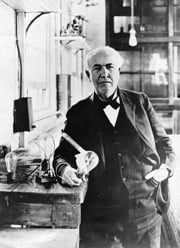
How to Take Notes like Thomas Edison
Famous inventor Thomas Edison is probably the most experienced note-taker in the world. His diary which is still maintained as an important part of the United States historical record contains five million (5,000,000) pages. Important developments such as his work on perfecting the light bulb and electric lighting systems are captured in great detail. He never met a sheet of paper he didn’t like.
What lessons can we take from his work today, a century later? How did his note-taking help him to become the world’s most famous inventor with over a thousand (1093) U.S. patents in his name for a wide range of technologies from movie cameras and phonographs to cement making and electric lighting? In short, what made his note-taking and filing system so great?
Edison’s system was developed to support his life work and was very successful in doing so. The main elements of his system are as follows:
- Any useful or important development was recorded so that no effort was wasted in repeating experiments or efforts unnecessarily. Edison’s method was once described as an “empirical dragnet” by Nikola Tesla, another famous inventor who worked for Edison for some time. Combining Edison’s hard working and hard thinking methods with an effective record creation and retention system was a very important aspect of his work.
- Forward-looking. Edison’s notes included the forward-looking things we tend to incorporate in many of our modern personal planners. Things like lists of contacts, appointments, “to do” lists, and actionable items for follow up or later review were all contained within his comprehensive system.
- Rearward-looking. The ability to go back and check his written record was useful in several ways. He was able to use his records in various lawsuits filed against him and by him against others as evidence and to substantiate his claims. His competitors were often unable to compete with his records so he often came out victorious in these legal battles. He was always able to review past work and avoid repeatedly going down dead-end roads. He could always review whatever he had said or was told. He never had to remember most things as long as he could remember how to look it up later.
- The record system was searchable. Sometimes, from among millions of pages, there would be a key document that would prove invaluable. Unfortunately, with his manual system, he often spent considerable time searching through these records looking for the key item. He did however have a fairly good system of archiving his records by a combination of chronological and subject matter based systems. He created numerous groupings, files, folders, etc. which helped him to get to the right part of his records in a reasonably short time.
- Who, what, where, when and how much. These details could be fairly easily retrieved from Edison’s system in relation to any aspect of whatever he was involved with. These included financial records and they formed an important part of his note-taking system. He kept all his incoming as well as copies of all his outgoing correspondence. This was not necessarily easy to do before the invention of the modern office copier.
- How and why. Edison’s research laboratory work was a focal point for much of his record system. Patent applications and reviews were based in large part on his notes that needed to include the how and why aspects in sufficient detail so that the patents themselves would be complete and able to withstand any legal challenges. Edison often used his records to defend his position from competitors in his day when patents and technologies were becoming very fashionable and important as they remain today. His system of experimentation and related record keeping has become the basis of the modern industrial research institution – which he is widely credited with having invented.
- Extremely powerful memory aid. Edison had an amazing memory. He was well informed on a wide range of topics and always seemed to be able to recall what he told someone or what he was told. Much of this is due to his system of notes. By writing everything down that he thought was worth writing, he was able to free himself of the burden of having to remember it. A strange and almost unexpected thing occurs. The process of writing things down aids in the mental memory retention. The combination of having the confidence in knowing the information is on record and easily retrievable combined with the improved retention from the process of writing it down, creates a winning combination when it comes to memory.
How can we improve upon Edison’s system using today’s technologies? Obviously, we have invented the ball point pen to replace his messy quill and ink bottle so that notes can be written in real time. In his day, he perfected the typewriter. Today, we are no longer committed to getting stuff onto paper as the final form of record retention. Vast portions of Edison’s original archives have recently been digitized and can be viewed online. This eliminates the need for mothballs and maintaining rooms full of old papers that can only be studied by someone showing up and going through them one page at a time.
How does your system compare to Edison’s? His was comprehensive and scalable to wherever his interests lay. Is your system similarly scalable? What about the content? How much of the information in your system has objectively measurable value? Edison kept everything and it all went up in value as his overall fame and power grew. How valuable has the information in your system become (or is becoming)? How scalable is your system as your interests change (whether expanding of shifting to other areas)? Edison always used the best available technology to maintain his records as efficiently as he thought they could be maintained. Have you similarly employed sound technologies for taking and keeping your notes?
Edison certainly subscribed to the philosophy that if life is worth living, it is worth writing about. At five million pages, he was at the extreme end of this. He did live a long, prosperous life. And he lived it quite fully since he always seemed to have something to write about.
Peter Paul Roosen and Tatsuya Nakagawa are co-founders of Atomica Creative Group , a specialized strategic product marketing firm. Through leading edge insight and research, sound strategic planning and effective project management, Atomica helps companies achieve greater success in bringing new products to market and in improving their existing businesses. They have co-authored Overcoming Inventoritis: The Silent Killer of Innovation now available.



Comments
rap says on October 10th, 2007 at 12:12 pm
I can not imagine achieving the level of brilliance let alone the organization of Thomas Edison. Technology does allow the less disciplined to get away with organization and achieve a higher level of note taking and recall:
A Tablet PC (TPC) with OneNote and Outlook has been a powerful combination in creating a note taking, diary and calendar system. The Tablet PC functionality reduces the reliance on paper while providing enhanced productivity tools:
Anytime/Anywhere - Nearly all work related documents are in one location. It is rare that any material discussed in the work environment is not distributed in digital format. I can refer to these documents anytime/anywhere on the Tablet PC.
Handwritten Notes - Taking notes during meeting on documents is integral part of the system. TPC/ON provides the functionality to handwrite on any digital document. It is critical to understand my handwritten notes are rarely converted into computer text. These notes remain in my handwriting for later review and are searchable…
Searching - Yes, unconverted handwritten notes are searchable. New search indexes the entire hard drive including the text of all documents/attachments within Outlook, OneNote, etc

Sorting - OneNote’s tabular sorting structure works quite well as a filing and an online note taking system.
The Tablet PC is not for everyone and will not replace paper but its functionality has improved my productivity. It does require some discipline and not surprisingly, backing up the hard drive is critically important.
Robert Byrd says on October 10th, 2007 at 1:25 pm
This is an interesting article but why doesn’t it have a link to some examples of Edison’s method?
Brad Newman says on October 10th, 2007 at 1:52 pm
Phenomenal post! It’s always interesting to learn how the great ones conducted their lives….
Thank You
John says on October 10th, 2007 at 5:25 pm
“The process of writing things down aids in the mental memory retention.”
My personal experience has shown this to be true. Does anyone know how this translates to typing information? I personally don’t remember a lot of what I type. I think it’s because I can type on “cruise control” that is type without putting much thought into it. My fingers just find the keys. However with writing I have to engage my mind more, so I retain that information better.
bonzo dog says on October 10th, 2007 at 5:42 pm
Good tips, buuuut… where in the article does it explain HOW to Take Notes like Thomas??
What record-keeping system did he use (so that I don’t have to re-invent it as suggested by the article)?
What sort of info did he write down regarding a conversation with a colleague? That would be nice to know what sort of things he thought were important in a brainstorm session.
“How does your system compare to Edison’s?” I dunno, describe his system to me first. I don’t actually have a system and was hoping to use Tom’s but details on his system are sketchy.
Travis Jeffery says on October 10th, 2007 at 8:20 pm
At least show the methodology of Edison, and 2 Tesla’s work was revolutionary compared to Edison who stole from Tesla.
Brian says on October 10th, 2007 at 11:01 pm
When I read the article title “How to take notes like Thomas Edison”, I thought it might be about how to take notes like Thomas Edison. Silly me.
Brian
Peter Roosen says on October 10th, 2007 at 11:02 pm
EDISON VERSUS TESLA:
We have written quite a bit about both Edison and Tesla in our new book Overcoming Inventoritis: The Silent Killer of Innovation. Edison certainly stole stuff - he didn’t invent the light bulb but rather made it a commercially viable product. Edison was a brilliant marketer, we think the best the world has ever known. Tesla certainy was brilliant, but since he was a lousy marketer compared to Edison - died broke and miserable. Tesla had severe inventoritis while Edison was relatively free of it.

EDISON NOTES AND RECORD RETENTION SYSTEM:
As for the Edison note-taking aspects, you can see it first hand at the new and developing online archive at http://edison.rutgers.edu/ like we did as we were working through the book writing process. We also traveled to historical sites as part of our research. Searching Edison’s records through the Rutgers website is much faster and easier. The specifics of Edison’s archive and system is not something that we can easily describe in a few words because the depth and breadth is so vast. Taking a few minutes to poke around the online archive would be far more instructive.
A MORE PERSONAL NOTE REGARDING RECORDS:
I’m just going through the process of taking my personal one million pages of notes and records from the past 25 years and dealing with this archive that fills a stand-alone building and overflows into another. I converted to a paperless system 2 years ago after 2 decades of creating and managing paper. My million pages of earlier material still gets searched from time to time and is closely modeled on the Edison method. Maybe 0.1% of it is stuff I’ll still get value from but the problem is knowing exactly which sheet of each thousand is the keeper. Tatsuya has taken a different approach to records and we often compare notes and seek out best practices.
Any suggestions as to how I can cost effectively have my building and my relevant papers too? The building is destined to be repurposed into a railway locomotive maintenance shop within the next few months. Swapping tons of paper for tons of iron.
Thanks again for all your comments and questions. We really welcome and appreciate your feedback on our articles.
Steve M says on October 11th, 2007 at 12:45 am
Modern blogging tools and things like twitter allow anyone to have a great search able index of notes on hand anywhere in the world
Mihir says on October 11th, 2007 at 4:43 am
Can you please change your article title to “How Thomas Edison was taking Notes” because I feel thats what article says.
Bob says on October 11th, 2007 at 4:56 am
I really doubt he wrote 5 000 000 pages… alone!
He died at the age of 84.
Let’s say he wrote at the tender age of … one day (he was a genius, right!).
5000000/84/365.5 ~163 pages /day !!!!
No way he did it. Or he wrote 2 or 3 words a page!
Just my 2cts.
GreatManagement says on October 11th, 2007 at 7:16 am
Re: taking Notes.
I attended a conference where Ken Blanchard was a guest speaker.
He told the audience that if you want to learn from him, we are going to have to listen so hard we get a headache. He said if we were to take notes as we normally do, we would only remember 50% of the content within 3 days; and only 20% within a week.
His view of the best way to take notes is as follows:
Split your note page (by drawing a line) into two – roughly 4/5’s on the left of the page and 1/5 on the right.
The left of the line is your capture column. Just write, write and write. Capture everything. Do not look at the presenter (why do you want to look at the ugly presenter? (Ken’s words)). Do not evaluate what is being said – just write.
Use neat writing – do not scribble – you will not be able to read your own writing, later.
The right of the line is for capturing the key concepts.
Then, within 24 hours write up your notes and summarise everything.
Within 1 week, share your notes with others and ‘teach’ what you have learnt by using your notes. This has a huge impact on your own understanding and learning when you share / teach others.
To summarise:
1. do not look at the presenter
2. split your paper into two as per above
3. write, write and write even more
4. within 24 hours write up your notes and summarise everything
5. within a week teach others what you have learnt using your notes
I have since used the tip on numerous occasions and it works.
Andrew
Peter Roosen says on October 11th, 2007 at 12:48 pm
Yes Bob, 163 pages per day for Edison was about right. My number is about 125 pages per day average and I have not missed a day in 25 years. Some days are at just a couple pages and some at 2000 to 5000 pages depending on what is going on. You are also right in that these are not all personally authored pages. Incoming correspondence and stuff produced by others is also included. For example, when working on a project, any and all documentation relating to said project was counted in. Have a look at Edison’s online archive at the Rutgers site as I mentioned in my previous comment response and you can get a clear picture of what he was doing. All projects here are paperless now and the page counts are much lower but still high. Somewhere between 50 and 100 pages per day.
Thanks Andrew for detailing Ken Blanshard’s approach. For the handwritten journal part of my note system, I do something quite similar when capturing content from a presenter. This is only for presentations where I am in pure content capture mode, only a small percentage of the time
When actively evaulating a speech or reviewing material in real time which is something I often do, I’ll often split the page in half with a vertical line and write positives on one side and improvement suggestions on the other. Depending on the type of presentation I am evaluating, I might split the page in three with two horizontal lines. First section are things I like, middle has the improvement suggestions and stuff I question or disagree with and the bottom third has my overall impression (generally a positive one). I learned this at Toastmasters http://www.toastmasters.org where we are often giving public oral evaluations within minutes of a speaker concluding a presentation. The goal at Toastmasters is to help the speaker improve with every presentation.
FASHIZZLE BA ZAM!!!! says on October 12th, 2007 at 12:43 am
AWESome poste man!!!! great to know
FASHIZZLE BA ZAM!!!!
evillll waffle man says on October 12th, 2007 at 12:45 am
bazzzzaaaaaammmm, you have just been turned into a waffle, now you have to go eat a faffle or you will disappeer into outerspace man!!!!!!
thrust me, i would know but, you better do this
Remco says on October 12th, 2007 at 8:01 am
@Andres: if the lecture is such that writing down as fast as you can without looking at the presenter is a good method, then the lecture sucks. He should have just handed you his lecture on paper in the first place.
In a good lecture, you need all your brains to understand what the presenter is getting at; and you need all the visual cues that a good presenter gives you while talking. If notes are helpful for the particular subject, he can always just hand them out.
Writing a summary later and giving a presentation to others do seem like excellent ideas.
matt says on October 14th, 2007 at 4:47 pm
how could he have made 5 million pages of notes? 50 years of notetaking (50 x 365) is 18,250 days. 5 million pages would mean 273 pages of notes every day. He wrote a novel worth of notes per day? Or maybe 100 years of notes at 137 a day?
Jonathan Kyrlach says on October 15th, 2007 at 2:50 am
Tesla was a lousy invetor, anda lousy scientist, the article quotes Tesla’s description of Edison’s methods, but fails to quote how frustrated Tesla was by Edison’s methodology of using brute force over application of scietific procedure. The lightbulbis a great exampleof this. Instead of just rying filament after filament, Edison could have used science to deduce an adequate filament material. I’m not saying Edison’s note sytem isn’t good, but we shouldn’t be saying that his science was.
Jonathan Kyrlach says on October 15th, 2007 at 2:54 am
Edison Note-Taking System:
Step One: Arrange to have a lab assistant distract Tesla.
Step Two: Take Tesla’s notes.
Alternative Method:
Step 1: “Borrow” notes from colleague Tesla
Step 2: Retype, change name to Edison, and send to publisher.
Step 3: Explain to Tesla that this is American humor.
Jonathan Kyrlach says on October 15th, 2007 at 2:57 am
I am a lousy typist, and meant to say that Edison, not Tesla, was a lousy inventor. I highly esteem Tesla, and would never attack his scientific prowness. My apologies to the LH community.
Rob says on October 15th, 2007 at 10:18 am
I’d like to read more about this. Could you cite the source where you found it?
dr love says on October 18th, 2007 at 3:40 am
my bottom hurts - could someone please invent anti sitting down sore bum creme - thanx - the good docktor!
Peter Roosen says on October 26th, 2007 at 4:54 pm
You can read more Rob in our Overcoming Inventoritis book that is in the advance release phase and available directly from our publisher at http://www.happyabout.info/ove.....oritis.php
Scott says on November 1st, 2007 at 8:44 pm
Edison did not write a 5 million page diary. This entire post and the resulting responses are a bunch of uninformed crazy talk, and the people claiming to personally write 5000 full pages of text per day are complete liars. I will pay $1 million to the first person who can prove that they write 5000 full pages of comprehensible original text per day.
Peter Roosen says on November 14th, 2007 at 1:57 pm
Where should I send the boxes in exchange for payment Scott? You should be careful about underestimating Edison’s accomplishments and what some people are capable of. Edison’s documents are all a matter of public record. Mine are not but I can spare a few.
historyforest says on January 8th, 2008 at 8:46 am
Neat article. Edison truly was prolific! Amazing man! Thanks for the post!