

Why Impulse Buying Keeps Happening After You Decide to Stop
Impulse buying keeps happening after you decide to stop because the decision was general and the purchase is specific. You decided to spend less. The purchase arrived as eleven seconds on a couch, with the app logged in, the card saved, and a banner saying the price held until midnight. A general resolution has to win that moment every single time, and it only has to lose once a week to undo the month.
You are not careless with money. You have a number you check. You have read the lists, and you probably tried waiting a day before buying anything. It held for about nine days.
Then the spending came back, and it came back in the same places. Same app, same hour of the evening, same kind of week. One purchase looks like a lapse. Four purchases with the same fingerprint are a pattern, and a pattern is something you can change without becoming a different person.
What Actually Fails When You Break Your Own Spending Rule
Look at where the rule was written and where the buying happened. Sunday at the kitchen table, Thursday at 11pm. A spending rule has to travel between those two places, through a checkout built to take three taps, a countdown timer, and whatever kind of day you had. Most rules never make that trip, because nothing about them lives at the point of sale. Your resolve was never the part under test.
The retail side is not accidental. Saved cards, one-tap checkout, free returns and expiring banners all exist to shorten the gap between wanting and owning, and stores arrange the shelf and the screen the same way. On a saved-card checkout, buying takes fewer taps than checking whether you need the thing.
Most advice on how to stop impulse buying is thin exactly where it matters. Avoid the mall. Make a list. Wait 24 hours. Pay in cash. None of it is wrong. It is aimed at nobody in particular, which usually means it is aimed at the wrong trigger.
You Picked the Rule Before You Read the Receipt
You picked a rule before you knew what you were buying, when, and in what state. Your card statement from the last 30 days holds all three. The question that decides everything else is whether your unplanned purchases bunch up in a few repeating situations, because a rule only works while it sits on top of one of them. You can answer that in 20 minutes, and nobody else can answer it for you.
Two things about the standard advice are worth saying before you collect any more of it. We looked for a study that tested a mandatory 24-hour or 48-hour wait and measured what people bought or regretted afterwards, and did not find one. On cash versus card, the research is not settled enough for us to give you a number. Both rules are cheap, so run them if you want to. Just do not count on either as a mechanism, and do not read a rule that slipped as evidence about your character.
Two things about the buying moment do have research behind them, and both point at triggers: the urgency cues in the storefront, and your mood in the hour you bought. That is the argument of this piece. Find the trigger, then pick the rule that blocks it.
The 30-day audit below, the four trigger types, and the two-week check are our own construction. They are not a validated instrument, and nobody has tested them in a trial. They are built from what the research supports about what sets off a purchase, plus a bias toward rules specific enough to check.
How to Stop Impulse Buying in Four Steps
Learning how to stop impulse buying takes about 20 minutes of reading your own record, then two weeks of running one or two rules aimed at what the record showed. The order matters more than the tactics. Audit first, name the trigger second, write the rule third, check in two weeks fourth. Skipping to the rule is what you already did, and it is why the rule did not hold.
Step 1: Read your last 30 days before you change anything
Open your card statement and the order history in whatever two apps you buy from most. Write down every purchase you would not have put on a list that morning. For each one, note four things: the amount, the date and rough time, where it happened, and one word for what you were doing beforehand. Then total it and count the entries.
Two numbers come out of this: the total, and where the entries bunch up. The bunching is the part you can act on, something like four of eleven purchases in one app, or six of them after 10pm, which runs close to how decision fatigue works late in the day. If nothing bunches, you will know that in 20 minutes too, and the last section says what to do instead. Tracking is also the one habit here with field evidence behind it, though the evidence is bundled. In a field experiment published in the Journal of Financial and Quantitative Analysis, Di Bu, Tobin Hanspal, Yin Liao and Yong Liu ran a self-control intervention with students at five Chinese universities that combined spending and borrowing tracking, budgeting and reflection, and found reduced online borrowing and lower delinquency charges, mostly through less entertainment spending. The package worked; the study cannot tell you that tracking alone did it, and a student borrowing sample is not a US household. Treat the audit as a diagnostic, which is what tracking is actually good for.
Step 2: Sort each purchase by its trigger
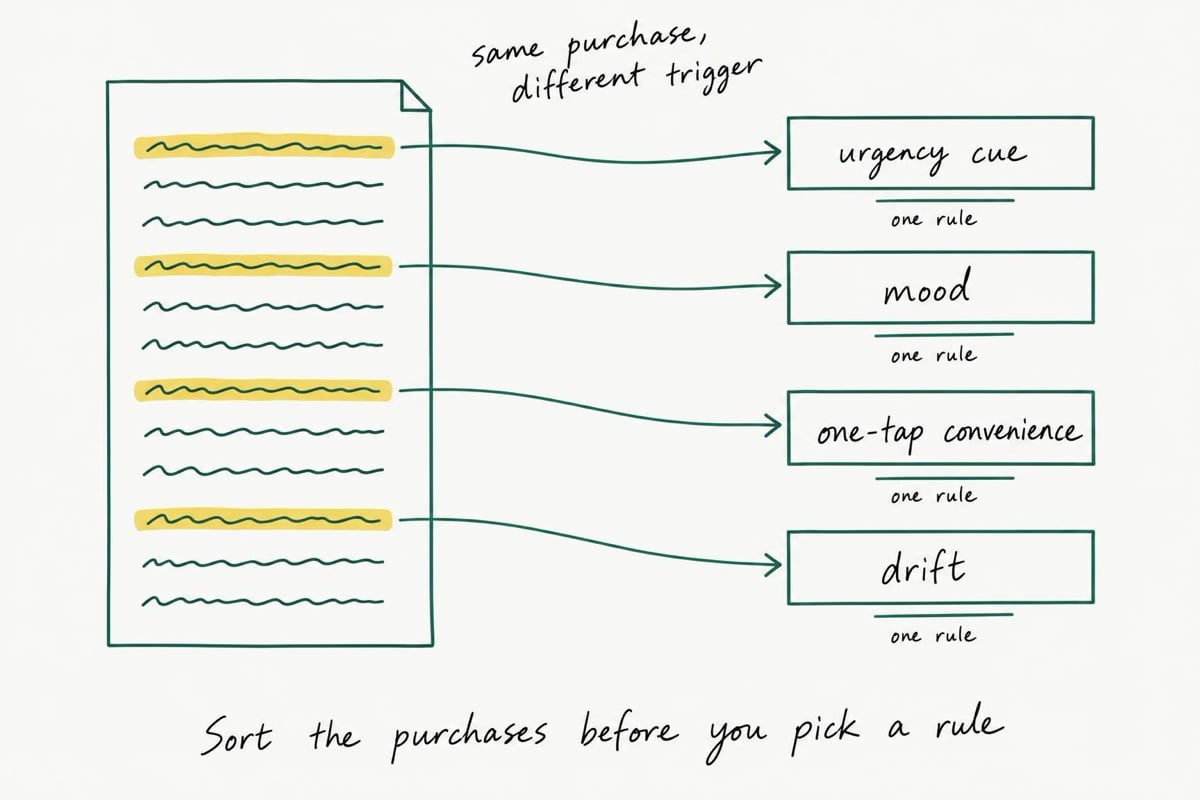
Sort each entry into one of four triggers. Urgency cue: a countdown, a flash sale, a low-stock warning. Mood: a specific bad hour you can name. One-tap convenience: the card was saved and you were already in the app. Drift: you opened the app or walked into the store with no target and found one.
Urgency is the trigger with the clearest research behind it. A 2025 study in Current Psychology using a questionnaire survey and a situational experiment reported that limited-time and limited-quantity scarcity appeals affect impulse-buying intentions, with fear of missing out carrying the effect and anticipated regret changing its strength. Read that as evidence about intentions in the settings tested, not a guarantee that every countdown produces a sale, and the paper does not give a figure you can apply to your own week.
Mood is narrower than the advice suggests, because the clear finding is about sadness. Writing in PLOS ONE in 2018, Nitika Garg, Lisa Williams and Jennifer Lerner reported a replication of the sadness effect: sad participants set higher prices than participants in a neutral mood, and the effect held even where other kinds of spending were available. Combining their result with the original study gave a pooled estimate of d = 0.43, 95% CI 0.12 to 0.77, which is a small-to-medium effect measured in choice tasks rather than in anyone's checkout. Stress and boredom get blamed constantly and may do the same thing, so if your one-word notes keep saying "bored", act on your own pattern. Just do not expect this study to back it up.
Step 3: Write one rule per trigger, placed where the trigger is
One rule per trigger, and this weekend you write only the two whose triggers took the most money. A rule has to name the trigger and the exact action, and it has to live where the trigger does.
For urgency, the rule closes the tab: any countdown or low-stock banner means the item goes into a note with the date, and the tab closes. If you still want it on Sunday, buy it at full price. For one-tap convenience, delete the saved card from the two apps your audit actually named, not from all of them, and log out of those two. For mood, the rule needs a replacement action available in that hour, which is why the two-minute reset is more useful here than a vow. For drift, do not open a shopping app without a target item, and do not enter a store without a list of what you came for.
Keep the wording specific enough that someone else could tell whether you followed it. "Spend less on clothes" is not checkable. "No clothing purchase without 48 hours in the note, and no saved card in that app" is.
Step 4: Set a two-week check with a stop rule
Put a 15-minute appointment two weeks out. Re-run the audit on those 14 days using the same method, then compare two numbers: how many unplanned purchases, and the total. Here is the stop rule. If you broke the same rule twice, swap it for one that is easier to follow, because a rule you cannot keep is the wrong rule. If your count barely moved, you probably named the wrong trigger, so go back to step 2 with the fresh 14 days of evidence. If both numbers dropped, keep the rule and leave everything else alone.
What the Four Steps Look Like Over One Weekend
Here is a hypothetical audit, invented to show the arithmetic. Eleven unplanned purchases, $412 in total. Four of them in one marketplace app after 10pm, $188. Three from emails with expiring discounts, $121. Two in a single grocery run with no list, $39. Two in one bad hour on a Wednesday, $64. Four triggers, and the top two hold $309 of the $412.
| What the audit showed | Trigger | The rule |
|---|---|---|
| 4 purchases, one app, after 10pm, $188 | One-tap convenience | Saved card deleted from that app only, logged out, app off the home screen |
| 3 purchases from expiring-discount emails, $121 | Urgency cue | Promotional senders unsubscribed; any countdown goes into a dated note, tab closed |
| 2 purchases, one bad hour, $64 | Mood | A replacement action named in advance for that hour |
| 2 purchases, one grocery run, no list, $39 | Drift | No store entry without a written list, including the two items you actually came for |
Two of those rows get written this weekend: the app cluster and the discount emails, because they hold $309 of the $412. The bad-hour and grocery rules go in the note for next month, after the first check tells you whether the top two held. And notice what is missing from the table. No budgeting app, no cash envelopes, no vow to stop shopping online.
If your audit comes back almost entirely online, the online-specific tactics are worth running on their own, and there is a shorter checklist for online impulse spending that covers the browser and app side. If it comes back spread across small daily purchases with no clear cluster, you are looking at a spending-habit question rather than an impulse question, and a daily routine will do more there than any single rule.
A slip is going to look like this: you delete the saved card, then type it in by hand three weeks later for something you do want. That is the system working. Those 30 seconds of typing are the ten seconds you were missing, and you used them to decide yes. Deleting the card moves the decision to before the payment instead of after the parcel.
What to Do When the Rules Do Not Hold, and When to Get Help
If a rule breaks twice in two weeks, change the rule. The tempting move is to stack a second rule on top of the one that just failed, and two weeks later you are running a system too complicated to follow and feeling like nothing works. Swap instead of stack. One rule per trigger, replaced the moment it fails twice, is easier to keep than five rules written in one burst.
There is a different situation the audit cannot address. For some people, buying is not an occasional eleven-second lapse but a persistent pattern that brings real distress. In a review in World Psychiatry, Donald Black describes compulsive buying as excessive shopping thoughts and buying behavior tied to distress or impairment, and that line matters more than how often you buy. A systematic review in Frontiers in Psychiatry by Octavian Vasiliu reports a pooled adult prevalence estimate of about 4.9% drawn from an earlier meta-analysis spanning 16 countries and roughly 32,000 people, while noting that estimates move a lot depending on the measure and threshold used. That is a heterogeneous pooled figure rather than a US rate, and it describes something different from the unplanned purchase you regretted last Tuesday.
Nothing in this article is a diagnosis or a checklist for one. If buying feels hard to control and it is causing real distress, hiding purchases, or debt you cannot see a way out of, that is a reason to talk with a qualified health professional rather than to try a fifth rule.
Start With Last Month
Do the smallest version tonight, before you choose any rule at all. Open last month's statement, write down every purchase that would not have been on a list you wrote that morning, and put one word beside each for what you were doing beforehand. Twenty minutes, no rules yet, no decisions, no budgeting app. The point of the exercise is to find out which two situations are taking your money, because you probably already know what to do about them.
Count the clusters when you are done. If one app or one hour owns more than a third of the money, you already know which rule to write, and you can skip everything else in this article. If nothing clusters, you are probably looking at ordinary money habits rather than impulse purchases, which is a different and frankly easier problem.


