
The idea won't leave you alone. Some version of it has idled in the back of your mind for years now: the shop, the consultancy, the small thing you always meant to build once the kids were grown and the mortgage got smaller. You're 60-something. The time you kept postponing is finally here. And right behind the excitement sits a colder thought that shows up at 3 a.m.: isn't this the age when sensible people wind down, not start up? Isn't starting a business now just a good way to lose money you can't earn back?
So you look it up. You type "how to start a business at 60" and brace for a real answer. What comes back is a wall of forum threads, a few generic listicles that could have been written for a 22-year-old, and an AI summary that hedges every sentence. Nobody addresses the two things actually keeping you awake: whether it's reckless at your age, and how to do it without lighting your retirement on fire.
The advice out there is written for someone half your age
Here's what makes this search so frustrating. Almost every guide treats "starting a business" as one thing, aimed at one person: young, broke, willing to sleep on a floor and burn three years finding out if the idea works. That person can afford to fail because they have four decades to recover. You don't. Your questions are different, and the internet keeps answering the wrong ones.
You already know how to run things. You've managed budgets, people, suppliers, and crises for thirty-plus years. What you need isn't a pep talk about "believing in yourself." You need a straight answer to the money question, a way to test the idea before you commit, and permission to believe that experience is an asset here and not a liability. The culture keeps telling you 60 is for winding down. That message is loud, it's everywhere, and it's mostly wrong.
Starting at 60 is the safest run at this you've ever had
Starting a business at 60 isn't the reckless bet the culture makes it out to be. It's the safest, best-equipped run at it you've ever had. The three things that sink most young founders, no experience, no network, and no financial cushion, are the exact three you've spent forty years accumulating. The real danger at your age isn't that the business fails. It's funding it wrong, so that a normal, survivable failure takes your retirement down with it.
Look at who actually builds successful companies. When economists studied 2.7 million US company founders, the average age of the founders behind the fastest-growing 0.1 percent of startups was 45, and a 50-year-old founder was about 1.8 times more likely than a 30-year-old to build one of those top-growth firms. [1] Success rates kept climbing into the late 50s, not down. [2] Experience is a tailwind. The founder mythology that worships the 23-year-old dropout is describing the exception, not the rule.
And you'd have plenty of company. Among Americans 65 and older who work, 23 percent are self-employed, more than double the 10 percent rate for workers aged 25 to 64. [3] Starting something of your own is one of the most common shapes a working life takes after 60, not a strange thing a few reckless people do.
The playbook: six moves that protect you while you build
The whole game is sequencing. Do these six things in order and you get most of the upside of building something while keeping the downside small enough that a failure is a bruise, not a catastrophe. The order matters as much as the moves. Most people who lose money at this skip straight to spending, which is the one step you earn last, not first.
One: build it where your skill, your energy, and a paying market overlap. Don't pick a business off a trend list. Pick the one that sits where three circles meet: what you already know cold, what still gives you energy instead of draining it, and something people will actually pay for. Miss any one and you've bought yourself a job you'll quietly hate. If you're still deciding which second act fits at all, we walk through that choice in encore career ideas, and the wider version of picking your next move sits in career change at 40 or later. Starting a business is one path out of several, and it's worth being honest about whether it's yours.
Two: get a paying customer before you spend real money. This is the move that separates a business from an expensive hobby, and it's the one older founders are best placed to make. Before you register anything, build a website, or buy inventory, go find one person who will pay you. A signed check, a deposit, a "yes, invoice me." That single sale tells you more than six months of planning. If you can't get one paying customer with a phone and your reputation, more money won't fix that. It will just cost you more to learn the same thing.
Three: fence off your retirement money, and never climb the fence. This is the rule that makes everything else safe. Decide up front how much you're willing to lose, treat that number as the entire war chest, and put a wall between it and your retirement savings that you do not cross no matter how promising things look. Your nest egg is your floor for the next 30 years. It is not startup capital, it is not a bridge loan to yourself, and it is not the thing you tap "just this once" to make payroll. Founders in their 20s can afford to bet everything because they have time to rebuild. You have money and judgment instead. Use the judgment. The moment a business needs your retirement fund to survive is the moment it has told you the truth about itself.
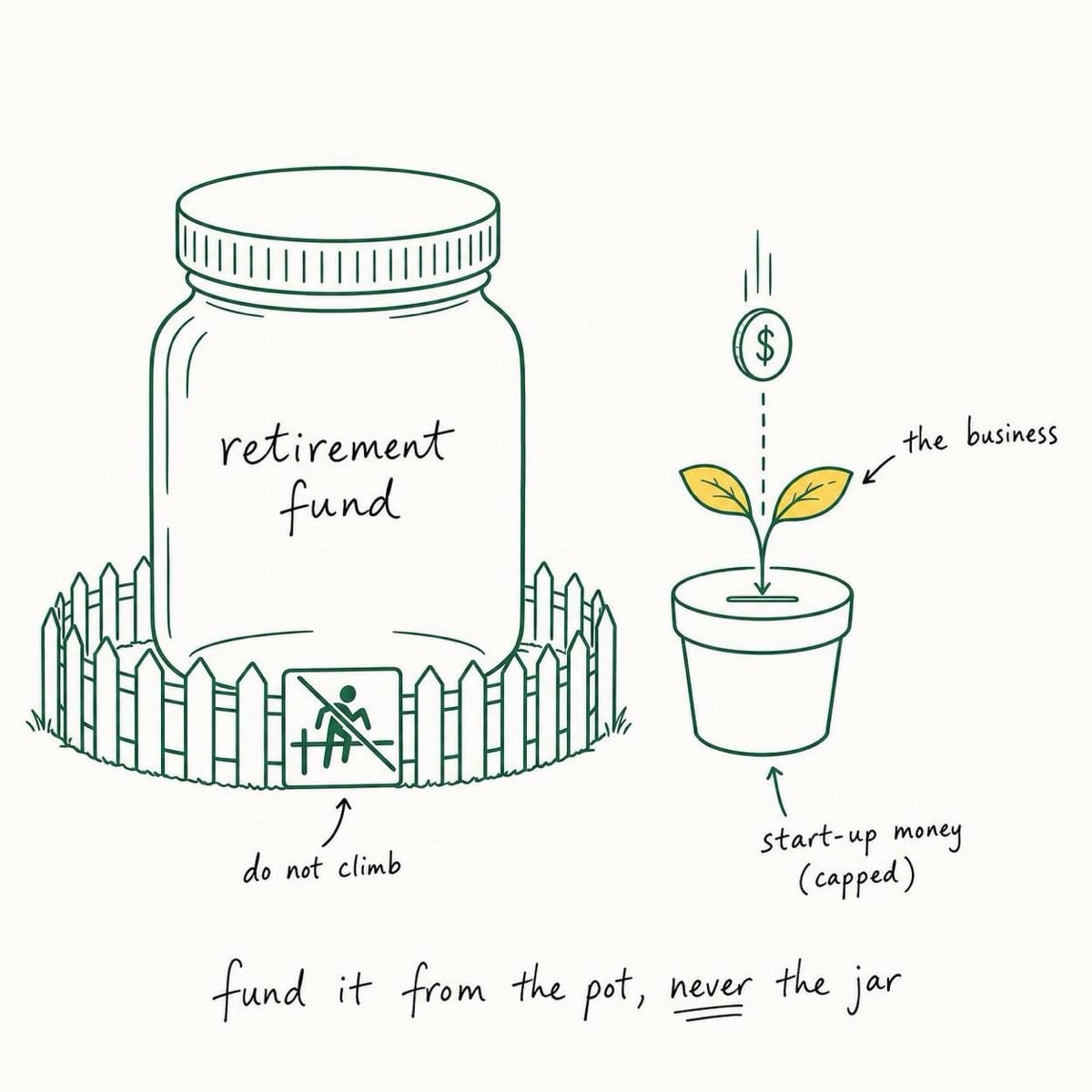
Four: start lean and start home-based. Real businesses cost far less to launch than the fear in your head assumes. The median cost of starting a US small business is around 25,000 dollars, and plenty of founders launch for a small fraction of that. [4] Most don't need a storefront or a lease either: 53 percent of small businesses are run from home. [5] The lean start isn't a compromise you settle for. It's the smart play. Keep the fixed costs near zero until customers are paying the bills, and a slow month is an inconvenience instead of an emergency.
Five: get the boring legal and tax skeleton right early. Set up a simple business structure (for most solo starts, an LLC), open a business bank account the day you make your first dollar, and talk to an accountant once before you're busy rather than in a panic at tax time. This is unglamorous and it takes an afternoon. It also keeps your personal assets, the house and the savings, legally separate from the business, which is a second fence around the money that matters. Older founders tend to skip this because it feels like overkill for something small. It isn't. It's cheap insurance.
Six: give it a runway measured in years, not months. New businesses fail on a normal, predictable curve. About half of new US employer businesses survive five years, and roughly a third make it to ten. [6] That isn't a reason not to start. It's a reason to plan for a slow build and to define, on day one, what "this is working" and "this isn't" actually look like so you're not guessing 18 months in. You have the patience for this that you didn't have at 30. Spend it.
What this looks like when a real person does it
Here's the shape of it in practice, because the six moves sound abstract until you watch someone walk through them.
Mark spent his whole career in commercial kitchens, the last decade as a head chef. At 61 he wanted his own thing, a small catering company. He didn't sign a lease or buy a van. He cooked two events out of a rented commissary kitchen for people he already knew, got paid for both, and only then registered the LLC and printed cards. His startup cost was under 3,000 dollars, most of it a deposit and insurance. His retirement account never came up, because he'd decided before he started that it never would. Two years in, the catering company covers its costs and pays him a modest wage for work he loves. The thirty years that read as "old" on a job application turned out to be the entire product.
Dave ran logistics for a mid-size distributor for 28 years. His encore wasn't a storefront at all. He advises four small e-commerce shops two days a week, invoicing for the judgment it took him three decades to build. He landed the first two clients over coffee before he'd spent a dollar, which is move two done exactly right. Contrast that with the version of this that goes wrong: the retiree who reads a "passive income" listicle, sinks 40,000 dollars of savings into a franchise or a rental he doesn't understand, and spends the fund before a single customer proves the idea. Same age, opposite outcome. The difference was never talent. It was the order of operations.
If money is the piece that worries you most, the same floor-first thinking that steadies a startup steadies the rest of your finances, which we lay out in getting your finances in order. And if you want the business to sit inside a fuller picture of the decade ahead rather than swallow it, life planning in your 50s maps how the pieces fit.
But I didn't picture 60 as the year I take a risk
Fair. And this isn't the all-or-nothing risk you're picturing. The version that scares you, remortgage the house, empty the 401(k), bet it all on one shot, is exactly the version these six moves are built to prevent. A lean, fenced, validate-first start risks a capped amount you decided you could lose, in exchange for years of work that means something. That's not a gamble. That's a considered investment with a hard stop-loss.
The "I'm too tired for a startup" worry deserves an honest answer too. A business at 60 doesn't have to mean 80-hour weeks. It means choosing the scale that fits your energy, which is a freedom a 30-year-old drowning in debt doesn't have. And there's a quieter reason to do it at all: purpose is close to medicine in this decade. In a study of nearly 7,000 US adults over 50, those with the weakest sense of purpose were more than twice as likely to die over the following years as those with the strongest. [7] Work that matters, on your own terms, is one of the cleaner ways to give the decade a reason to get up in the morning, the same way a solid daily routine after 60 does. If you're not yet sure what that work should be, how to find purpose in midlife is a good place to start. If the whole idea has you questioning who you're becoming next, that's worth sitting with, and reinventing yourself at 50 digs into it.
Start this week, before you spend a dollar
Don't register anything yet. Take one page and write three lines: what I know cold, what still gives me energy, and who would pay for it. Then set a second number at the bottom, the most you're willing to lose, and circle it. That circle is the fence. Everything you build sits inside it, and your retirement savings sits safely outside.
Do that this week, before the website, the cards, or the inventory. If you want a structured way to turn those answers into an actual plan for the decade ahead, get your free personalized plan here. The business you've been putting off isn't a young person's gamble you missed your shot at. It's a build you're finally equipped to do right.