

You are somewhere between 45 and 55. The kids are older or gone, the parents need more, the career is as senior as it is going to get, and the body sends a memo every time you skip sleep. And lately a quiet voice keeps asking the same thing: is this it. You are not falling apart. You are not buying the sports car. But the days blur, the routines you meant to keep have drifted, and the life that looks fine from the outside feels off-axis from the inside.
That is a midlife transition. Not a breakdown. A re-architecture window.
Most of what you have read about this stage frames it as a crisis to survive or a personality flaw to fix. We think that framing is wrong, and it is costing you the one thing this decade is actually good for. So before anything else, let us be precise about what a midlife transition is, and what it is not.
What Is a Midlife Transition (and How It Differs From a Crisis)
A midlife transition is a normal developmental stretch, usually starting around 40 to 45, where you reassess the life you built and ask whether it still fits. It is reflection and re-evaluation, not collapse. Here is the distinction that decides everything: a midlife crisis tries to escape your life in one dramatic swerve, while a midlife transition rebuilds it across the parts that already matter. Psychologist Daniel Levinson named this period the "mid-life transition" and described it as a predictable phase of adult development, not a malfunction. [1]
That is the heart of the midlife transition vs midlife crisis question, and it is the part almost no one gets right. The crisis story sells movies: affair, motorcycle, quit the job, blow up the marriage. One big swerve to feel alive again. The transition is quieter and far more common. You keep the people and the work that matter. You change how you carry them.
The data backs the quieter version. Only 10 to 20 percent of adults report the kind of disruptive crisis the cliche promises, and even those episodes tend to be triggered by a specific event (a job loss, a divorce, a health scare) rather than by age itself. [2] Margie Lachman, who has spent more than 30 years studying this stage, calls the midlife-crisis idea largely a myth: most middle-aged adults report satisfaction, health, and optimism, not despair. [3] If you want the full picture of what the dramatic version actually looks like, we have written about what a midlife crisis really is and how it shows up differently in men and in women.
Why This Stage Feels So Heavy Right Now
The midlife transition feels heavy because of structure, not weakness. Around 45 to 55 you hit a rare pileup: career at its peak, teenagers or college bills, aging parents starting to need you, and a body recovering slower than it used to. Researchers call this the structural squeeze of midlife, a unique constellation of competing role demands that arrive at the same time. The weight you feel is the math of too many roles, not a sign that something is wrong with you.
This is the part the crisis framing misses entirely. It tells you the heaviness is internal: you are restless, you are vain, you are afraid of aging. The MIDUS research program at the University of Wisconsin tells a different story. Midlife is defined by a stack of simultaneous obligations (peak career, active parenting, caregiving for aging parents) that no other life stage carries at once. [4] The same body of work found that women in their 40s report the highest negative work-family spillover precisely when they are raising school-aged kids and managing caregiving at the same time. [5]
So when your morning routine collapses or you snap at dinner, that is not a character defect. It is role strain. And there is a second engine running underneath it.
Time starts to feel different. In midlife your sense of the future shifts from open-ended to finite, and that shift quietly rewrites what you want. Laura Carstensen's Socioemotional Selectivity Theory shows that when people perceive time as limited, their priorities move away from chasing new knowledge and toward emotional meaning and the relationships that matter most. [6] Stanford's Lifespan lab found this is driven by time horizon, not birthday number. [7] That restlessness you feel is not a malfunction. It is your priorities trying to update. The transition is the update.
The Reframe: A Window to Re-Architect, Not Reinvent
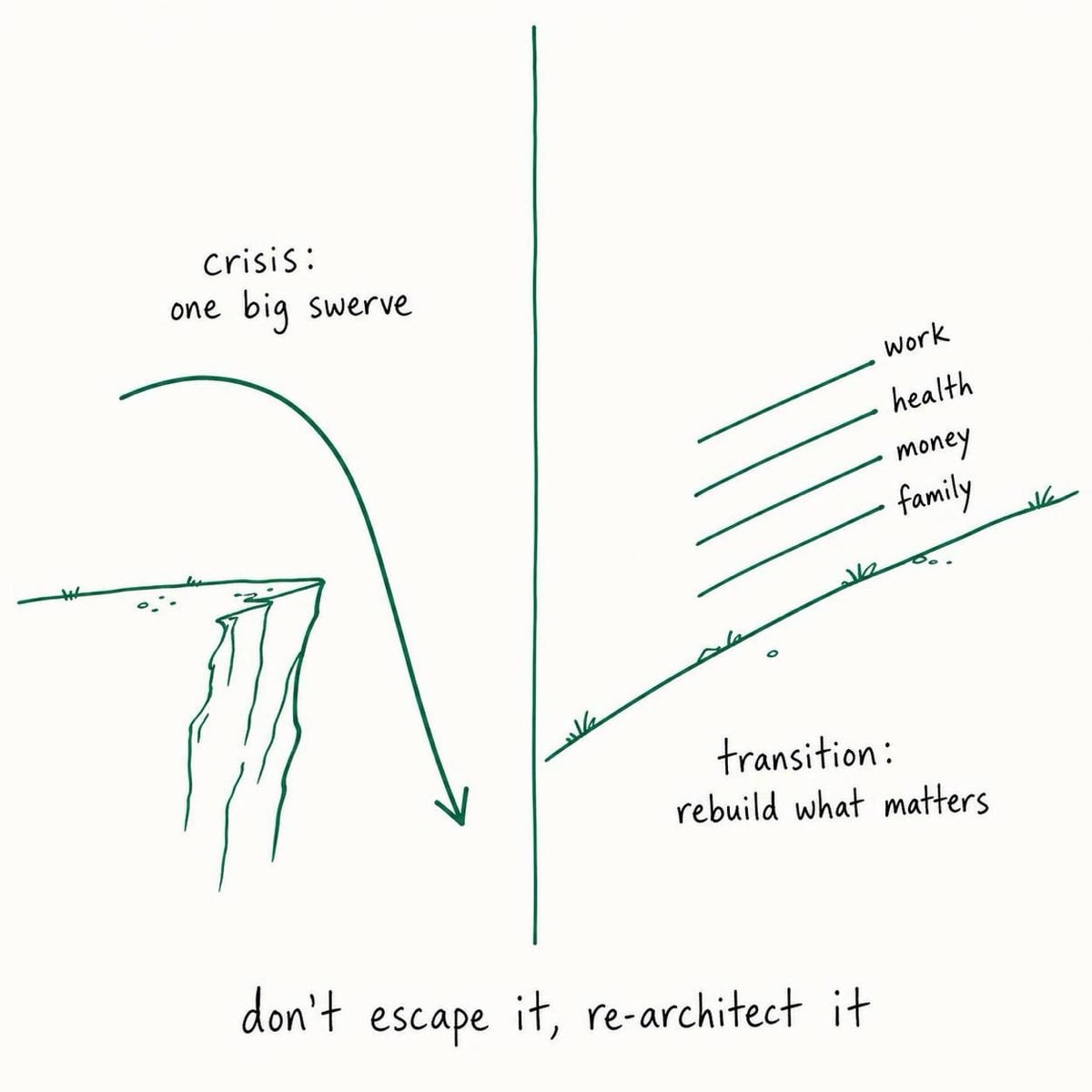
Here is the shift that changes how the next ten years go: a midlife transition is a re-architecture window, not a reinvention contest. You are not tearing the house down to build a stranger's. You are reworking the structure of a life you mostly want to keep, across the domains that already define it: work, health, money, family. Reinvention says burn it down and start over. Re-architecture says fix the load-bearing walls one at a time. One is a gamble. The other is engineering.
The developmental research describes this stage as exactly that kind of structural work. The normal tasks of the midlife transition are reassessing your commitments, reconciling the pulls between young and old in yourself, and modifying your life structure. [8] Read that again. Modify the structure. Not abandon it. The swerve is usually an attempt to feel something fast, and it leaves the actual structure of your life untouched.
The trap of the crisis frame is the all-at-once overhaul. You feel the restlessness, you decide everything must change, and you try to fix work and health and money and your marriage in one heroic January. It is the same mistake as the crisis swerve, just spread across more fronts. It collapses for the same reason: you cannot rebuild four systems at once on a decade's worth of competing demands.
Re-architecture works differently. You pick the one domain that is hurting most, rebuild a single keystone routine there until it holds, then let that win fund the next one. Calm discipline, not a dramatic clean slate. This is also why "starting over" is the wrong verb. You are not starting over at 50 from zero. You are starting from 25 years of experience and rebuilding selectively. The reframe matters because it changes the unit of work from "my whole life" to "this one system, this week."
How to Re-Architect One Domain at a Time
The way through a midlife transition is to rebuild one domain at a time, built for your worst day, not your best. Pick the single area causing the most drag (work, health, money, or family), choose one keystone routine inside it, shrink that routine to a version you can do on your hardest day, and anchor it to something you already do. Then protect the recovery: you are allowed to miss once, never twice. This is the whole method. Slow on purpose, because slow is what survives a real midlife schedule.
The good news is that your stage of life is built for exactly this. People between 45 and 75 actually form daily habits faster than younger adults and report higher automaticity once a routine clicks, which means your "I am too set in my ways" worry is backwards. [9] Midlife is a motivation advantage for rebuilding, not a disadvantage. Here is how to use it.
Build for the floor, not the ceiling. A crisis-era overhaul designs for your best week. Re-architecture designs for your worst. Define the minimum version of each routine, the one you will still do on a brutal Tuesday: not "an hour at the gym" but "put on the shoes and walk to the end of the street." The floor is what keeps the structure standing when life gets loud. Habit-formation studies in adults 45 to 75 found that interventions work best when they stress consistency and a stable context over intensity. [10] Our deeper guide to keystone habits covers how one well-chosen routine pulls the others up with it.
Anchor it to a cue, not a mood. The reason last year's routine drifted is that it relied on remembering and on feeling like it. Tie the new behavior to something already automatic: after I pour my morning coffee, I check the one money number that matters. After I park at the office, I write the three things I will not let slide today. The anchor does the remembering so you do not have to. This is the engine behind habit stacking and the practical fix for why staying consistent is so hard in a crowded decade.
Sequence the domains; do not storm them. Work, health, money, family. Pick one. Get a single routine holding there for a few weeks before you touch the next. Progress compounds, and the momentum from one held routine is what makes the next one stick. The crisis story wants you to overhaul all four in a weekend. The transition rebuilds them in a line. If your drag is professional, our pieces on a midlife career change and being stuck in your career work the same way: one move at a time, not a leap. If the body is the weak point, building muscle in your 40s and rebuilding better money habits follow the identical floor-and-anchor logic.
Protect the recovery loop. The thing that ends a rebuilt routine is never the missed day. It is the missed week that the missed day turns into. Build one rule into every domain: miss once if life demands it, never twice in a row. Missing Thursday is data. Missing Friday too is a decision. The measure of discipline in midlife is not your streak, it is how fast you come back, which is the entire idea behind a self-discipline recovery loop.
What This Looks Like Across a Real Year
Here is the re-architecture in practice, slow on purpose. Take Anika, 51, an operations director with a teenager, a father two years into early dementia, and a marriage running on logistics. The crisis script would have her quit, move, or detonate something. Instead she treats the transition as structural work: one domain, one routine, built for her worst day, anchored to a cue she already has. Nothing dramatic happens. Everything slowly holds.
She starts where the drag is heaviest: her own body and energy, because everything else runs on it. One keystone routine, a ten-minute walk. The cue is her first coffee, not a clock time that a bad night would wreck. The floor, on a day when her father has a fall and work is on fire, is to step outside for two minutes. That is it. She does not touch money, work, or the marriage yet. This restraint is the whole skill. Most people in transition try to fix the entire life plan in one go and stall out by February.
Week one she walks four days. Thursday her father is in the ER and the walk does not happen. Old Anika would have written off the month. The rule says walk Friday, no exceptions, because the cost of missing twice is a dead routine. She walks Friday. By around week nine the walk is automatic, the thing she does without arguing with herself, which is roughly what the habit research predicts for her age group.
Only then does she add the next system: a five-minute Sunday money review, anchored to the coffee she already makes. Then a weekly no-logistics dinner with her husband. Each new domain is funded by the one before it holding. A year in, Anika has not become a new person who finally found willpower. She is the same person running a life that no longer depends on it. That is what moving through a midlife transition actually looks like: not a swerve, a re-architecture. The same logic scales whether you are 51 or planning the decade after 60.
But What If It Really Is a Crisis This Time
The honest answer: sometimes the heaviness is more than a normal transition, and it is worth being clear-eyed about the difference. A midlife transition is reflection that still lets you function. If what you are feeling is persistent, drains your sleep and appetite, kills your interest in everything, or comes with thoughts of self-harm, that is not a re-architecture project, that is a clinical signal, and the right move is a professional, not a productivity system. The myth is not that midlife distress is fake. The myth is that it is universal and untreatable.
For most people, though, the restlessness is the update we described, not depression. The way you tell the difference is partly in what helps. A genuine transition responds to structure: pick a domain, hold one routine, and within a few weeks the fog lifts a little and you feel some agency return. The reframe is not "think positive." It is to stop trying to escape the life and start re-architecting it, on purpose, slowly, one wall at a time. If a small held routine starts to give you traction, you are in a transition. If nothing moves the needle for weeks, get help. Both are valid. Only one is a willpower question.
Where to Put Your First Brick
Do not overhaul your life this month. Pick the single domain that is dragging hardest right now: work, health, money, or family. Choose one keystone routine inside it. Shrink it to a two-minute floor, the version you would still do on your worst day. Anchor it to something you already do every morning. Then write the one rule that protects it: miss once if you must, never twice in a row.
That is the entire start of a midlife transition done as re-architecture instead of crisis. Not a clean slate, not a new identity, not a dramatic swerve. One small routine, engineered to survive your hardest day, in one domain, this week. Once that first brick holds, the same logic scales into a full midlife reset across every domain, one at a time. You have the experience. You know what needs to change. The work now is rebuilding it in the right order, at a pace you can actually keep. You are not in decline. You are at the rebuild.