
Work expands to fill the period of time available for its completion. If you're into productivity, you'll know this proverb as Parkinson's Law.
This interesting statement was made by Cyril Northcote Parkinson[1], the famous British historian and author, in 1955—first appearing as the opening line in an article for The Economist and later becoming the focus of one of Parkinson's books, Parkinson's Law: The Pursuit of Progress.
Parkinson was qualified to make such a statement, having worked in the British Civil Service and seeing first hand how bureaucracy ticks. Bureaucracy itself is a by-product of our culture, thanks to the limiting belief that working harder is somehow better than working smarter and faster.
Parkinson's Law—the amount of work expands to fill the time available for its completion—means that if you give yourself a week to complete a two-hour task, then (psychologically speaking) the task will increase in complexity and become more daunting so as to fill that week[2]. It may not even fill the extra time with more work, but just stress and tension about having to get it done.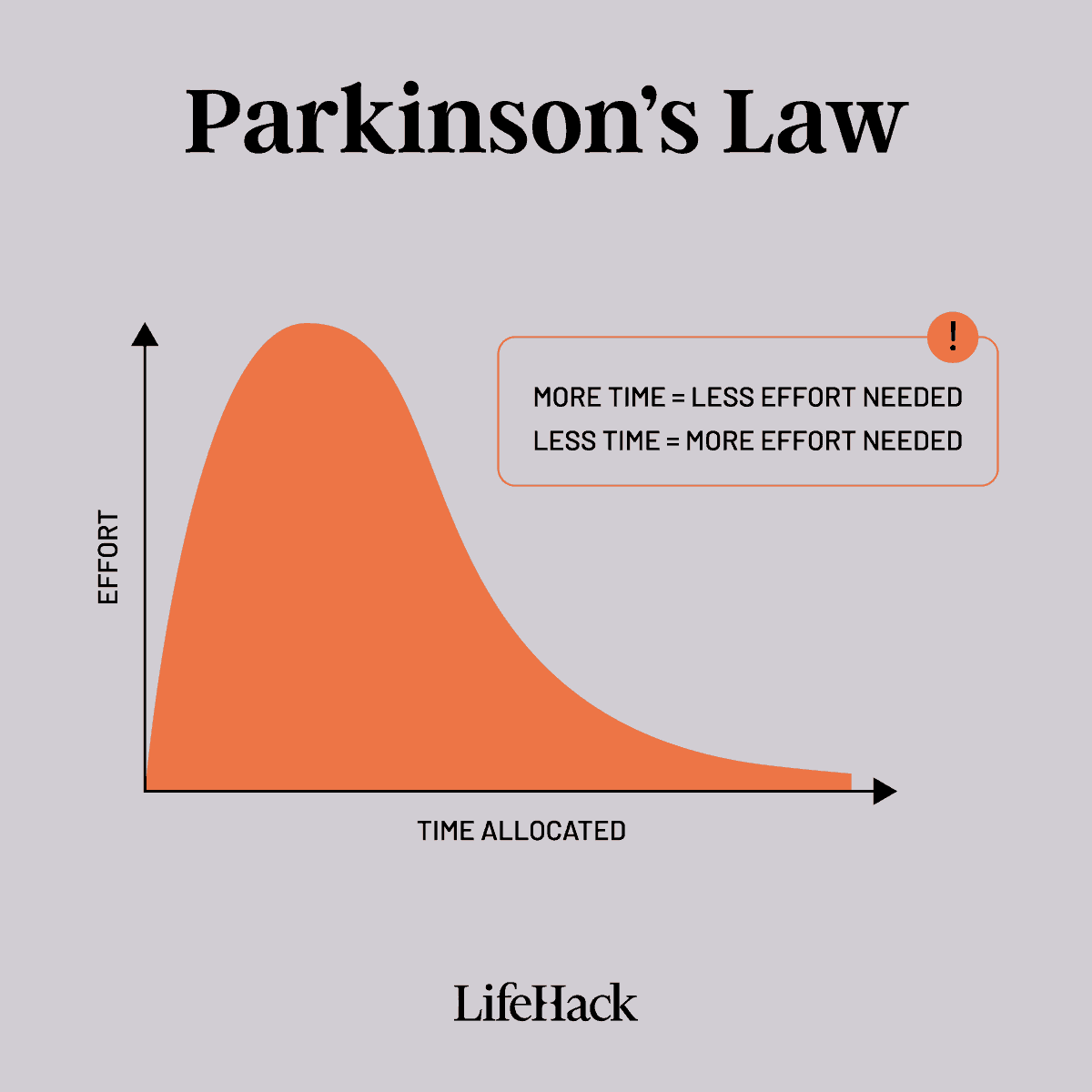 By assigning the right amount of time to a task, we gain back more time, and the task will reduce in complexity to its natural state[3].
I once read a response to Parkinson's Law insinuating that if it were an accurate observation, one would be able to assign a time limit of one minute to a task, and the task would become simple enough to complete within that minute.
However, Parkinson's Law is simply an observation, not some voodoo magic. It works because people give tasks longer than they really need, sometimes because they want some "leg room" or buffer, but usually because they have an inflated idea of how long the task takes to complete. People don't become fully aware of how quickly some tasks can be completed until they test this principle.
Most employees who defy the unwritten rule of "work harder, not smarter" know that, despite the greater return on investment for the company, it's not always appreciated. That's related to the idea that the longer something takes to complete, the better quality it must inherently be.
Thankfully, the increasing trend of telecommuted employment is changing this for those lucky early adopters, but only because employers have no idea what you're doing with all that spare time!
Let's look at a few ways you can apply Parkinson's Law to your life, get your to-do list checked off quicker, and spend less of the work day filling in time just to look busy. This is relevant whether you work in an office or at home, since "work harder, not smarter" is a cultural idea that many individuals fall prey to even when nobody's supervising their work.
Part of reversing what we've been indoctrinated with (work harder, not smarter) is to see the deadlines you set for yourself as unbreakable—just like the deadlines your boss or clients set.
Use that human, instinctual longing for competition that fuels such industries as sports and gaming to make this work for you. You have to win against the clock; strive to beat it as if it were your opponent, without taking shortcuts and producing low-quality output. This is particularly helpful if you're having trouble taking your own deadlines seriously.
Those that are spot on may be the ones that you are unable to beat the clock with when you halve the time allotment, so experiment with longer times. Don't jump straight back to the original time allotment because there may be an optimum period in between.
If you work at a computer, a digital timer is going to be very useful when you start doing this. It'll also save you a bit of time, because a timer allows you to see at a glance how much longer you have. Using your clock involves some addition and subtraction!
Instead of doing the leisurely 20-30 minute morning email check, give yourself five minutes. If you're up for a challenge, go one better and give yourself two minutes.
Don't give these tasks any more attention until you've completed everything on your to-do list that day, at which point you can indulge in some email reading, social networking and feed reading to your heart's content.
Experiment with how far you can take this. Make your criteria for what makes an email important very strict and the penalties harsh! That means using the Delete button, by the way—I'm not advocating violence against your colleagues.
By using Parkinson's Law correctly, you can get more done in less time and learn how much time each of your tasks really requires.
This interesting statement was made by Cyril Northcote Parkinson[1], the famous British historian and author, in 1955—first appearing as the opening line in an article for The Economist and later becoming the focus of one of Parkinson's books, Parkinson's Law: The Pursuit of Progress.
Parkinson was qualified to make such a statement, having worked in the British Civil Service and seeing first hand how bureaucracy ticks. Bureaucracy itself is a by-product of our culture, thanks to the limiting belief that working harder is somehow better than working smarter and faster.
Parkinson's Law—the amount of work expands to fill the time available for its completion—means that if you give yourself a week to complete a two-hour task, then (psychologically speaking) the task will increase in complexity and become more daunting so as to fill that week[2]. It may not even fill the extra time with more work, but just stress and tension about having to get it done.
By assigning the right amount of time to a task, we gain back more time, and the task will reduce in complexity to its natural state[3].I once read a response to Parkinson's Law insinuating that if it were an accurate observation, one would be able to assign a time limit of one minute to a task, and the task would become simple enough to complete within that minute.
However, Parkinson's Law is simply an observation, not some voodoo magic. It works because people give tasks longer than they really need, sometimes because they want some "leg room" or buffer, but usually because they have an inflated idea of how long the task takes to complete. People don't become fully aware of how quickly some tasks can be completed until they test this principle.
Most employees who defy the unwritten rule of "work harder, not smarter" know that, despite the greater return on investment for the company, it's not always appreciated. That's related to the idea that the longer something takes to complete, the better quality it must inherently be.
Thankfully, the increasing trend of telecommuted employment is changing this for those lucky early adopters, but only because employers have no idea what you're doing with all that spare time!
Let's look at a few ways you can apply Parkinson's Law to your life, get your to-do list checked off quicker, and spend less of the work day filling in time just to look busy. This is relevant whether you work in an office or at home, since "work harder, not smarter" is a cultural idea that many individuals fall prey to even when nobody's supervising their work.
Running Against the Clock
As you get started with Parkinson's Law, make a list of your tasks, and divide them up by the amount of time it takes to complete them. Then give yourself half that time to complete each task. You have to see making the time limit as crucial. Treat it like any other deadline.Part of reversing what we've been indoctrinated with (work harder, not smarter) is to see the deadlines you set for yourself as unbreakable—just like the deadlines your boss or clients set.
Use that human, instinctual longing for competition that fuels such industries as sports and gaming to make this work for you. You have to win against the clock; strive to beat it as if it were your opponent, without taking shortcuts and producing low-quality output. This is particularly helpful if you're having trouble taking your own deadlines seriously.
Get Better at Judging Time
At first, this will be partially an exercise in determining how accurate your time projections for tasks are. Some may be spot on to begin with, and some may be inflated if you're not used to using Parkinson's Law.Those that are spot on may be the ones that you are unable to beat the clock with when you halve the time allotment, so experiment with longer times. Don't jump straight back to the original time allotment because there may be an optimum period in between.
If you work at a computer, a digital timer is going to be very useful when you start doing this. It'll also save you a bit of time, because a timer allows you to see at a glance how much longer you have. Using your clock involves some addition and subtraction!
Crush the Cockroaches of the Productivity World
When implementing Parkinson's Law, look for those little time-fillers, like email and feed reading, that you might usually think take ten or twenty (or even, god forbid, thirty!) minutes. These are the "cockroaches" of the productivity world—little pests that do nothing but make your life a pain in the backside, pains that you can't seem to get rid of no matter how much you run around the house with a shoe or bug spray.Instead of doing the leisurely 20-30 minute morning email check, give yourself five minutes. If you're up for a challenge, go one better and give yourself two minutes.
Don't give these tasks any more attention until you've completed everything on your to-do list that day, at which point you can indulge in some email reading, social networking and feed reading to your heart's content.
Learn to Prioritize
These are tasks where 10% of what you do is important and 90% is absolutely useless when it comes to Parkinson's Law. This forces you to tend to the important tasks—feeds you need to read in order to improve in your work (for instance, if you're a web designer who needs to read up on new practices), and emails that are actually high-priority.Experiment with how far you can take this. Make your criteria for what makes an email important very strict and the penalties harsh! That means using the Delete button, by the way—I'm not advocating violence against your colleagues.
The Bottom Line
You can experiment with Parkinson's Law and squashing your deadlines down to the bare minimum in many areas of your life. Just be conscious of the line between "bare minimum" and "not enough time"—what you're aiming for is a job well done in less time, not a disaster that's going to lose you employment or clients.By using Parkinson's Law correctly, you can get more done in less time and learn how much time each of your tasks really requires.