

The form has been open since 8:40. It is 9:25 now. You have read the field marked "pay period start" four times.
You know what the task is. You know how to do it. You did it eleven times last year. And here you are, reading five words like they are in a language you studied once and forgot.
People reach for a name for that gap: executive dysfunction. It describes the distance between knowing the task and getting your hands to perform it. It is a description of trouble, not a diagnosis, and that distinction changes what you should do next.
Most advice on how to combat executive dysfunction is one tactic said louder. Break the task into smaller pieces. Sometimes that lands. Often you break it down, end up with nine small pieces, and find you cannot start any of the nine either.
One specific job failed this morning. You have been pouring effort into a different one.
The short answer: find the moment you stalled, then move that one job out of your head
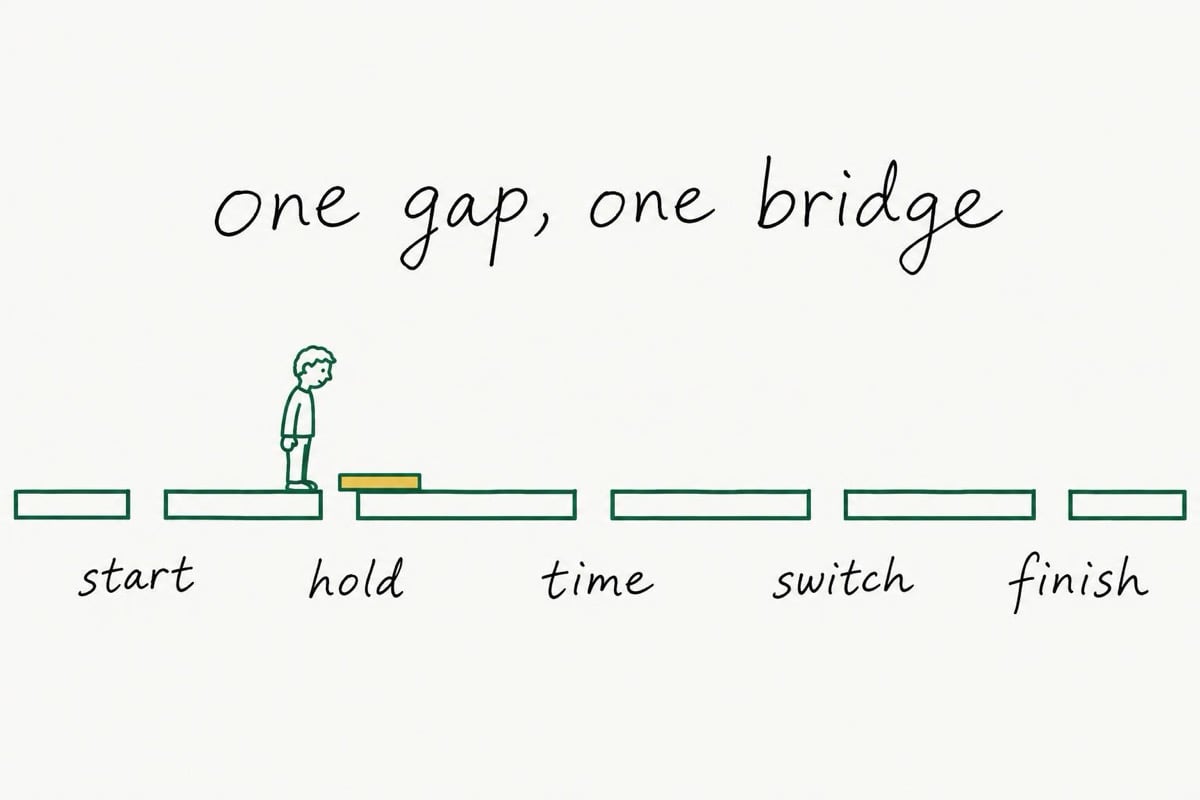
Executive function is not a single switch that is either on or off. So the useful question is not how to want it more. It is where the morning actually broke:
- you cannot get the first motion going (start)
- you get going and lose the thread (hold)
- you work to a timeline that was never real (time)
- something interrupts and you never come back (switch)
- you do most of it and never close it out (finish)
Pick the one that matches your morning. Then take that single job off your brain and hand it to something outside your head: a cue sitting in the room, a written line, a visible clock, a named parking spot for whatever you dropped. One stalled job, one external stand-in. That is the method for how to combat executive dysfunction on a normal Tuesday, and the rest of this article is how to run it.
"Just start" fails because willingness was never the broken part
Someone has probably told you that you are not trying. You may have said it about yourself by 10am.
It is worth knowing how ordinary this trouble is. A clinical review of executive dysfunction describes dysexecutive symptoms showing up in most neurodegenerative diseases and in many other neurologic, psychiatric and systemic illnesses. [1] The pattern turns up across many different clinical pictures, which is precisely why a stalled morning tells you nothing about which picture, if any, is yours. Stop grading your character. Do not hand yourself a label either.
A bad run of sleep, a grinding month, grief, a new medication: any of those can leave you staring at a form. The stall is a function dropping out, not a verdict on how much you care.
Two readers with the same complaint often need different articles. If one specific task has swollen until you freeze in front of it, read what to do when you get so overwhelmed that you do nothing. If you start fine but cannot stay in anything for twenty minutes, run the four checks in how to focus and concentrate better first, because sleep and live notifications beat any method on this page.
Executive function is several separate jobs
A widely used framework splits executive function into three core pieces: inhibition, working memory and cognitive flexibility, with reasoning, problem-solving and planning built on top of those. [2] It is one prominent framework rather than the only taxonomy, and it settles the question this article turns on.
If executive function is several jobs, then "try harder" is a strategy with no target. Effort lands mostly on the jobs that were working fine, the dropped one stays dropped, and you end the morning with four words typed. So stop treating the stall as one condition with one cure. Treat it as a question with five plausible answers.
The five moments where it stalls
The five labels below are ours, not a diagnostic tool. There is nothing to score and nothing to add up. The point is to name one moment, so you know what to replace.
Start. The task is clear and the first motion will not fire. You know the document needs opening. Your hand goes to the phone instead. You are not deciding against the task, you are failing to launch into it.
Hold. You launch fine, then lose the thread. You went to the kitchen for the charger and came back with a glass of water. You opened the spreadsheet to check one number and spent nine minutes reformatting a column.
Time. You plan as if the task takes twenty minutes and it takes ninety, every time, and you keep being surprised. Or the opposite: a ten-minute errand sits undone for five weeks because it feels enormous from the outside.
Switch. Something interrupts, you deal with it, and the original task never comes back. Not refused. Just gone, with no trace that it existed.
Finish. You do eighty percent, then the thing sits there. The report is written and unsent. The form is filled and unsubmitted. There is no finish line, so there is no finishing.
Read those and one will probably sting more than the others. Use that one. Resist the urge to work on all five, which is the same mistake as trying harder, just better organised.
Move the stalled job outside your head
The principle is the same for all five. The job your brain dropped is a job something in the room can hold instead.
There is real support for the general move, strongest in the memory case. A systematic review and meta-analysis of prospective memory interventions, covering 73 intervention studies and 3,749 participants across healthy middle-aged and older adults and clinical groups, found external memory aids associated with a large improvement in remembering to carry out intended actions, at Hedges g of 0.805. [3] That is evidence about remembering, not about all five moments below, and the aid studies were mostly small. Treat it as a direction rather than a dose.
Stalling at start: make the first motion physical, not a decision
Write down the first bodily movement, not the task. Not "do payroll" and not "do payroll for ten minutes", both of which still need you to decide something. "Open the payroll tab and type the start date" is a motion. The test is whether a stranger could watch you do it.
Then put the cue where your body already goes: the folder on the chair you have to move before you sit, the tab left open overnight. Reminders that live in your head are the ones you are already failing to use.
Stalling at hold: one surface holds the thread
Keep one piece of paper or one open note per work block, and write the current line on it before you start: "reconciling October invoices". When you surface in the kitchen with a glass of water, the paper tells you where you were, which is faster than reconstructing it.
Every interruption you generate yourself goes on that surface as a line, not an action: check the number, order the filters, reply to the message. The paper carries them so your working memory does not have to.
Stalling at time: make time visible instead of estimated
Stop estimating and start recording. For one week, write the real finish time next to each task you thought would take twenty minutes. You will probably find your own rough multiplier, and your number beats any published average.
Then make the clock something you can see rather than something you consult. A kitchen timer on the desk, a clock app left running on a second screen. If you have to check the time, you have already lost the thing that checking was meant to protect.
Stalling at switch: give the dropped thing a parking spot
Before you handle the interruption, say out loud or write the one line you were in the middle of. Then the dropped task has an address. Without that, the only record of it was a thought you had while being interrupted, which is the worst possible storage.
If a run of interruptions is the shape of your whole week, the problem may be the queue rather than the switch, and priority levels for tasks is the better place to spend an hour.
Stalling at finish: write what done means before you begin
One sentence, before the work starts, in the plainest language you have: "done is the form submitted and the confirmation screenshot in the folder". Not "done is payroll handled". Our view is that vague finishes are what leave so many tasks sitting at nearly done.
Where you can, make the last motion the smallest one. Attach the file before you write the email. Fill the envelope before the cheque. Pay the thing from the seat you are already in.
A Tuesday with this running
Two made-up examples.
Trevor manages a small warehouse team and has lost three weeks to a supplier dispute that needs one written summary. He has broken it into steps twice. He stalls at start: his hand goes to the phone each time the document opens. So he writes one line on an index card, "open the dispute doc and type the date we first flagged the shortage", and leaves the card on his keyboard overnight, where he has to move it before he can sit. Wednesday he types the date, then keeps going for nineteen minutes, which was never the hard part.
Maureen keeps the books for two clinics and starts everything. She stalls at finish, with six reports sitting at ninety percent in her drafts folder. Her stand-in is one written line per report, set before she opens it: done is sent to the clinic manager with the invoice attached. The reports stop accumulating, because now there is a line to cross.
Notice what neither of them did. Neither added a system, an app, or a morning routine. Each changed one thing at the one moment they stall, and left the other four alone.
"I have set reminders before and ignored every one"
Fair. Most reminders deserve to be ignored, because most reminders name a task rather than a motion. A phone alert reading "payroll" arrives, you already knew about payroll, and dismissing it costs nothing. An alert reading "open payroll tab, type start date" is harder to dismiss honestly, because the thing it asks for takes four seconds.
Two things people ask about here, where we would rather give you our position than a number we cannot stand behind. Body doubling, the practice of working alongside another person to get started: plenty of people say it helps them, we found no controlled test of it, and if it works for you then keep doing it. Brain-training apps: our position is that an app asks you to practise the job that keeps dropping out, while a stand-in removes the need for that job. We would spend the money on a kitchen timer.
And if the pattern you recognise is really avoidance of a particular task rather than a stalled function, the mechanism is different and so is the fix. Avoidance coping and why you procrastinate when you know better cover that ground.
Task paralysis and executive dysfunction describe different things
They get used as synonyms and they are not. Task paralysis describes one state: you are frozen in front of a specific task, often one that feels large or carries a risk of getting it wrong. It is a moment, and it usually involves an undecided question underneath.
Executive dysfunction is the wider description: the jobs that carry you from intention to action are not delivering reliably, across tasks and often across the day. Task paralysis is one of the ways it shows up, which is why the two overlap in search results.
The response differs. Frozen in front of one task, you shrink the task or name the decision you have not made. Stalling at the same moment across many tasks, you install the stand-in for that moment. For the broader skills view rather than the Tuesday-morning one, see executive functioning skills, and how to focus with ADHD for attention specifically.
When this belongs with a clinician
Everything above is ordinary self-management, and none of it is assessment. If attention or executive-function trouble is persistent and is affecting your work, your home, or your relationships, take it to a doctor rather than to another productivity method. NHS guidance describes referral for assessment when symptoms are causing significant problems, with the assessment done by a specialist rather than self-administered. [4] That page is about suspected ADHD specifically, and executive-function trouble on its own does not mean you have ADHD.
A rough fortnight is a rough fortnight. A pattern holding for months, or one that arrived suddenly with no obvious cause, is a medical conversation, and the five moments above are a useful thing to describe in it rather than a substitute for it.
Your next ten minutes
Take the task you have been failing to do all week. Decide which of the five moments it dies at, and write that word down. Then write the one line that moves that job out of your head, and put it somewhere your body will encounter it before tomorrow morning: the index card on the keyboard, the sentence defining done, the timer on the desk.
One moment, one stand-in, one week. If it holds, take the second moment. If it does not, you have at least learned which moment it really was, and that is further than any general plan for how to combat executive dysfunction will take you.


