

A business strategy rarely announces its failure. It keeps not working while you keep paying for it. Nine months in, revenue is flat, you are busier than you were, and you cannot tell whether the plan needs more time or needs to stop. That is what makes failed business strategies so expensive. The cost is not the idea. It is the quarters you spend unable to call it either way.
You picked a direction and committed. Wholesale instead of retail. Retainers instead of one-off projects. A second van, a second location, a first employee. You did the work. The spreadsheet still looks like last year's.
So you do the reasonable thing and give it another quarter. Then another. Each month you stay in, the decision gets harder, because there is more sunk into it than there was in March.
Nobody told you the one thing that would have made this simple. Before you started, you needed a number that would prove the plan wrong.
Why "Give It Another Quarter" Keeps Winning
Giving a strategy more time wins by default because nothing is competing with it. Without a number set in advance, "not working yet" and "not working" look identical from the inside, so patience becomes the only choice that needs no defending. Then the money already spent joins the argument. People stay with a losing course of action in part because of what they have already paid into it, not because of what it will return.
You have probably already tried the standard repairs. A new channel. A price cut. More posts. A rebrand. Another piece of software that promised to fix the funnel. None of those were your problem. Your problem was that none of them changed what you were measuring, so none of them could settle the question.
Look at how failed business strategies get described after the fact and you will notice the same words: we were early, the market was not ready, it never quite took off. Each of those is a story told at the end. None of them is a test you could have run in April.
The pull of money already spent is not a character flaw, it is a studied pattern. In one of the early field experiments on it, people who paid full price for a university theater season ticket went to more of the plays in the first half of the season than people who were sold the same ticket at a discount. The price was already paid either way. It still changed who showed up [1]. A plan with nine months and $40,000 behind it gets the same unearned benefit of the doubt, which is why the sunk cost fallacy shows up so often in the small business decisions owners make too late.
What Failed Business Strategies Have in Common: No Losing Condition
A failed strategy is usually not a bad idea. It is a bet nobody wrote down in a form that could lose. If you never said which result, by which date, would prove the plan wrong, you have no way to separate a slow start from a dead end. The plan then ends one of two ways: you run out of patience, or you run out of cash.
This is worth sitting with, because it moves the blame off your judgment and onto your bookkeeping. Companies with research budgets larger than your annual revenue are wrong most of the time too. Across the big online experimentation programs, only about a third of tested ideas improved the metric they were built to improve, and in heavily worked areas like search relevance the share of winners drops closer to one in ten [2]. Those teams are not smarter than you about which ideas will work. They are faster at finding out which ones did not.
That is the whole gap. They run a two-week test with a number attached. You run a nine-month commitment with a feeling attached.
It also explains why the famous examples of companies that failed due to poor strategy read so strangely in hindsight. The decision usually looks obvious once the result is in. It was not obvious at the time, because nobody had agreed in advance which result would settle it, and in that fog the expensive option, continuing, is also the comfortable one.
A strategy that cannot fail on paper will fail in your bank account instead. So the first fix is not a better idea. It is giving the idea you already have a condition under which you agree to stop.
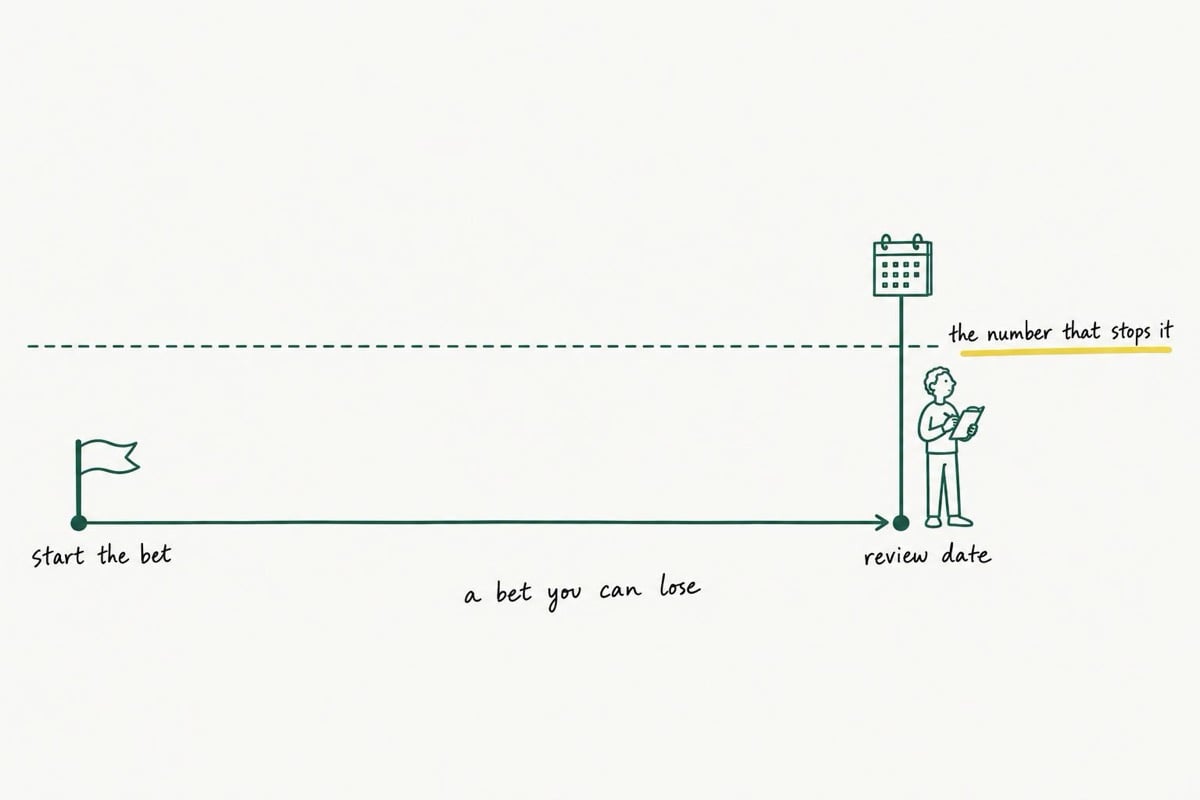
Turn the Strategy Into a Bet You Can Lose
Four moves turn a vague direction into a bet with an exit. Write the bet as one sentence. Set the number that would prove it wrong. Put the review date on the calendar. Decide now what stop, shrink, and commit each mean in dollars and hours. It takes about twenty minutes per strategy, and the payoff lands on the day you would otherwise have given it another quarter out of habit.
1. Write the bet as one sentence
The sentence has a shape: we are doing X so that Y happens by Z. "We are moving to monthly contracts so that eight clients are on retainer by June 30." "We are supplying cafes so that twelve standing weekly accounts exist by week sixteen."
If you cannot finish the sentence, that is the finding. A strategy you cannot state in one line is not a strategy yet, it is a preference about how you would like the business to feel.
2. Set the number that would prove it wrong
Pick the number at which you agree to stop, and pick it before you have any data to argue with. Make it a count, not a percentage: signed accounts, paying customers, repeat orders, booked installs. Then write the sentence that nobody wants to write. "If we have fewer than six retainer clients by March 31, the retainer model is wrong for this business."
One warning on choosing it: pick a number that money would notice. Followers, impressions, and conversations are not disproof conditions, because they can all go up while nothing is bought.
A simple way to find the right number is to imagine the failure first. Say the review date has arrived and the plan clearly did not work, then list the reasons why. People who start from a result that has supposedly already happened come up with more reasons than people asked to predict what might go wrong, by around 30 percent in the research this draws on [3]. Your number usually sits in that list of reasons.
3. Put the review on the calendar, not in your head
A review date you remember is not a review date. Put it in the calendar the same hour you start the bet, give it twenty minutes, and name who runs it. If that is you and only you, say so on the invitation, because a solo operator skips the meeting that has no attendees.
Keep the agenda to three lines: the number we said, the number we got, the exit we chose. This is the one process step worth borrowing from the way bigger companies make a decision-making process repeatable instead of heroic.
4. Decide the exits before you need them
Three exits, defined in advance.
Stop. The model is wrong. You cancel the plan, keep what you learned, and recover the hours. Write down what stopping costs so the number is not a surprise later.
Shrink. The model works for a narrower slice than you bet on. Keep the slice that paid, drop the rest, and rewrite the sentence around the smaller version.
Commit. The number came in. Now you fund it properly, which usually means time rather than money, and it earns a claim on your calendar ahead of whatever you were doing before. Choosing what loses that claim is the part owners skip, and it is why priority levels for tasks matter more once a bet is winning than while it is unproven.
That four-move sequence is ours, not an established management model. It is ordinary bet-keeping, written down so a busy owner can actually run it between jobs. If your calendar is the binding constraint, the mechanics in time management for entrepreneurs pair with it.
What This Looks Like in Two Small Businesses
On the ground this is less dramatic than it sounds. You get a sentence, a number, a date, and then one of three fairly boring decisions. The two businesses below are composites we wrote to show the mechanics, not clients, and the numbers are illustrative rather than measured. What matters is the shape: in both cases the review produced a decision in under half an hour, which is the thing nine months of worrying never does.
A wholesale bakery, owner plus three staff, bets on supplying cafes instead of running a retail counter. The sentence: we are selling wholesale so that twelve standing weekly accounts exist by week sixteen. Week sixteen arrives with five accounts, which is a clear miss. But four of the five reorder every week at better margin than the counter ever produced, and all four are within six miles. That is a shrink, not a stop. The new sentence names a six-mile radius and eight accounts by week thirty, and the delivery van stops driving across the county.
A two-person IT support shop bets on monthly contracts instead of hourly callouts. The sentence: eight contracts at $900 a month by June 30. June 30 arrives with three. The three cover the shop's fixed costs, renew without a conversation, and came from the same source, an accountant who refers clients. So the model is not the failure, the sales motion is. One more cycle, one changed input (two more referral partners instead of more cold outreach), one new date. If it misses again, they stop, and they have already written down what stopping means.
The pattern is not restricted to businesses your size. Quibi launched its short-form mobile video service on April 6, 2020 and announced it was shutting down on October 21 of the same year, having raised about $1.75 billion [4]. Plenty of explanations have been offered since. The structural point is simpler: the question that decided the company, whether enough people would pay for short mobile-only episodes, was testable long before that much money went in.
"My Business Is Too Small to Measure Anything"
At your volume the numbers are noisy, and that is a real objection rather than an excuse. The answer is not statistics, it is coarser units. Count things that touch money and use windows of at least a quarter. Then read the result simply: land one short of your number and extend the date, because that is a timing miss. Land at half your number or less and treat it as a real answer about the direction.
This is also where the smallest businesses have an advantage that large ones pay consultants to simulate. You can see every account by name. You do not need a dashboard to know whether the eight contracts exist, and failed business strategies are much harder to hide from an owner who can count the customers on two hands.
Two honest limits. Seasonality will lie to you if your review date lands in your slow month, so set the date against a comparable period rather than a round calendar quarter. And some bets cannot be unwound on a ninety-day cycle: a lease, a hire, a financed vehicle. For those, the number still gets written, but the exits change. Stop usually becomes shrink, and the useful question is which commitment you would not renew. The early signs that a business is failing tend to show up in those renewals first, well before the reasons most small businesses fail read like a verdict, and long before a cash crunch turns into a business crisis.
Start With the Bet That Has Been Running Longest
Open a notebook and write down the strategy you have been running longest without a number attached. Give it the sentence: we are doing X so that Y happens by Z. Pick the count, something you can see in the bank or in the client list. Pick the date, against a comparable period rather than a round quarter. Put the review in the calendar before you close the notebook. That is the whole task, and it takes one page.
If you cannot name a number that would make you stop, you do not have a strategy. You have a habit with a budget, which is how most failed business strategies begin. Naming the number does not make the bet safe. It makes the bet decidable, which is the only part that was ever in your control.
If the direction turns out to be right and the work inside it is just slow, that is a different problem with a different fix: see how to streamline business processes for the flow side, and when to hire in your small business if the answer is capacity rather than direction.


