
You sat down at 9:05 with one job. It is 11:40 now. The document has four sentences and you wrote two yesterday.
Nothing dramatic happened. A message came in. You opened a tab to check one thing. You remembered the dentist. Each cost a few seconds, which is exactly why it is hard to take seriously, and somehow the morning is gone.
The standard answer is a list. Sleep more, meditate, try Pomodoro, block the distracting sites, download a brain-training app. Fourteen tips, all defensible, none of them ranked. So you take the top three, run them for four days, and end up back at 11:40 with four sentences.
Here is what we would say over coffee: you probably do not have fourteen problems. You have one binding constraint, and the rest of that list is currently fine. Learning how to focus and concentrate better is mostly a matter of working out which constraint is yours this month, then leaving the others alone.
Why can't I focus and concentrate?
Four conditions are worth checking before anything else: sleep across a run of nights, live input within arm's reach, a task that was never defined clearly enough to start, and recovery that never got scheduled. Each has published evidence behind it, cited below. Grouping them into four checks is our own way of organising that evidence, not a finding, and it exists so you change one thing at a time.
It also helps to know what normal looks like. In an experience-sampling study of 2,250 adults that collected roughly 250,000 reports, people said their minds were wandering in 46.9% of the moments sampled, and were less happy during those moments. [1] That is self-report sampling, and the happiness link is a correlation. Still, it settles one question: a mind that drifts is not a broken mind. The target is not zero drift.
The 23-minute recovery number does not hold up
You have probably read that it takes 23 minutes and 15 seconds to get back to a task after an interruption. We went looking for the study behind that number and could not verify it as a measured resumption time, so we are not going to repeat it. What replaces it is smaller and more useful: interruptions of only 30 seconds to 2 minutes produced measurable after-effects on verbal, visual-search, and monitoring tasks in controlled testing. [2]
Switching between tasks also carries a reliable cost that grows as the rules get more complex and shrinks when the switch is signalled in advance. [3] Exact millisecond figures were not verifiable from the reachable record, so treat that as a direction rather than a dial.
The difference matters. If recovery took 23 minutes, the fix would be defending long unbroken blocks. If the cost is a smaller tax charged on every switch, the fix is making fewer switches, which is a far more achievable job. Why multitasking does not work covers the same ground from the other direction.
Focus is a constraint problem, not a willpower problem
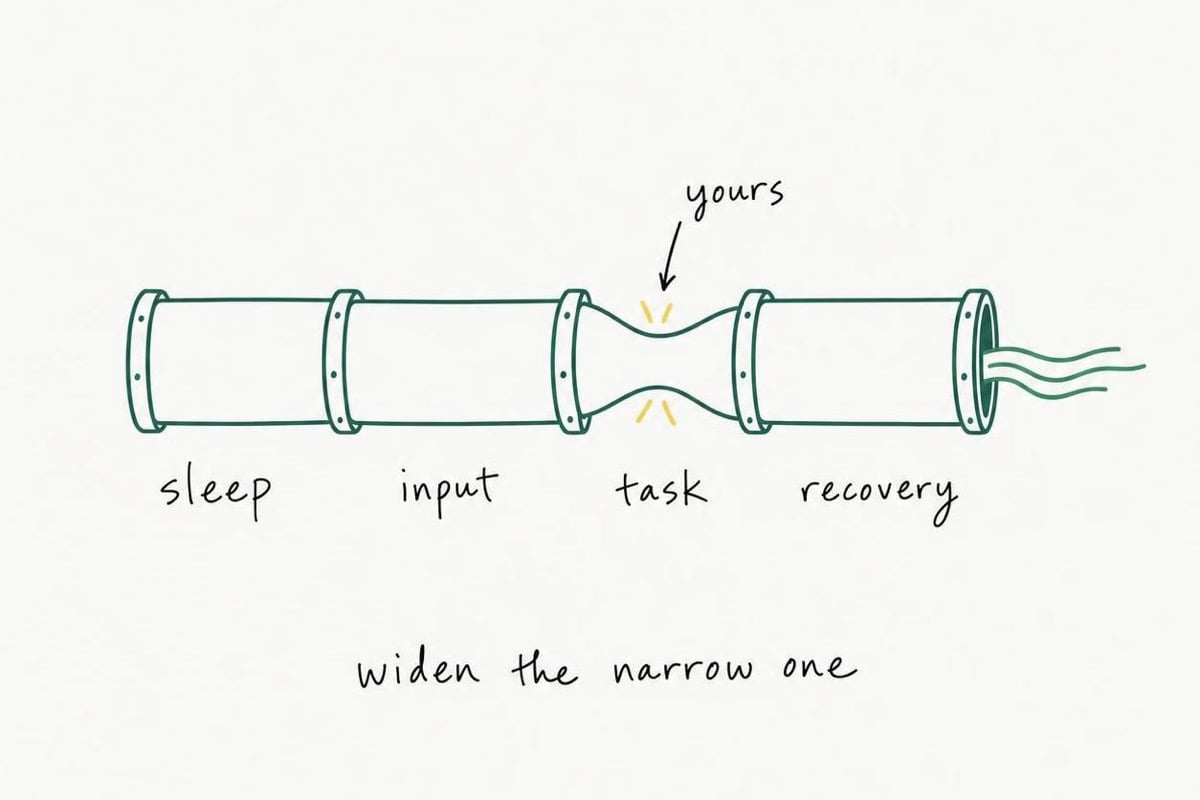
Concentration behaves like a pipe with four sections in series: output is limited by the narrowest one, and widening the three that are already wide enough changes nothing. That is why unranked tip lists disappoint. Adding meditation to a week running on five hours of sleep aims at the wrong section. So does installing a website blocker when the real problem is a task you never defined well enough to start.
A list cannot know which section is narrow for you. So the first job is diagnosis, not effort. Find the narrow section, change that one thing, and measure. Pick wrong and you have lost two weeks instead of a year, which is the cheapest way we know to be wrong.
The four checks that find your constraint
Run all four, then act on the worst answer only. Check 1 is sleep across a run of nights. Check 2 is what sits within arm's reach while you work. Check 3 is whether the task was ever defined. Check 4 is whether any recovery exists in your week. The evidence behind each condition is cited below, but the four-part sorting is LifeHack's own framing, not a validated instrument from the literature.
The cut-offs in each check are our starting lines, picked because they are easy to count in a week. They are not clinical thresholds and nothing published sets them. Move them if your work looks different from the examples.
Check 1: Sleep, across a run of nights rather than last night
In a laboratory study, adults restricted to 4 or 6 hours in bed for 14 nights showed cumulative, dose-dependent decline on sustained-attention and working-memory tasks. The 4-hour group fell further than the 6-hour group, and the deficits kept accumulating rather than levelling off. The part worth sitting with: their own sleepiness ratings badly understated how far performance had degraded. [4] That was a controlled study of healthy adults in a lab, not a rule that everyone needs a specific number of hours.
The self-assessment problem is why this check goes first. Feeling fine is not evidence. Count instead: over the last fourteen nights, how many gave you under six and a half hours of sleep? Four or more, by our starting line, and this is where to look first. If those short nights came from staying up rather than from being unable to sleep, bedtime procrastination is the pattern to read next. If you could not sleep, that belongs in the medical section below.
Check 2: What sits within arm's reach
The much-quoted finding here is that the mere presence of your own phone reduces available cognitive capacity, even face down and silent, with the effect strongest for people most attached to their phones. [5] Our source check flagged this one as contested rather than settled, and we could not verify the later replication work well enough to cite it. Treat "your phone silently drains your brain" as an open question, not a fact to plan around.
What survives is a cheaper argument. Moving the phone to another room costs nothing and removes the switch entirely, and the switch is the part with evidence behind it. Same for the second monitor of chat. The test: during your last work block, how many times did you reach for a device you had not planned to use? More than five, by our starting line, and this is your section. Internal distractions matter here too, because some of those reaches start as a thought, not a notification.
Check 3: The task you never actually defined
No citation for this one. Everything in this check is our own observation from the drafts and calendars we see, offered as a working hypothesis rather than a finding, including our impression that it is the check that most often turns out to be the narrow section once sleep and phone habits are already reasonable.
Take a composite case: a reader we will call Dana blocks 90 minutes for "work on the Q4 plan," sits down, and goes straight to email. Dana is not weak. Dana was handed a task with no entry point, no finish line, and no way to tell whether the 90 minutes succeeded. Brains do what brains do with ambiguity: find something with a clearer next move. Email always has one.
The test: read the next item on your calendar. Can you say out loud what the first physical action is, and what will exist at the end that does not exist now? If either answer is fuzzy, rewrite the item before blaming your attention. "Work on Q4 plan" becomes "list the three budget lines we are cutting, in the doc, in bullets." Difficulty is not the enemy of concentration. Ambiguity is. If the task is large enough to freeze you, I get so overwhelmed that I do nothing covers the unsticking.
Check 4: Recovery you never put on the calendar
A meta-analysis of micro-breaks found they reliably improved vigor and reduced fatigue, while performance effects were smaller and depended heavily on the task. [6] A meta-review of 30 systematic reviews concluded a single bout of exercise can help cognitive function, with the benefit depending on when performance is measured. [7] Both are real and both are modest.
Caffeine belongs here rather than in its own section. In a randomized, double-blind, placebo-controlled study, 400 mg of caffeine disrupted sleep taken 0, 3, or even 6 hours before bed, including reduced total sleep time at 6 hours. [8] That was 12 healthy adults at a fairly high dose, so it is not a verdict on your 3 p.m. cup. But caffeine's half-life in adults runs roughly 4 to 6 hours with wide individual variation, which means an afternoon dose can quietly move you into Check 1.
The test: in the last five working days, how many contained a real break away from screens? Fewer than three, by our starting line, and this is your section. Our guide to symptoms of cognitive overload covers what a week without any of them can feel like.
How to run the two-week focus test
Count one number for two weeks: completed blocks. A completed block is any planned stretch of work, 30 to 90 minutes, finished on the task you planned without switching. Week one you change nothing and just mark the tally on paper. Week two you change the single item your worst check identified, and keep the same tally. Two numbers, one variable, no app. This protocol is ours, not a published intervention.
Week one, change nothing. Work as you normally do and mark the tally. Whatever the number is, it is your baseline, and it is usually lower than the version of your week you carry in your head.
Week two, change only that. Phone in another room for every block. Or rewrite every calendar item into a first action plus a finish line. Or a hard lights-out that gets you seven hours. Nothing else changes, because two changes leave you unable to say which worked.
Attach one if-then rule, written as a sentence you can read back: when the urge to check the inbox arrives mid-block, write the thought on the pad and go back to the sentence you were on. If-then planning is a long-standing behaviour-change technique. We looked for a verified effect size to quote and could not confirm one from a reachable primary source, so treat it as a practical tactic, not a number we can stand behind.
Compare the tallies. A clear rise means you found your narrow section, so stay there a month before touching anything else. Flat means you guessed wrong, so take the next-worst check and run week two again. Focusing at work gives you tactics for whichever slot you land on.
What about Pomodoro, brain training, and coffee?
Breaks yes, timer length unproven, brain games no, coffee earlier. The break half of Pomodoro has meta-analytic support behind it, while no credible evidence establishes 25 minutes as the optimal work interval for anyone in particular. Brain-training apps are the clearest no in this category. Coffee is a timing question rather than a yes-or-no question, and moving it earlier costs nothing you will miss.
If a 25-minute timer feels like being interrupted by your own kitchen, change the number. The structure is doing the work, not the interval.
On brain training, a large online randomized trial found people improved on the tasks they practised, with no convincing evidence of transfer to untrained abilities. [9] You get better at the game. That is the extent of it. Focus apps that actually help do a different job, which is removing input rather than training your brain.
When poor concentration is a medical question
Trouble concentrating is not a specific symptom, so on its own it cannot tell you what is causing it. Sleep apnea is one documented example that has nothing to do with your calendar. Treat this as a medical question rather than a productivity one when the trouble is persistent, getting worse, or interfering with work or relationships, and take it to a clinician who can consider causes an article cannot.
Trouble focusing and paying attention is among the sleep-apnea symptoms the National Heart, Lung, and Blood Institute lists, and their guidance is to talk with a health care provider rather than self-manage. [10] On ADHD, the scale is larger than most people assume: using the NCHS Rapid Surveys System in October and November 2023, CDC estimated that 6.0% of US adults aged 18 and older had a current ADHD diagnosis, roughly 15.5 million people. [11] That counts adults reporting a current diagnosis from a probability-based online panel, not everyone who has ADHD.
Nothing here can diagnose you, name a cause, or rule one out, and the two-week test is not a screening tool. If the trouble arrived at the same time as any other change in your health, that is a reason to book the appointment rather than to run the test. Our guides on focusing with ADHD and losing focus during depression are written for readers already working with a diagnosis.
Start here tonight
Count your last fourteen nights and write the number that came in under six and a half hours at the top of a blank page. Tomorrow morning, add a tally mark for every block you finish without switching, and note which of the four checks looked worst. That is the entire first step, about four minutes of work, and it gives you what no tip list can: a reading on your week.
By Friday you will know which section of your pipe is narrow. Then change that one thing, and only that, for two weeks. That is the whole method for how to focus and concentrate better: four checks, one change, one number, two weeks.