
If you are typing "how do I change my life" into a search bar, you are in one of two states. Either something just broke (a job, a marriage, a diagnosis) and you need a sequence right now, or you have carried this question quietly for years and finally said it out loud. The answer is the same in both states. Changing your life is not a goal problem. It is an order problem. There are six areas (health, relationships, work, money, meaning, and mental clarity), you cannot rebuild them all at once, and the order is set by which one currently funds the next. This is a life rebuild, not a life hack. It is what you do instead of starting another diet on Monday.
A note before you read on. If the reason you are here is that you feel you cannot keep going, or you are in the middle of an acute crisis, reach a person, not an article. In the US, dial 988 for the Suicide and Crisis Lifeline. What follows is for the very common case: a life that has drifted, stalled, or worn out its old shape and needs rebuilding in the right order.
Changing Your Life Is an Order Problem, Not a Goal Problem
Almost every answer to "how do I change my life" hands you a goal or a fresh start. A new diet. A new planner. A 5am alarm and a cold shower. The goal was never the hard part. You already know roughly what a better life looks like, which is exactly why the advice feels hollow when you read it.
The reason the change has not happened is rarely that you picked the wrong goal. It is that you tried to move six things at once, on willpower, with no order. One of our users wrote this verbatim while setting up a goal: "I feel extremely stuck right now. It seems like what I'm doing right now isn't working." Read that again. What is "not working" is almost never the effort. It is the sequence.
Change isn't a goal problem. It's an order problem.
Mark Manson makes a version of this case well: the life you want is built from unglamorous daily actions, not a single dramatic leap. [1] We would push it one step further. Before the daily actions, before the habits, there is a question almost nobody asks: which area goes first? Get that wrong and the most disciplined daily routine in the world rebuilds the wrong room while the foundation keeps sinking.
The Six Areas You're Trying to Change (and the Order They Fund Each Other)
When people say they want to change their life, they almost always mean some combination of six areas:
- Physical health - energy, sleep, the body holding up.
- Family and relationships - the marriage, the kids, the people you live with.
- Work and career - meaningful work, or at least work that does not hollow you out.
- Wealth and money - debt, runway, the financial calm to make a real choice.
- Spiritual wellness - meaning, direction, the sense that any of this is for something.
- Mental strength - clarity, resilience, a mind that is not always at war with itself.
We call this the Full Life Framework, and the point of it is not the list. Anyone can list life areas. The point is that the six are not independent, and they do not get equal weight at the same time. They fund each other in a chain. Health pays for the energy that work needs. Work pays for the money that lowers the financial strain quietly poisoning your relationships. Steadier relationships restore the mental strength it takes to hold any sense of meaning at all. Fix one area in isolation and the others drag it back down within a month.
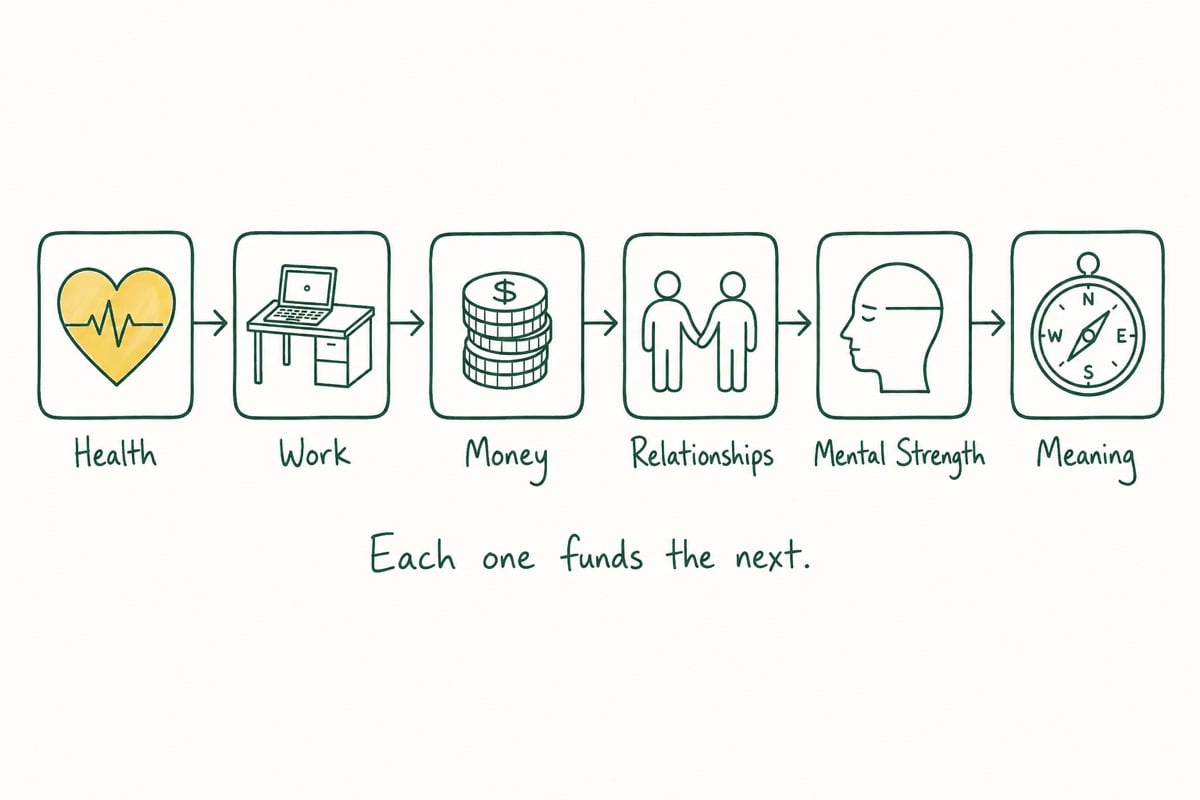
You cannot rebuild six areas in parallel. The order is set by which one currently funds the next.
So the starting point is not the area that hurts the most. It is the area whose collapse is starving the others. Usually that is one of the load-bearing two: health or money. A common mistake is to start with meaning ("I need to find my purpose") while running on four hours of sleep and a maxed-out credit line. Purpose is real, and we have written about finding it, but it is the worst possible place to start a rebuild. It is the area the others fund last.
When we looked at 153 active goals from heavily engaged LifeHack users, the pattern was hard to miss. The goals that held were written in sequence: one area first, then the next. The goals that stalled tried to fix everything at once. One read, verbatim, "Cultivate a fulfilling life with equal focus on career, health, and personal relationships." Equal focus is the trap. Equal focus is no focus. Rebuild one system at a time, in the right order, and let each one pay for the next. If you want the practical walk-through, the midlife reset lays out how to run this across the core areas without trying to lift them all on day one.
Why "Drastically" Is the Word That Sabotages the Whole Thing
A lot of people do not search "how do I change my life." They search "how do I drastically change my life," and that adverb is where the plan dies before it starts.
Drastic change is seductive because it feels proportional to the pain. Quit the job. Sell the house. Move to a new city. Throw out the whole life and start clean. It feels like finally taking yourself seriously. And it is, reliably, the fastest route back to exactly where you started, because nothing drastic survives contact with a normal Tuesday. You cannot overhaul six areas on willpower at once. You could not do it at 25. You definitely cannot do it now, with a mortgage and people depending on you.
Part of the restlessness, worth naming, is the calendar rather than your life. Life satisfaction follows a U-shape across most of the world, bottoming out in the mid-40s to mid-50s before rising again. [2] You feel stuck in the exact decade most people feel stuck. That does not mean nothing is wrong. It means do not torch a stable life to escape a feeling the data says lifts on its own, if you keep rebuilding instead of detonating.
"I deserve better than this." "It's time to reach my potential." Those are real, and we hear versions of them constantly. The drastic move feels like the way to honor them. It isn't. The honoring is the boring version: one area, sequenced first because it funds the others, held for 18 months and revised every quarter. Not a five-year plan (too far away to feel) and not a 90-day sprint (too short to hold a life).
Drastically is usually the wrong word.
The Stage Most People Skip: Telling the People Inside Your Life
Behavior change has stages, and the people who study it have mapped them. The most-cited model, Prochaska and DiClemente's Transtheoretical Model, runs precontemplation, contemplation, preparation, action, maintenance. [3] Most change advice obsesses over the jump from thinking about it to actually doing it. Fair enough. That jump is hard.
But there is a stage the textbook models leave out, and at midlife it is the one that decides everything: communicating the change to the people who live inside it. A rebuild done in private collapses. The spouse you do not loop in becomes the obstacle. The teenager you do not level with becomes the resistance. The colleague who got used to a specific version of you pulls, without meaning to, toward the old version.
This is the part that makes a midlife rebuild structurally different from a fresh-out-of-college one. You are not changing a blank life. You are renegotiating a shared one. If the area that just broke is your marriage, that conversation is the whole game, and we wrote a diagnostic for unhappy marriages for exactly that. If what you are calling a need to change your life is actually burnout, do not redesign everything; start with the recovery and see what still feels broken once your energy comes back. The change does not hold because you willed it. It holds because the people around you stopped fighting it.
Set a Northstar That's Smaller Than the Change
Here is the quiet reason you have not changed yet: the change you keep imagining is sized wrong. Too big to start. Too vague to measure. "Change my life" is not a thing you can do on Tuesday, so Tuesday comes and you do the dishes instead.
The fix is to set a Northstar that is smaller than the change but bigger than a to-do. One 18-month commitment, for one area, the load-bearing one, revised every quarter as you learn. Not "get healthy." Something like "rebuild my sleep and base fitness until I can hike the back trail again without stopping." Concrete enough to know if you are moving. Long enough to matter.
Devon, 52, did not change his life. He set one Northstar: get the debt off his back so a career change would actually be possible. Eighteen months of that one area, in sequence, did more for his marriage and his sleep than any of the times he had tried to fix all three at once. That is not a motivational story. It is what sequence looks like in practice. The money area was funding the others, so the money area went first.
The Northstar is the unit of a rebuild. You do not set six. You set one, for the area whose collapse is starving the rest, and you let it fund the next.
What to Do This Week, Whether You're in Crisis or Just Finally Ready
If something just broke, do not pick a grand new vision this week. You do not need a vision. You need to know which area to stabilize first so the others stop bleeding. Pick that one. Triage, then rebuild. If you are starting over, starting over still has an order.
If you have carried this question for years and nothing broke, your job is the opposite: do not overhaul. Pick the one area that currently funds the most others and set an 18-month Northstar for just that area. The years of not-acting were never a willpower failure. The change was just sized wrong.
Either way, the first move is the same and it is small. Write down the six areas. Then circle the one whose collapse is starving the others. That circle is where the rebuild starts. Not all six. One. Whether you are 44 or doing this at 60, the order is the work, and the order is what almost everyone gets wrong.
You're not behind. You're at the rebuild.
Frequently Asked Questions
What are the 7 steps to changing your life?
What is the 3-3-3 rule for habits?
The 3-3-3 rule is a popular focus heuristic, and versions vary: often three hours on your most important project, three shorter tasks, and three maintenance tasks in a day. It is a fine tool once your rebuild is already sequenced. It is not where you start. Habit advice assumes you already know which area you are working on. James Clear's Atomic Habits is the better-built version of the same idea, and even that works best once you have decided what the habit is in service of. Sequence first, habits second.
How do I drastically change my life?
What are the 4 stages of change?
Be careful here, because 4 stages of change is a simplified compression of a research model that actually has more. The most-cited model is Prochaska and DiClemente's Transtheoretical Model, which names five stages: precontemplation, contemplation, preparation, action, and maintenance (some versions add a sixth, termination). When people say 4 stages they have usually dropped precontemplation or maintenance. For a midlife rebuild the stages matter less than one most models leave out entirely: communicating the change to the people who live inside your life. Skip that one and the change collapses no matter how clean the first four stages were.