
In my last post, I talked about how to get the most out of social media sites and services like Digg, LinkedIn, and Twitter. Entirely coincidentally, Thursday Bram write a post about marketing yourself shortly after.
Unfortunately, any medium that makes itself so easy to use to promote yourself as today’s social media also makes it easy for idiots, jerks, and scam artists to promote themselves. As the cost of reaching out to thousands or millions of people goes down – to the point where today, it’s effectively free – the possibility to spam goes up.
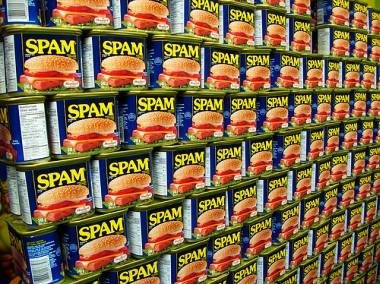
Spam is any communication that purports to offer a benefit but is unwanted. Of course that means come-ons for cheap prescription pills, penis enlargment and miracle fat-burner supplements, and mortgage refinancing, but it also includes too-frequent updates from companies you’ve done business with, useless “updates” from newsletters you’ve subscribed to, meaningless self-linking on social media, and so on. While the monetary cost of sending spam is small, the cost to the receiver in time, attention, and the disruption of beloved services is great.
Let me give you an example. Today, a new wave of spam flooded Twitter. The modus operandi of Twitter spammers is to create dozens or hundreds of bogus accounts, post one tweet to each with a link to the spammer’s page, and follow thousands of people. The default setting on Twitter is to send you an email notifying you whenever you have a new follower, so all day I’ve been getting emails linking to Twitter profiles.
Now, I like to see who’s following me on Twitter. Most of the time I follow back. So I click through, and see a profile with that one tweet and close it and delete the email. Over, and over, and over. If I don’t click through, I run the risk of missing a real follower who might be worth following, so my choices are a) lose time and attention checking out every bogus follower, or b) lose value from the service by failing to connect with people who share my interests.
Unfortunately, ruining my Twitter experience is a good business model. According to a recent study by Marshal, a global security consulancy, 29% of Internet users admit to having bought products advertised in spam. To paraphrase the old professor’s saw about graduation rates, look at the person to your left and the person to your right – if one of those people hasn’t bought anything from spam, then you have.
So here’s a what-(hopefully-not)-to-do for potential spammers out there. If making yourself universally unloved – except by that 10 people in a million who just loves them some Internet Viagra (that’s the response rate for spam, according to the FBI) – is your goal, follow these steps to spamming Nirvana.
1. Overstay your welcome.
Volume counts in the spam world. What was useful information the first time becomes a real nuisance by the 10th time, and downright annoying by the 20th.
A couple of years ago, I ordered some business cards from VistaPrint.com. Not the free ones – I paid good money for their premium cards. The cards were fine, but before they even arrived I ahd decided not to order from VistaPrint.com ever again. In the days following my order, I received dozens of “free” offers — “free” matching letterhead, “free” enveloped, “free” rubber stamps, and so on. (“Free” at VistaPrint.com means “shipping and handling only”, which tends to run into double digits per item ordered.) Then I achieved “VIP” status and started receiving even more offers for “great discounts”. Keep in mind, I still hadn’t received my order yet!
That’s spam, pure and simple. I didn’t mind a follow-up or two, but when I’m receiving offers every day, and I’m paying for each of them with my time and attention, they are no longer wanted information.
2. Don’t ask permission.
Of course, your stereotypical spammer just scrapes email addresses off the Internet or buys lists from other scam artists or even guesses, sending emails to every word in the dictionary at every common email domain. They clearly don’t have permission.
But what about the companies like VistaPrint.com — who is hardly alone in this, though the sheer volume of email I got from them sets them apart — who take the “pre-existing relationship” of an order as permission to send whatever they want? Or what about the person you met at a conference and gave a business card to, who then added your email address to his company’s email list? Or the blog that adds commenters’ email lists to their mailing list?
Having a relationship with someone, either now or in the past, is not the same thing as permission. Permission is when someone explicitly asks to hear from you — if you don’t have it, it’s spam.
3. Be irrelevant.
This morning, I got an email from BlogWorld Expo warning me that their early-bird registration was about to end, and I should act fast to get my discount! That might be important information — if I hadn’t already registered for the event.
Any piece of information that isn’t targeted to a specific recipient is potentially spam. Asking me to promote your new cheese brand on Lifehack is spam, no matter how personal and likeable the email, since Lifehack is not site devoted to cheesy comestibles. “Shouting” me for a digg on your story about how to pick up easy women or about how the blacks are ruining everything is spam — I teach race and gender studies, and there’s no way I’d digg up either of those stories (I might bury them, though).
Taking the time to get to know your target isn’t in spammers’ interest, because then it becomes expensive — you pay for my attention and time with your own.
4. Add no value
Every service you use — social media, telephone, blogging, email, whatever — was chosen by you for the value it offers you. Any use of that service that adds no value is spam — especially when they reach the point that they detract value from the service as a whole. I know I’m not alone in having disconnected my home phone because I received more value-less telemarketing calls than calls from people I wanted to talk to.
5. Control the “off” button.
If I have to jump through hoops to get you to stop bugging me — or if there isn’t any way at all to get you to stop — that’s spam. Forcing me to call or email someone — when all it took to sign up was a purchase or even a registration — is spam. In fact, as a general rule, any channel of communication that you control is most likely spam. Even on TV I can change the channel when I want!
6. Don’t respect me
This is the root of all the rest. If you want me as a customer, as a trading partner, show me respect. The Viagra and Cialis spammers are trying to take advantage of us, so of course they don’t respect us. If you don’t respect your audience, then you’re in the same league — you’re spam.
Maybe that seems harsh. But it’s a harsh reality we’re living. The number of ways we can communicate, and the reach of those communications, has vastly outstripped the social norms we have to regulate our interactions.
We talk a lot at Lifehack about how to control the flow of information into your life, how to filter out the good from the bad, but ultimately working our way free of spam depends on people controlling the stuff they send out so the rest of us don’t have to worry about what’s coming in. If you’re doing any of the above, you’re part of the problem — whether you do it by emailing, Twitter tweeting, Digg shouting, or even face-to-face.
Stop it.