

You fall asleep fine. That is exactly why you never suspected the coffee
If you drop off within ten minutes of lights out, you have probably crossed caffeine off the list of suspects. That is the wrong conclusion. In a controlled crossover trial of 12 adults, 400 mg of caffeine taken six hours before bed cut objectively measured total sleep time by about 1.1 to 1.2 hours, while in the participants' own sleep diaries the loss came to 41 minutes and did not reach statistical significance (Drake et al., 2013). Falling asleep is not the test. The next morning is.
So the 3:45 coffee stays. It gets you through the afternoon, you are out by 11, and by 10am you are running low again, which is when you pour the next one. From inside the loop it looks like a caffeine shortage. It can just as easily be a caffeine surplus arriving at the wrong hour.
That is the real question behind "caffeine cut off time," and nearly every answer you will find is a number somebody picked: 2pm, noon, six hours, eight hours. None of those numbers know how much you drank or when you go to bed.
"Stop at 2pm" is advice for a day nobody actually has
A fixed clock time fails because it ignores both ends of the problem. Two people follow the same 2pm rule. One has a single 8 oz drip coffee and goes to bed at 11. The other has a 20 oz cold brew and goes to bed at 9:30 to be up at 5. Same rule, nothing like the same night. The rule did not break. It was never specific enough to work.
You have probably run your own tests already. Swapped the second cup for green tea. Went decaf after lunch for four days, noticed nothing, went back. Skipped coffee entirely one Sunday, slept badly anyway, and quietly filed caffeine under "not my problem."
Here is what makes that frustrating. None of those tests ran long enough to show a pattern, and all of them measured the wrong thing. You were watching how fast you fell asleep. What caffeine can do is shave length and depth off a night you still rate as fine. In the Drake trial, slow-wave sleep duration decreased at all three tested intervals, reaching significance at bedtime and at six hours before bed (Drake et al., 2013). The diary numbers in that study did not track the recorded loss, which is the part worth taking from it: self-rated sleep is a weak instrument for this question.
A caffeine cut off time is a subtraction problem, not an hour
Your cut off is not a time on the clock. It is a gap: the number of hours your last dose needs in order to fade before lights out. Two things set that gap, and only two. How much caffeine was in that last dose, and how fast your body clears it. Change either and the clock time moves. This is why one universal hour cannot work, and why your coworker's 2pm rule tells you nothing about yourself.
Caffeine does not add energy. It blocks adenosine receptors, and adenosine is one of the signals that accumulates while you are awake and builds pressure to sleep (Bjorness and Greene, 2009). The pressure keeps building while the caffeine sits in the doorway. You just stop feeling it for a while. That is also why the drop-off later in the day can feel so abrupt.
Clearance runs on a half-life. In healthy adults the elimination half-life of caffeine is roughly three to six hours, and individual values reported in the literature run from about 2.3 to 9.9 hours (Willson, 2018). Every half-life, about half of what remains goes away. So one 95 mg cup of drip coffee at 4pm is not gone by 9pm. It is halved.
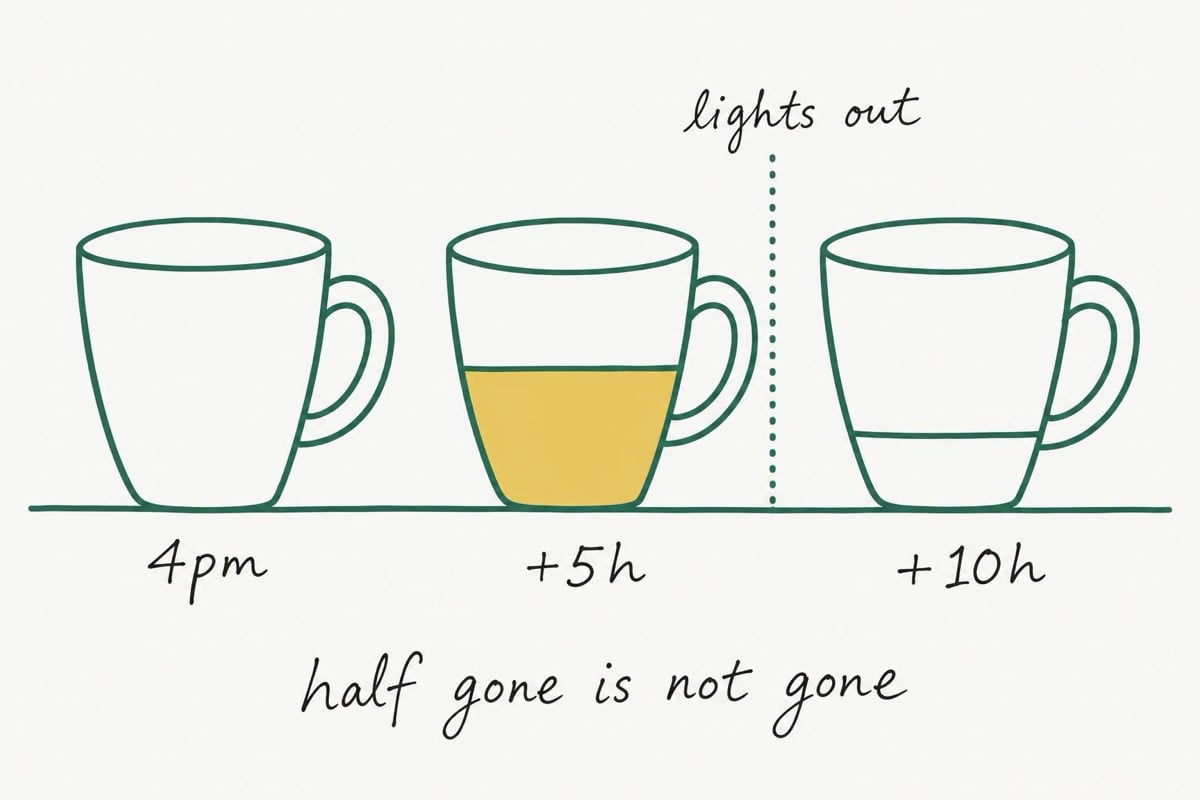
That arithmetic is worth seeing. Below is how much of a single dose is still circulating after a given gap, calculated across a fast-clearance estimate (a four hour half-life) and a slow one (six hours), so the width of the honest range is visible.
| Last dose | 4 hours later | 6 hours | 8 hours | 10 hours | 12 hours |
|---|---|---|---|---|---|
| 95 mg (one 8 oz drip coffee) | 48 to 60 mg | 34 to 48 mg | 24 to 38 mg | 17 to 30 mg | 12 to 24 mg |
| 190 mg (two cups, or one large) | 95 to 120 mg | 67 to 95 mg | 48 to 75 mg | 34 to 60 mg | 24 to 48 mg |
| 300 mg (a big cold brew or energy drink) | 150 to 189 mg | 106 to 150 mg | 75 to 119 mg | 53 to 94 mg | 38 to 75 mg |
Read that as arithmetic, not as a prediction about your night. The table says how much is left. It does not say what that amount does to your sleep, because that varies by person and nobody has measured yours. What it does show is the thing the clock-time rules hide: the size of the dose matters as much as the hour it arrived.
How to set your own caffeine cut off time
Four steps, about ten minutes tonight, then one week of paying attention. Write down the hour you actually fall asleep. Total the caffeine in your last dose, including the ones you forget. Pick a starting gap from the published estimates. Subtract to get a clock time, and write that time somewhere you will see it at 3pm.
1. Name the sleep you are protecting. Not bedtime. The hour you are actually asleep, which is later than the hour you got into bed. Count backward from that, never from a generic dinner hour. If you work nights or start at 5am, this matters more, not less, because your sleep window sits where the standard advice assumes you are awake.
2. Total the last dose, honestly. Count every source, not just the one you remember. Approximate figures from the USDA reference and the FDA:
| Drink | Serving | Caffeine |
|---|---|---|
| Brewed coffee | 8 fl oz | about 96 mg |
| Espresso | 1 fl oz | about 63 mg |
| Black tea | 8 fl oz | about 48 mg |
| Green tea | 8 fl oz | about 29 mg |
| Cola | 12 fl oz | about 33 mg |
| Energy drink | 12 fl oz | 41 to 246 mg |
Sources: USDA Agricultural Research Service for the brewed coffee, espresso and tea figures, FDA for the cola and energy drink ranges. Two things the table cannot do for you. Energy drinks and cold brew vary too much for a single number, and the FDA puts energy drinks generally at 54 to 328 mg per 16 fl oz, so read the label. And a 16 oz coffee-shop cup is not 96 mg; scale by volume.
Then add the stack. A noon coffee is not finished when the 4pm one lands. Using the six hour half-life column, 190 mg at noon still leaves roughly 95 mg in you by 6pm, which rides on top of whatever the afternoon cup contributed. If you drink three times a day, your real bedtime load is the sum of three fading curves, not the last one.
3. Pick a starting gap. A 2023 systematic review and meta-analysis modelled this directly. To avoid a statistically significant reduction in total sleep time, the authors estimated that a standard cup of coffee should stop about 8.8 hours before bed, and a standard pre-workout serving about 13.2 hours, while a cup of black tea required no cutoff (Gardiner et al., 2023). Those are modelled population estimates, drawn mostly from studies of healthy adults with low to moderate habitual intake, and they use statistical significance as the dividing line rather than anything you would notice. Treat roughly nine hours for one coffee as a starting point, not a verdict.
4. Subtract, and write the time down. Asleep at 10:30 with one afternoon coffee puts your caffeine cut off time near 1:30pm. Asleep at 11:30 moves it to 2:30pm. Asleep at 9:30 to catch a 5am alarm pulls it back to 12:30pm. If your last dose is bigger than one cup, move earlier: the arithmetic in the table above is the reason, and a 300 mg cold brew needs more clearance than a 95 mg cup does, not the same amount.
If the hour is impossible, change the dose instead. A 7pm commute with a two-hour drive does not have to mean 200 mg at 6:45. Half a cup, or tea, moves the load down without moving the clock, and the table shows why that is not a consolation prize.
One week, and the mornings do the scoring
Run it as one change over seven days, and judge it on how you wake up rather than how you slept. Days one to three, change nothing and just record. Days four to seven, move or shrink one late dose and keep everything else as steady as a real week allows. Four things go in the note each morning: the time you got up, how long until you felt like yourself, whether you needed caffeine before 9am, and one word for the morning.
Glenn starts at 8am with a 16 oz coffee, has another cup at 1pm, and a third around 3:45 on the days he has late calls. He is asleep by about 10:45, usually within fifteen minutes, and has always described himself as a good sleeper. His last dose lands roughly seven hours before sleep, and his bedtime load includes the tail of the 1pm cup as well. For days four to seven he keeps the 8am and the 1pm, and replaces the 3:45 with sparkling water. His nights may well look identical on paper, because that is not what he is watching. What he is checking is whether the 8am cup still has to land before he can read email, which is the only result he is after.
Marcy works 2pm to 10pm and is asleep around 1am. The generic advice tells her to stop at 2pm, which is the hour she clocks in. Counting backward from 1am and allowing about nine hours, her cut off lands near 4pm, so the 7pm energy drink is the problem and the morning coffee never was. She swaps the 7pm for the same drink at 3:30 and leaves everything else alone.
Neither of them should expect a clean verdict in three days. A bad week, a late deadline or one restless night will swamp a change this size, which is exactly why three days is not a test. Look for a pattern across the second half of the week, and if you see one, repeat the week before you believe it.
If you want the morning side of this handled separately, the grogginess in the first twenty minutes after your alarm is a different problem with a different fix, and we covered it in what actually clears morning sleep inertia. Caffeine timing is one lever among several; managing energy rather than time covers how the rest of the day gets allocated, and a week of records only works if the recording itself survives, which is where what it takes to make a habit stick and staying consistent when motivation drops earn their keep. If the flat feeling is really about attention rather than energy, concentrating better is the more useful place to start.
What a caffeine cut off time will not fix
Some of this will not be about coffee, and it is worth saying which parts.
"I have had coffee at 4pm for twenty years and I sleep fine." Possibly true. In a randomized crossover study, 20 habitual male caffeine consumers took 150 mg three times daily for ten days and showed no significant change in polysomnography-measured sleep compared with placebo (Weibel et al., 2021). That is a small, male-only study with daytime dosing, and the 2023 meta-analysis found the repeated-exposure evidence too thin to settle whether regular users habituate. So do not assume your tolerance protects your sleep, and do not assume it does not. One week of your own mornings will tell you more than either position can.
The 400 mg figure is not a bedtime rule. The FDA cites 400 mg a day as an amount not generally associated with negative effects in most healthy adults, notes that sensitivity and elimination vary between people, and lists insomnia among the possible effects (FDA). It is intake-safety context. It says nothing about what time to stop.
Your clearance might not be average. Reported half-life was about 11.8 hours in oral contraceptive users versus 5.3 hours in controls in one pharmacokinetic analysis, and separate data put smokers at about 3.0 hours against 4.3 hours for nonsmokers (Csajka et al., 2005). CYP1A2 is the main pathway and genetic differences in its activity contribute to the spread (Thorn et al., 2012). Late in pregnancy the half-life can reach roughly 15 hours (Qian et al., 2019). If you are in one of those groups, start from a longer gap rather than the average one.
It might be the schedule, not the caffeine. If your sleep window is pinned by a shift pattern or a 5am alarm and the coffee is the only part you can move, you are solving the wrong half. Till Roenneberg's book is the clearest non-clinical account of how body-clock timing and work schedules collide, and it will do more for that version of the problem than any cut off time will.
And sometimes tiredness is medical. Fatigue that is not relieved by enough sleep, decent food and a lower-stress stretch deserves a clinician rather than another habit experiment. Sleep apnea, iron-deficiency anemia, thyroid disease and depression all show up as persistent tiredness (MedlinePlus). If your mornings do not improve after a fair test, that is useful information, not a failure. Specific causes have specific fixes, which is also why something like sleep disruption during menopause needs its own answer, and why running flat for months with no clear reason is worth getting checked instead of managed. If what you are describing is closer to the later stages of burnout or a nervous system that will not settle, the reset that actually applies there is a better starting point than coffee arithmetic.
Start with tonight
Write two numbers on a sticky note: the hour you were actually asleep last night, and the milligrams in your last caffeinated drink yesterday. Subtract about nine hours from the first if that drink was one ordinary coffee, more if it was bigger. That is your caffeine cut off time for the next seven days. Then watch your mornings, not your nights, because the mornings are the part you were trying to fix. If nothing changes after a fair week, you have ruled something out, and that is worth more than another guess.


