

You packed the shoes. They came home clean.
That is the usual shape of travel workouts. The intention gets packed, the session never happens, and a four-night trip quietly becomes the thing that ended a program you had running for two months. Not because a hotel room is a bad place to train. Because at 6:40am in a city you did not choose, with a client breakfast at eight and a body clock that thinks it is the middle of the night, nobody designs a workout.
What survives a trip is a decision you already made. So pack two sessions, written down before you fly: one that takes 20 minutes and one that takes eight. Then pack one rule for which of them you run today, so the choice is never open for debate in a room with blackout curtains and a 9am start.
Both travel workouts are below, with the hotel-room version of every movement and the rule we would write into your phone notes.
Why "I'll find a gym there" keeps failing
The plan to find a gym on the road fails on logistics, not willpower. The hotel fitness room turns out to be two adjustable dumbbells, a treadmill with a dead display, and one bench with somebody on it. The real gym nearby wants a day pass and a 15-minute walk you did not budget for. By the time you have checked both, the window you had is gone and the first meeting has started without you.
What you reliably have instead is a floor, a wall, a chair, a door, and a suitcase. That list does not change between Cleveland and Frankfurt, which is the only reason it is worth building a session around. If you want more range than that, a resistance band weighs nothing and folds into a shoe, and our guide to resistance band workouts covers what to do with one.
Sleep is the other thing a trip takes. A survey of 2,242 business-class travelers in Japan and the United States found worse self-reported jet lag among people with sleep disorders and milder jet lag among the more physically active. [1] Two answers on a questionnaire, not a mechanism. It does describe the room you will be training in: short sleep, a moved clock, and a schedule somebody else wrote.
The trip is not where you lose it. The week after is.
Four nights away costs you very little physically. A short break is not long enough to undo months of work, and fearing that it is drives the two worst responses: cramming a harder session into a worse week, or writing the week off because a partial week feels pointless. Neither is the real threat. What a trip risks is the thread, the simple fact of having a session booked when you land.
In one small trial, 20 resistance-trained men trained four weeks, stopped two, then trained again, and their leg-press strength did not drop across the break. [2] Twenty young men, one lift, exactly two weeks. Not a law, but enough to answer the question people ask in airports.
You come home instead with nothing booked, a vague sense of being behind, and the idea that you should start again properly on Monday. Monday is where the damage happens. The session you skipped on Wednesday in a hotel room cost you almost nothing. The restart it set up can cost you a month, and if that has already happened to you, how to start working out again is the piece for the way back in.
So the purpose of travel workouts is not progress. It is to land at your own airport still mid-program.
That inverts what most travel fitness advice hands you. The usual move is a denser, harder session to make up for the gym you are missing, which asks more of you in the week you have least to give. We would do the opposite: shrink the session until the trip cannot beat it, and let the full version happen when the morning cooperates.
Travel workouts: the 20-minute session and the 8-minute floor
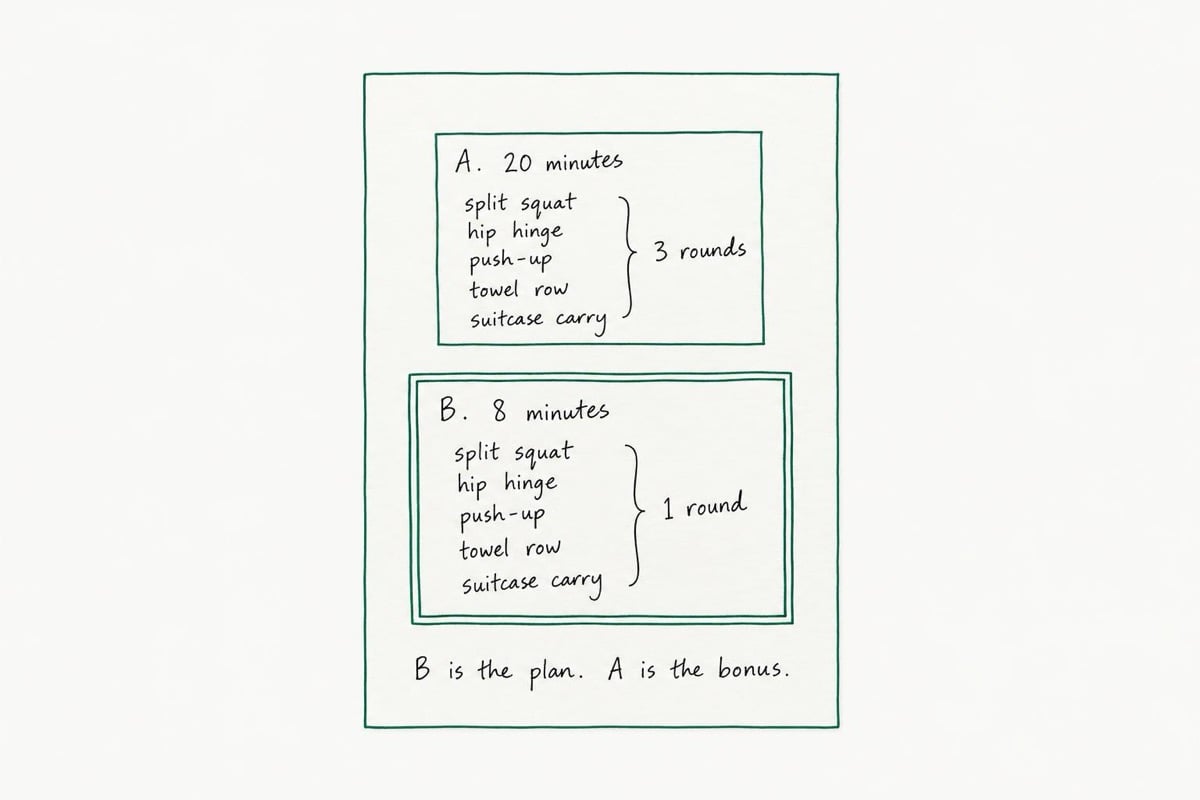
Pack two sessions and nothing else. The full session is five movements, three rounds, about 20 minutes. The floor is the same five movements, one round, about eight minutes. On a trip the floor is the default and the full session is the bonus, the reverse of how you would run them at home. Every movement uses a wall, a chair, a door, or your suitcase, so nothing depends on what the hotel owns.
| Movement | Hotel-room version | Full session | Floor |
|---|---|---|---|
| Split squat | Back foot on the floor a long stride behind you, fingertips on the desk chair for balance | 3 sets of 8 to 10 per leg | 1 set of 8 per leg |
| Hip hinge | Single-leg deadlift: stand on one leg, reach toward the floor, back leg light behind you | 3 sets of 8 per leg | 1 set of 8 per leg |
| Push-up | Hands on the desk, the chair seat, the bed frame, or the floor | 3 sets of 8 to 12 | 1 set of 8 to 12 |
| Row | Towel looped around a door handle, lean back and pull, or a bent-over row holding the packed suitcase | 3 sets of 10 | 1 set of 10 |
| Carry | Suitcase in one hand, down the corridor and back, switch hands | 3 sets of 30 steps per side | 1 set of 30 steps per side |
One safety note on the row, because it is the only movement here that trusts the furniture. Pick a door that latches and that opens away from you, so pulling on it presses the door into its frame instead of swinging it open. Loop the towel around the handle, then test it with a light lean before you put your weight on it. A sliding door, a loose handle, or a door that opens toward you is a no. In that room, do the suitcase row instead and leave the towel in the bathroom.
Those five cover the same ground as the five in our at-home weight training plan, on purpose. You are not switching programs for a week. You are running a stripped version of the one you already have, which is why coming home does not feel like arriving at a start line. If any movement does not suit your room or your body, swap it for its nearest equivalent in our bodyweight workouts for beginners rather than dropping the slot.
The small dose is not a consolation prize either. A review of maintenance training reports that younger adults held onto strength and muscle size for as long as 32 weeks on one session a week and a single set per exercise, provided the relative intensity of the work stayed up, while older adults may need two sessions and two to three sets to hold size. [3] That is maintenance rather than gains, and it rests on the effort staying high.
Which is the part travelers get backwards. The variable to protect on the road is not how many sets you fit in. It is how hard the last set is. Run the three sets as a circuit, which is what the round count in the table means: go through all five movements once, then start again, the way circuit training does. It holds the effort up and it is faster than finishing three squat sets before you touch anything else.
Now the rule, decided at home rather than in the room:
- Session A on any morning you wake with 25 clear minutes before your first commitment.
- Session B on every other morning, before the shower, in whatever you slept in.
- A travel day with an airport at both ends is still a Session B day, done in the room you land in, not written off on the grounds that it was a long day.
Put those three lines in the same phone note as your flight confirmation. The note is the actual intervention. Everything above it is just exercise selection.
Trips longer than about a week need one change, and only one: keep at least one Session A in every week you are away, instead of letting the whole trip run on floors. That is our own margin for error, not a finding. The maintenance review above tested small doses that kept their intensity, not weeks built entirely out of easy mornings, so we would rather protect one hard session a week than find out which way that goes on a three-week trip.
How to make a hotel-room session hard without weights
A bodyweight set works when it is difficult at the end, not when it is long. What you can change in a hotel room is the angle and the speed: lower your hands, slow the way down, train one leg at a time, pause at the bottom. When a set stops being hard by the last two reps, make the movement harder rather than chasing reps past 15. Counting to 40 push-ups is a different activity than training.
There is reasonable evidence that this is real work and not a placeholder. In a four-week trial, 23 moderately trained men did either progressive push-up variations or bench press three times a week. Both groups improved their bench press one-rep max and their push-up progression, and neither showed a significant change in measured muscle thickness. [4] That is 23 men over four weeks on a structured progression, so it is not proof that any unloaded movement matches its loaded twin. It does mean a push-up that keeps getting harder is a training variable.
The rungs below are ours rather than the study's. For the push: desk, then chair seat, then floor, then floor with a slow three-count down, then feet up on the bed. Move one rung when you can finish all three sets at the top of the rep range and the last rep still is not a fight. The split squat climbs the same way: fingertips off the chair, then a pause at the bottom, then a slow descent, then back foot on the bed frame. The carry gets harder by getting heavier, which is what the hotel laundry bag and a few books are for. If the corridor is busy or the bag will not hold weight, take something from our core strength exercises for that slot instead of dropping it.
If something hurts, step back down a rung rather than pushing through. A smaller range of motion, a folded towel under the knee, or one of these low-impact exercises in place of the squat for a day is a better answer than finishing the set. Clear existing pain or a diagnosed condition with a clinician before you train around it.
What a four-night work trip actually looks like
Four nights, four mornings, and one of them is a write-off. A realistic trip is one full session, two floor sessions, and one morning the 5:40am airport car wins outright. That is a successful trip, not a compromised one. You left with a program and came home with the same program, having trained three times in a week you had already written off.
Monday. Land at 11pm, two time zones east. Nothing happens tonight.
Tuesday. Awake at 5:50 whether you like it or not. Session B before the shower: eight minutes, five movements, push-ups on the desk because the floor felt optimistic. Done before the first email.
Wednesday. First meeting at 10. Session A at 7:15, the full 20 minutes, suitcase carry up and down the corridor while the floor is still asleep.
Thursday. Conference day, dinner that will run past 10. Session B at 6:45, then 11,000 steps because the venue was a mile from the hotel.
Friday. Car at 5:40am. Nothing. Correct call.
Two things about that week are worth naming. The first is that every session landed in the morning, which is partly a scheduling truth and partly a hedge against bad sleep. A meta-analysis of 69 studies covering 959 participants found acute sleep loss associated with a mean drop of 7.56 percent across physical performance tests, with evening tests consistently worse and morning tests largely unaffected. [5] The pooled figure covers many kinds of performance and varies widely between studies, so take the timing lesson rather than the number. If the trip has knocked your clock sideways for longer than the trip itself, our guide to fixing a sleep schedule is the next thing to read.
The second is Thursday's 11,000 steps, which are good for you and are not the session. In a 16-week trial, 67 older women were assigned to walking, resistance circuit training, or a control group. The walkers did improve on some measures, including quadriceps isometric strength. The resistance group still came out ahead on strength and functional autonomy. [6] Older women over 16 weeks is not your business trip, but it settles the bargain travelers keep making in airport terminals. Walk the city, and know what the walking is for: our case for power walking is about what it does well, which is not holding your strength.
"I'll pick it back up when I'm home"
That sentence is not wrong about the week. It is wrong about the month. The trip ends, then there is the catch-up week, then the weekend, and a program that was running fine in month two needs a restart it never actually earned. Eight minutes on Tuesday is not about the eight minutes. It is about not creating a gap that needs a decision later.
A few of the other objections, briefly. Sharing a room: the floor session has no jumping and no dropped weight in it, so it works at 6am beside a sleeping colleague. The hotel gym turns out to be decent: use it, run Session A there, the dumbbells make the hinge and the row better. The eight-minute version feels pointless: it is not meant to be impressive, it is meant to keep you from having to begin again. And if you already fell off a trip ago, start from how to start working out again rather than from guilt.
Pack the decision before you pack the shoes
Tonight, before the next trip, do three things. Write the two sessions into the phone note that holds your flight confirmation. Pick the rung you are on for the push-up and the split squat, so Tuesday morning has no decisions left in it. Then set the rule: Session A when you have 25 minutes, Session B every other morning, including travel days.
The shoes are optional. The suitcase is the equipment. The note is what actually makes travel workouts happen.