
Weight training at home for ladies works when it is written down as a plan rather than collected as a pile of exercises: five movements, two sessions a week, one pair of dumbbells, and a stated rule for the week that falls apart. Most home programs leave out that last part. That is why they end in month two rather than month one.
Take a hypothetical reader we will call Carla. Eight-pound dumbbells under the bed, a band in a kitchen drawer, three abandoned starts behind her. She does not need another list of exercises for women. She needs to know what to do on Monday, how to make it harder by week three, and what to do on the Monday after a week when nothing happened.
All three are below. Table first.
Weight training at home for ladies: the 6-week plan
Two sessions a week for the first four weeks, then three in weeks five and six. Every session is the same five movements: squat, hinge, push, row, carry. Sets run eight to twelve repetitions, counted per side on the row, while the carry is timed per side instead of counted. A session takes 20 to 30 minutes. Each week also carries a floor version, which is the shortest thing that still counts as having trained.
| Weeks | Sessions | The session | The floor | |---|---|---|---| | 1-2 | 2 | 2 sets of each movement: 8 to 12 reps for squat, hinge and push, 8 to 12 per side for the row, 30 seconds per side for the carry. Rest 1 to 2 minutes between sets. About 20 minutes. | 1 set of each movement, same reps and both sides. About 7 minutes. | | 3-4 | 2 | 3 sets of each, same reps, carry 45 seconds per side. About 30 minutes. | 1 set of each movement, same reps and both sides. About 7 minutes. | | 5-6 | 3 | 3 sets of each, same reps and carries, with load added by the rule further down. About 30 minutes. | 1 set of each movement, same reps and both sides. About 7 minutes. |
Two sets of each movement to start, three from week three. Notice that the floor column never changes. Everything else gets harder while the floor stays exactly where it is, so your worst week is never also the week that asks you for more than the last one did.
Two sessions a week is not a beginner's compromise. It is the federal baseline for adults: muscle-strengthening activity covering all the major muscle groups on at least two days a week, alongside 150 to 300 minutes a week of moderate aerobic activity, with the same guidelines stating plainly that some activity beats none. [1]
The aerobic half is what walks are for, and the arithmetic is worth doing rather than assuming. A 30-minute walk on five days of the week is 150 minutes, the bottom of that range. Two walks a week is not going to get you there, so put them on most days, including the days you lift.
The five movements, and what to use if you own no dumbbells
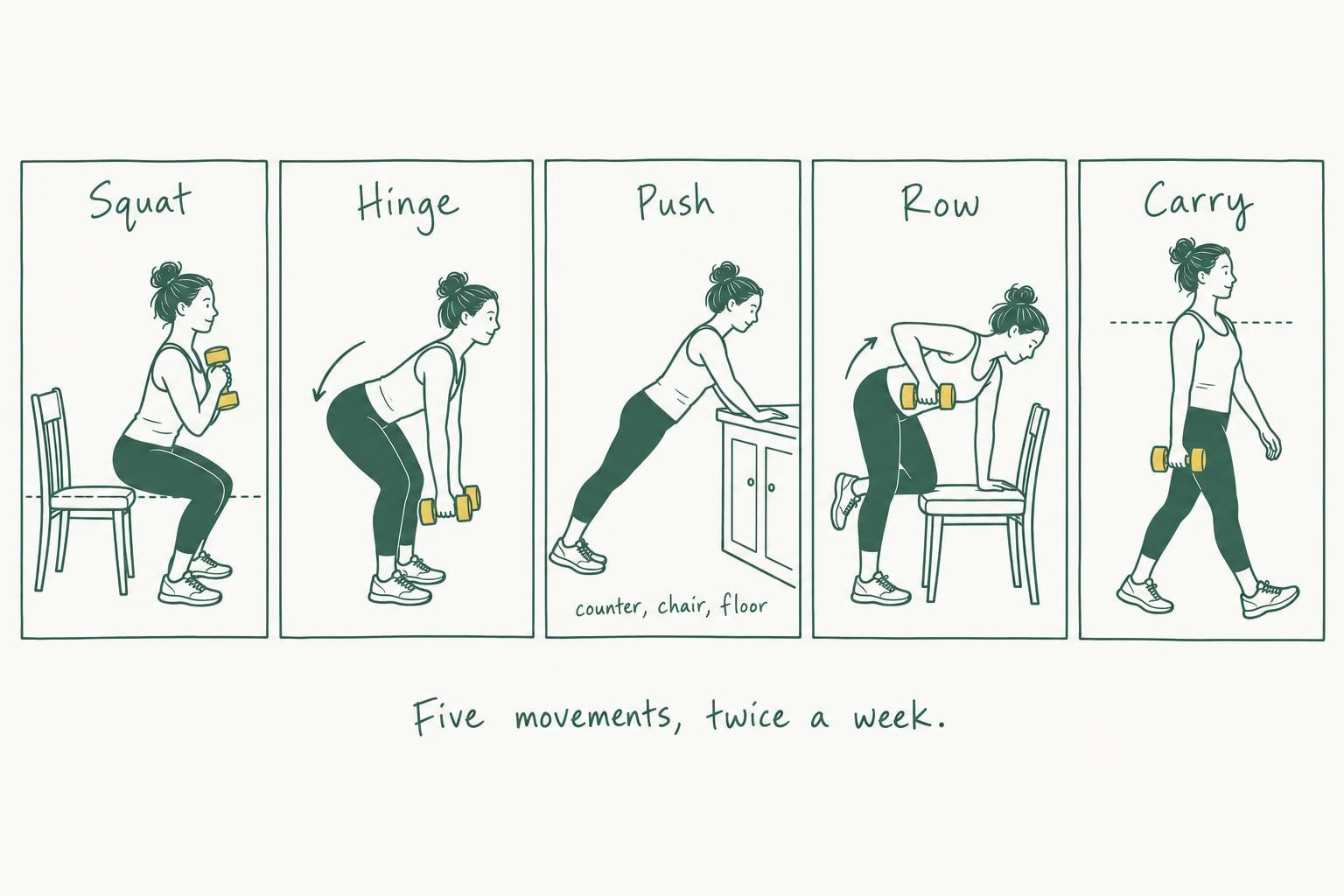
Squat, hinge, push, row, carry. Between them they load the legs, the hips and lower back, the chest and shoulders, the upper back, and the grip and trunk, which is what "all the major muscle groups" means once you turn it into actual movements. Each one has a household version, so an empty equipment drawer is not a reason to postpone week one. Set them up once and the following six weeks are repetition.
Squat. Stand in front of a dining chair, feet about shoulder width, one dumbbell held against your chest with both hands. Sit back until you touch the seat, then stand up. The chair sets your depth and catches you if the last rep is a grind. No dumbbell yet? Do it empty-handed with a slow three-count on the way down. This video demonstrates the squat pattern; its squat chapter starts at 1:12 and runs through 4:22.
Hinge. Dumbbells in front of your thighs, knees softly bent, back flat. Push your hips backward and let the weights travel down the front of your legs to about mid-shin, then stand by squeezing your backside. Your spine stays long instead of rounding. This is the movement most often botched in week one, so watch this 57-second physical-therapist demonstration before you film your first set.
Push. Hands on the kitchen counter, body in a straight line from heel to head, lower your chest toward the counter and press away. The higher your hands, the easier it is. Move to a sturdy chair seat when the counter stops being hard, then the floor. This demonstration uses a countertop and shows how to keep the hips aligned with the shoulders.
Row. One hand and one knee on a chair seat, a dumbbell in the other hand hanging straight down, pull it to your ribs with your elbow tracking close to your body. Do 8 to 12 reps with that arm, then switch and repeat, because one side is half a set. This supported one-arm row demonstration shows the same braced setup, hand-to-hip path and controlled return.
Without a dumbbell, loop a resistance band around a door anchor or a banister and pull one arm at a time. Plenty of home routines skip rowing, which leaves the upper back out of a plan that claims to cover everything.
Carry. Pick up one heavy thing, a dumbbell or a loaded grocery bag, hold it at one side, and walk for 30 seconds. Keep your shoulders level instead of leaning away from the load. Swap hands and walk again, so each side gets its own carry. This physical-therapy demonstration shows the same one-sided setup and the goal of controlling side-to-side motion.
Work the two carries up to 45 seconds each by week three. It is the movement that changes how a suitcase feels a month from now.
Equipment, in the order we would buy it: one pair of adjustable dumbbells spanning roughly 5 to 25 pounds, then resistance bands, then nothing. Substitutes that work tonight: a gallon jug of water weighs about 8.3 pounds, a loaded backpack held at the chest works for squats, and a filled canvas tote is a fine carry. For more options later, our beginner weight lifting exercises and kettlebell exercises guides cover the next tier, and how to exercise at home covers setting up the space.
Sets, reps, and how long to rest
Eight to twelve repetitions, two to three sets, two to three sessions a week. Those numbers are not ours. They follow the American College of Sports Medicine's guidance for novice lifters, which places training loads in the eight to twelve repetition maximum range at two to three sessions a week. [2] Rest one to two minutes between sets, and take longer when you need it.
How light is too light is the question we hear most from women training at home with whatever dumbbells they already own. The reassuring answer: when sets are taken close to the point where another clean repetition is not happening, loads at 40, 60 and 80 percent of a one-rep maximum produced similar muscle growth in a review of resistance training studies, while heavier loading produced greater gains in maximal strength. [3] That review covered adult men, so read it as direction rather than a result measured in women. The practical version: your 8-pound dumbbells are a real starting point as long as the last two reps of each set are hard to finish.
For anyone who wants the least that still works, a meta-analysis of weekly set volume found strength improves even at low weekly volumes, though the evidence does not pin down one universal minimum. [4] Two sets of five movements, twice a week, is a defensible starting dose, which is why this plan opens there instead of at five sets of everything.
Rest length gets argued about more than it deserves. A 2024 Bayesian review of inter-set rest concluded that rests longer than roughly 60 seconds may slightly favor muscle growth, but the pooled results were imprecise and varied enough that a confident one-minute-versus-two-minute rule is not supported. [5] So use your breath as the timer. When you can say a full sentence without gasping, start the next set.
How to add weight without guessing
The progression rule: when you can complete one or two repetitions beyond your target on a set, with the same form, increase the load by 2 to 10 percent. That is ACSM's published progression guidance for healthy adults, and it removes both failure modes of home training, which are adding nothing for six months and adding far too much on a Tuesday you felt good. [2]
Home equipment does not come in 2 percent increments, so here is how we translate that rule for a dumbbell rack. The mapping below is LifeHack's own, not a research finding: on a 10-pound dumbbell the smallest jump most people own is 5 pounds, a 50 percent increase, which is far outside the guidance. Reps go first, load goes second.
- Start the squat, hinge, push and row at 8 reps with a weight whose last rep is hard but clean.
- Add one rep per set each week until every set of those four reaches 12.
- Take the next dumbbell up and drop back to 8 reps.
- Repeat.
The carry sits outside that ladder because it is timed, not counted. Add five seconds per side each week until you reach 45 seconds, then pick up the next heavier object and start again at 30.
Change one thing per movement per week, not four. If a week goes badly, you do not undo the progression, you run the floor version and pick it back up where you left it. Bands complicate this, because the jump between colors is usually large and unlabeled. Shorten your grip to make the band harder, and treat that as your small increment.
When you run out of reps to add and out of heavier dumbbells to move up to, this plan has done its job. That is the moment to look at structured programming with more movements and more sets, and how to gain muscle is a reasonable next door.
The floor version and the 48-hour rule
The floor is one set of each of the five movements, about seven minutes, and you run it when the week goes wrong. The rule attached to it: after a missed session you get back inside 48 hours, and what you come back to is always the floor, never the session you missed and never a penalty session. This pairing is our own construct rather than a research finding.
It exists because the restart, not the training, is where home programs break.
Carla's third attempt ended in March. Not with a decision, with a Thursday. A work trip moved, she missed one session, the missed session became a week, and the week became a story about not being the kind of person who keeps this up.
The 48-hour rule makes that Thursday small. Seven minutes on Friday is not a comeback. It is a Friday. And the reason the floor never gets harder across the six weeks is that a bad week should not also hand you a bigger number than the last one.
Write the floor down before you need it, and keep a bodyweight version you can run in a hotel room. The week you need it is the week you will not be making good decisions about training.
What this will and will not do
Four honest boundaries, because the search results on this topic promise a great deal. Training at home with light weights builds size slowly, it does not choose where your body loses fat, it may support bone under conditions this six-week plan does not meet, and unfamiliar training may leave you sore in the first week. Each one below comes with the study behind it and the part that study does not cover.
Size changes slowly. In a 2025 Bayesian meta-analysis of healthy adults, relative gains in muscle size were similar in women and men, while absolute increases slightly favored men. [6] For anyone worried about looking bulky, that is the useful fact: the same training produces real change in women, spread across a smaller starting frame, and it accrues over months and years of steady work rather than inside a six-week block.
It will not slim one specific body part. A systematic review with meta-analysis covering 13 studies and 1,158 participants aged 14 to 71 found that training a muscle did not preferentially reduce the fat sitting on top of it. [7] Crunches strengthen your trunk and do not select where fat leaves. Targeted work is still worth doing for strength, which is the honest case for our at-home leg toning workouts, just not as a fat-loss strategy.
It may support bone, with limits worth reading. A meta-analysis of 17 randomized trials in 690 postmenopausal women found resistance training improved bone mineral density at the lumbar spine, femoral neck and total hip, with significant effects at the hip and femoral neck for high-intensity training defined as at least 70 percent of a one-rep maximum. [8] Results varied by skeletal site and the trials were heterogeneous. Two caveats we will not skip: this six-week plan sits below that intensity by design, and bone mineral density is a measurement, not a promise about fractures.
Expect soreness in week one. Unfamiliar training tends to hurt most the first time, a pattern known as the repeated bout effect. In one study of men repeating a resistance session, soreness was significantly lower after the second bout at 24 and 48 hours. [9] Small study, one population, so read it as a reason to expect the first week to be the worst one rather than a schedule you can count on.
Before week one: when to ask a clinician
Nothing here is a clinical protocol, and a few situations deserve a phone call before your first session. If you are pregnant or recently postpartum, get exercise cleared and adjusted with your clinician, which is what the American College of Obstetricians and Gynecologists advises for anyone starting or substantially changing activity. Everything else in this section is ordinary caution rather than sourced guidance, and it is worth the two minutes it takes. [10]
If you have a heart condition, chest pain or dizziness during exertion, a recent surgery or injury, an osteoporosis diagnosis, or medication that affects your heart rate or balance, ask a clinician before week one, and mention the hinge and the carry, since both are done standing with the weight held away from your center. Pain inside a movement is information: drop that movement, keep the other four, and see someone if it is sharp or lasts beyond a few days. If you are over 50 and starting from nothing, how to start exercising at 50 sequences the first month differently.
Start Monday with the floor
Not the full session. Start with the floor: one set each of squat, hinge, push, row and carry, about seven minutes, using whatever weight is already in the house. Do it Monday and Thursday this week, then run the week one column of the table from there. Your first session is then one you cannot fail to finish, which is the piece the last three attempts were missing.
A plan that survives a bad week beats a better plan you abandon in March.