
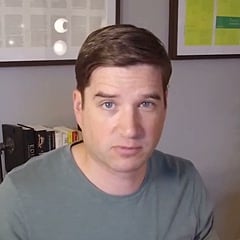
The daily routine of
Cal Newport's Daily Routine
Georgetown computer science professor, New Yorker writer and author of Deep Work, Digital Minimalism and Slow Productivity. A father of three in his 40s, he stays off social media and has ended his workday at 5:30 p.m. since grad school.
Repeats daily or weekly
Routine
-
Coffee, breakfast, everyone out the door
On wakingHis weekday mornings start as a parent of three: make coffee, get the kids fed and packed up (2026). He says his brain does not work until he has had that coffee (2025). 1
"wake up, make coffee, make sure they have breakfast, get everyone packed up and out the door"
-
Walk the kids to the bus stop
7:30 amThe family leaves at 7:30 to walk the kids to a bus stop half to three-quarters of a mile away (2025). He and his wife usually walk them together so they can talk on the way back (2024). 3
"we leave the house to walk the kids to the bus stop at 7:30."
-
Straight to the desk for deep work
Back from the bus stopFrom the bus stop he goes straight to his office, two minutes from home, and does something deep, even if a busy day means only 20 minutes. He says he still falls out of the habit and has to recommit (2025). 2
"I just do this every morning bus stop to my office sit down do something deep even if it's symbolically 20 minutes"
-
Write for 2 hours from 8:30
8:30 amHis writing block usually starts at 8:30, sometimes earlier, and ideally runs 2 hours. He writes 5 days a week, 6 when a deadline needs it (2024). 3
"Um usually it's 8:30. Sometimes it's earlier."
-
Write in a room the phone never enters
During the writing blockHe writes in a library at home with no permanent technology in it. If he writes on a computer he brings a laptop, but his phone stays out (2024). 4
"I'll bring my laptop in there to write if I'm going to write on a computer and my phone doesn't come in there"
-
Block the writing mornings for the whole semester
Start of each semesterAt the start of the fall semester he blocked his writing mornings on the calendar until at least 10:30 for the whole term, and says he is willing to be a pain about keeping them (2024). 3
"I've actually gone through and just protected that time on my calendar for the entire fall"
-
When a morning gets taken, write right after
After an early meeting OptionalWhen something takes a morning, like the monthly Friday faculty meeting, he goes straight from it to a campus library for 90 minutes of writing (2024). 3
"the faculty meeting, as soon as that's over, I'm going to this library on campus, 90 minutes writing."
Workday
-
Time-block the rest of the day
After the morning blockOnce the deep work block is done, he plans the rest of his workday in time blocks rather than working from a to-do list (2025). He has time-blocked since college (2024). 2
"as soon as that block is done then I time block plan the rest of the day"
-
Expect about 4 hours of real thinking
All dayHe does not work long hours and says his brain gives him about 4 to 4.5 good hours of hard thinking a day, so he spends them on what matters most (2024). 4
"I'm good for four four and a half good hours a day of actually producing good stuff with my brain"
-
Save lighter work for the afternoon
AfternoonHis main project gets the morning. Afternoons go to a second, less demanding project, meetings and admin, because he cannot write at his best then (2022). 8
"I can't write at that level in the afternoon"
-
Think on foot
During the dayHe walks a lot and works out article ideas and proofs while walking, sometimes composing whole paragraphs in his head (2024). 4
"I do a lot of my original focused ideating on foot"
-
Go hours without checking your phone
All dayHe often goes 2 to 4 hours without looking at his phone, then clears his texts in one go, which he calls declaring text bankruptcy, a few times a day (2024). 4
"my problem is I'll go two three four hours you know without looking at my phone"
-
Stop work by 5:30 p.m.
5:30 pm at the latestHe ends his workday at 5:30 and plans the hours before it. He calls it fixed-schedule productivity and has worked this way since he was a grad student (2024). 4
"end at 5:30 every day uh and time block"
-
Run a shutdown check
End of the workdayBefore he stops, he processes loose notes, checks that no urgent email is waiting, sends follow-ups and notes where each project goes next, so nothing is left open overnight (2022). 9
"loose notes have been processed uh there's no critical email that needs an urgent response that i missed"
-
Say "shutdown complete"
Last thing at workHe ends with a set phrase, "shutdown complete", and ticks a checkbox for it in his paper planner. He invented the ritual in grad school because he could not stop thinking about his dissertation (2024). 4
"now I have a planner that has like a checkbox that says shut down complete next to it"
-
Work out to switch off from work
After the shutdown, before dinnerAlmost every day he uses a 45 to 50 minute workout, usually in his garage gym and often with his wife, as the line between work and home. He likes to start before 5 when he can (2024). 3
"after I do my shutdown routine, I'm using exercise almost every day as my transition from work to non-work."
-
Leave evenings and weekends unplanned
Evenings and weekendsHe time-blocks every minute of the workday but none of his evenings or weekends, which he keeps loose (2024). 4
"I don't do time block planning of my weekends or my evenings"
-
Watch an episode or two of The Office
Late evening OptionalTo wind down at night he watches an episode or two of The Office, because it is comforting and asks nothing of him (2024). 6
"I watch an episode or two of the office because it's it's comforting and it's dumb"
-
In the bedroom by 10
10:00 pmHe aims to be in the bedroom by 10 p.m. He has had insomnia in the past, which shaped much of his thinking about work, though he says it has not bothered him in years (2024). 4
"I want to be up you know in our room by 10"
Weekly and seasonal
-
Make a weekly plan
Once a weekEach week he builds a plan from his longer-term plans, his calendar, his task list and a short list of personal values he wants to act on that week (2022). 7
"i build a weekly plan based on a review of my strategic plans my calendar my task list and my value plan"
-
Set quotas for the things that pile up
Every weekHe caps recurring requests with fixed quotas. In fall 2024 he did one podcast interview a week and turned the rest down, after doing 5 to 10 a week on his book tour (2024). 3
"I have a simple rule, one podcast per week."
-
Reset the weekly template each season
Start of each semesterAt the start of every semester he writes a fresh weekly template, a bulleted list of what each kind of day is for, because his fall and winter weeks look different (2024). 3
"what's relevant for me in the fall will be different than what's relevant to me in the winter"
-
Summers: deep work, meetings midweek only
Summer OptionalWith no teaching in summer, he does mostly deep work, keeps Mondays and Fridays free of meetings, and puts admin in the middle of the day (2024). 4
"all I do for the most part is deep work no meetings on Mondays and Fridays all admin stuff is uh midday to early afternoon"
What Cal recommends
Reading List
-
Slow Productivity
Cal Newport
His 2024 book: fewer things, a natural pace, and quality. His own. 3
View on Amazon
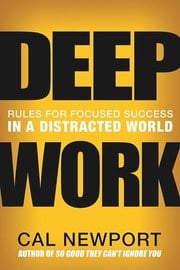
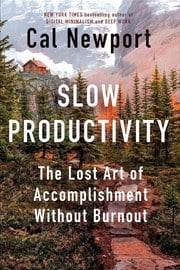
Books appear only when we can cite where Cal recommended them. Amazon links are affiliate links: LifeHack may earn a commission at no cost to you.
Set up once
Tools
Apps
-
 Scrivener Used for: writing his nonfiction books and articles 8 Visit site
Desk setup
-
 The Time-Block Planner Used for: his paper planner for time blocks, with a "shutdown complete" checkbox (he designed and sells it) 4 View on Amazon
Questions
What time does Cal Newport wake up?
He doesn't give an exact time. On school days the family is out the door at 7:30 to walk his kids to the bus, and his writing usually starts around 8:30 (2024).
What is Cal Newport's shutdown ritual?
At the end of the workday he processes loose notes, checks for urgent email, notes the next step on each project, then says "shutdown complete" and ticks a box in his planner. After that he does not think about work.
How many hours does Cal Newport work?
He stops by 5:30 p.m. and says he gets about 4 to 4.5 hours of real deep work a day. He keeps evenings and weekends unplanned.
Does Cal Newport use social media?
No. He says he stays off it partly because he does not trust himself with it (2024), and that without it his phone is not very interesting, so he often goes hours without checking it.
Sources
- How To Build A Morning Routine That Works · Cal Newport (YouTube), 2026
- The Optimal Morning Routine For 2025 · Deep Questions with Cal Newport (YouTube), 2025
- How I Manage My Time - The Weekly Productivity Template To Achieve More · Deep Questions with Cal Newport (YouTube), 2024
- How to Enhance Focus and Improve Productivity | Dr. Cal Newport · Huberman Lab (YouTube), 2024
- Productivity Expert: What's WRONG w/ Modern Work (+ How To Fix It) · Rich Roll Podcast (YouTube), 2024
- Stop Phone Scrolling Before Bed & Do This Instead · Deep Questions with Cal Newport (YouTube), 2024
- Cal Newport's Planning System (In Detail) · Cal Newport (YouTube), 2022
- The Secrets To Cal Newport's Article Writing System | Weekly Update #6 · Cal Newport (YouTube), 2022
- How Do I Eliminate Post-Shutdown Anxiety · Deep Questions with Cal Newport (YouTube), 2022
Based on what Cal Newport has shared publicly. LifeHack is not affiliated with Cal Newport. Cal Newport sells the books on this page and the Time-Block Planner, which has the "shutdown complete" checkbox he mentions, and hosts the Deep Questions podcast, where most of these sources come from. His schedule changes with the academic calendar: teaching semesters are busier and summers are mostly writing, so each step says which year its source is from. Images: Photo by Cal Newport (Video still). Spot a mistake? Tell us and we'll fix it.
Coming soon to the LifeHack app
Run Cal's routine for 30 days
A daily checklist set to your wake time, streaks, and a Day 30 card showing what stuck. Join the waitlist and we'll email you the day it opens.