
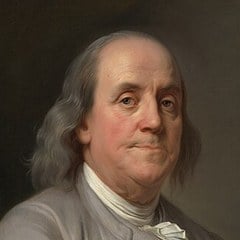
The daily routine of
Benjamin Franklin's Daily Routine
Benjamin Franklin (1706-1790) was a Philadelphia printer, writer, scientist and statesman who described his self-improvement system in his Autobiography.
Repeats daily or weekly
Routine
Morning
Compare morning routines-
Rise at 5, wash, and say a short prayer
5:00 a.m.His written schedule opens at five o'clock: get up, wash, and say the short prayer he wrote himself, which begins "Powerful Goodness" and asks for the wisdom to see his true interest and the resolve to act on it. 2
"O powerful Goodness! bountiful Father! merciful Guide! Increase in me that wisdom which discovers my truest interest."
-
Sit in a cool room for an "air bath"
On rising (1768 habit) OptionalBy 1768, living in London, Franklin wrote that he got up early almost every morning and sat in his room unclothed for half an hour to an hour, depending on the season, reading or writing. He found cold-water baths too harsh and preferred cold air, and sometimes went back to bed for an hour or two afterwards. 3
"I rise early almost every morning, and sit in my chamber, without any clothes whatever, half an hour or an hour"
-
Ask "What good shall I do this day?" and plan
6:00 a.m.The morning section of his table carries a question to answer before starting. Next to it he wrote that this hour is for laying out the day's business and choosing the one resolution he means to keep that day. 2
"What good shall I do this day?"
-
Study, then have breakfast
7:00 a.m.Before work begins at eight, the table gives time to push forward whatever he was currently studying, and to eat breakfast. Elsewhere in Part Two he says he set aside an hour or two every day for study, and that reading was the only amusement he allowed himself. 2
"for which I set apart an hour or two each day"
Day
-
Work from 8 to noon
8:00 a.m. - 12:00The table blocks out four straight hours for work. At the time his work was his printing house in Philadelphia. 2
-
Read or check your accounts, then eat
12:00 - 2:00 p.m.At noon his plan was to read, or look over his accounts, and have his main meal (he says "dine"). Two hours are set aside for this. 2
-
Keep the midday meal light and read while others eat
Midday (habit from about age 16) OptionalAs a teenage apprentice in Boston, after reading a book by Thomas Tryon, he ate a simple meatless meal, often just a biscuit or bread, raisins and a glass of water, so he could stay alone in the printing house and study while the others were out. He later went back to eating meat. 1
-
Work from 2 to 6
2:00 - 6:00 p.m.A second four-hour work block, giving eight working hours in his plan. 2
-
Exercise until you are warm (1772 note)
Any time (1772 letter) OptionalIn a 1772 letter to his son he said exercise should be judged by how warm it makes you, not by time or distance. He recommended brisk walking and climbing stairs indoors when short of time, and said that with a dumb-bell he had raised his pulse from 60 to 100 in forty swings. 4
"by the use of it I have in forty swings quickened my pulse from 60 to 100 beats in a minute"
Uses Dumb-bell
Evening
-
Put things back in their places
6:00 p.m.The evening opens with tidying up, which belongs to the virtue he called Order. This is the one he admits he failed at: he says keeping places for papers and things was extremely hard for him, he relapsed often, and in old age he still felt the lack of it. 2
"In truth, I found myself incorrigible with respect to Order"
-
Supper, then music, diversion or conversation
6:30 - 9:00 p.m.After tidying, the plan gives the evening to supper and to music, some other diversion, or conversation with others. 2
-
Ask "What good have I done to-day?" and review
9:00 p.m.The day closes with an examination. He answered the evening question and went through his virtue book, putting a small black dot against each virtue he had slipped on that day. He says he was surprised how many faults he found, but pleased to watch them decrease. 2
"What good have I done to-day?"
Uses Virtue tracking book -
Sleep from 10 to 5
10:00 p.m.The schedule marks every hour from ten at night to four in the morning as sleep, about seven hours before the five o'clock start. 2
Weekly
-
Focus on one of 13 virtues each week
Each week, in orderHe listed 13 virtues, each with a one-line rule, and gave one week of strict attention to each in turn, starting with Temperance, while still logging the rest. That made a full cycle every 13 weeks, four a year. Over time he did fewer cycles and finally stopped, but he says he always carried the book. 2
"I determined to give a week's strict attention to each of the virtues successively."
Uses Virtue tracking book -
Keep Sunday as a study day
Sundays OptionalAs a young man he did his reading and writing practice at night, early in the morning, and on Sundays alone in the printing house. Looking back he called Sunday his studying day and said he skipped church services to keep it. 2
-
Meet a self-improvement club on Friday evenings
Friday evenings OptionalHe formed a club of friends called the Junto that met on Friday evenings. Each member brought questions on morals, politics or science for the group to discuss, and every three months read an essay of his own. Arguing to win and flat contradiction were banned, with small fines. 1
What Benjamin recommends
Reading List
-
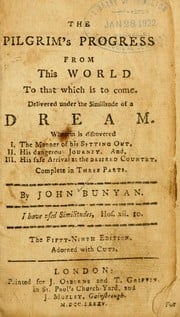
The Pilgrim's Progress
John Bunyan
He was so taken with it as a boy that Bunyan's works were the first books he collected, and he later called Bunyan his old favourite author. 1
View on Amazon -
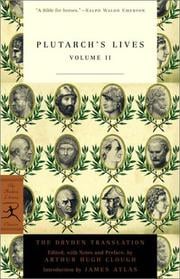
Plutarch's Lives
Plutarch
He read it heavily in his father's small library as a boy and still thought that time well spent decades later. 1
View on Amazon -
An Essay on Projects
Daniel Defoe
One of two books he credited with shaping a way of thinking that influenced some of the main events of his life. 1
View on Amazon -
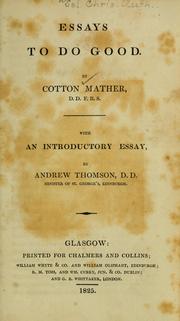
Essays to Do Good
Cotton Mather
The other book he named alongside Defoe as giving him a turn of thinking that shaped his later life. 1
View on Amazon -
The Spectator
Joseph Addison and Richard Steele
He taught himself to write by noting the ideas in its essays, rewriting them from memory days later, and comparing his version with the original. 1
View on Amazon -
Memorable Things of Socrates
Xenophon
It taught him the Socratic method of asking questions instead of contradicting people, which he adopted in place of blunt argument. 1
View on Amazon

Books appear only when we can cite where Benjamin recommended them. Amazon links are affiliate links: LifeHack may earn a commission at no cost to you.
Set up once
Tools
Used in the routine
- Virtue tracking book Used for: A small book with one page per virtue, ruled in red ink into seven day columns and 13 virtue rows, where he marked each fault with a black dot. He later moved it to ivory leaves he could mark in pencil and wipe clean with a wet sponge. 2
Gear
-
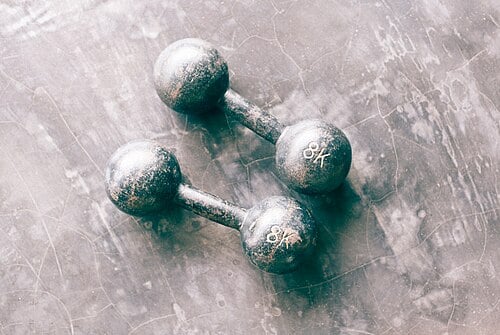 Dumb-bell Used for: a short burst of indoor exercise that quickly raised his pulse 4
Questions
What time did Benjamin Franklin wake up?
His written schedule starts at 5 a.m. with rising, washing and a short prayer, and marks 10 p.m. to 4 a.m. as sleep.
What were Benjamin Franklin's morning and evening questions?
In the morning he asked "What good shall I do this day?" and in the evening "What good have I done to-day?", followed by a review of his virtue book.
Did Franklin actually follow his schedule?
Only partly. He says the virtue of Order gave him the most trouble, that a fixed timetable was not practical once he was a master printer who had to see people at their hours, and that he called himself incorrigible on it.
How did Franklin track his 13 virtues?
He kept a small book with a page per virtue, gave one virtue a week of strict attention, and each evening marked a black dot for every slip, cycling through all 13 in 13 weeks.
What was Franklin's air bath?
In a 1768 letter he described getting up early and sitting unclothed in his room for half an hour to an hour, reading or writing, which he preferred to a cold-water bath.
Sources
- Autobiography of Benjamin Franklin, Part One (written at Twyford, 1771) · Project Gutenberg, ed. Frank Woodworth Pine, 1771
- Autobiography of Benjamin Franklin, Part Two (written at Passy, 1784) · Project Gutenberg, ed. Frank Woodworth Pine, 1784
- Benjamin Franklin to Jacques Barbeu-Dubourg, 28 July 1768 · Founders Online, National Archives, 1768
- Benjamin Franklin to William Franklin, 19 August 1772: extract · Founders Online, National Archives, 1772
Based on what Benjamin Franklin has shared publicly. LifeHack is not affiliated with Benjamin Franklin. The hourly schedule is the plan Franklin wrote down as a young printer in the 1730s, recalled by him in 1784. He says himself that he could not keep it exactly once he was running a business. The air bath and dumb-bell steps come from later letters (1768 and 1772) and describe his own habits, not medical advice. Not medical advice: check with your doctor before trying cold exposure, fasting, supplements or other health-related steps. Images: Photo by Joseph-Siffred Duplessis, about 1785, National Portrait Gallery (Public domain); Dumb-bell by Cyril Saulnier c_reel (CC0). Spot a mistake? Tell us and we'll fix it.
Coming soon to the LifeHack app
Run Benjamin's routine for 30 days
A daily checklist set to your wake time, streaks, and a Day 30 card showing what stuck. Join the waitlist and we'll email you the day it opens.