
Have you ever wondered why some people remain calm in the face of adversity, while others crumble? People who are able to effectively navigate the highs and lows of life have what psychologists call resilience, or an ability to effectively bounce back from adversity.
Whenever you come across a difficult situation, you have two choices: you can either let your emotions get the best of you and become paralyzed by fear, or you can uplift yourself from the negative and transform pain into possibility.
Even if you consider yourself to be a happy person, it is inevitable that you will encounter challenges at some point along your journey. These experiences may bend you, but they do not have to break you.
Building resilience is the key to turning challenges into successes.
All of us have the power to develop a resilient mindset; just like a muscle, it needs to be conditioned and strengthened every single day. Sometimes it takes hitting your emotional threshold before you are able to tap into your personal resilience.
But what is resilience truly? And why is it so important for our success?
Whenever you come across a difficult situation, you have two choices: you can either let your emotions get the best of you and become paralyzed by fear, or you can uplift yourself from the negative and transform pain into possibility.
Even if you consider yourself to be a happy person, it is inevitable that you will encounter challenges at some point along your journey. These experiences may bend you, but they do not have to break you.
Building resilience is the key to turning challenges into successes.
All of us have the power to develop a resilient mindset; just like a muscle, it needs to be conditioned and strengthened every single day. Sometimes it takes hitting your emotional threshold before you are able to tap into your personal resilience.
But what is resilience truly? And why is it so important for our success?
What Is Resilience?
The construct of resilience has its roots in the field of developmental psychopathology during the 1970s. In the course of studying children with psychiatric disorders, psychiatrists and psychologists noted that a small number of children did not display the expected maladaptive behaviors.Instead, they displayed behaviors that were within the normal range of social development.[1]
However, it was the studies of children of schizophrenic parents and the findings that some children thrived despite their high-risk status that led to the expansion of research on resilience. These included multiple adverse conditions, including socioeconomic disadvantage, parental mental illness, maltreatment, illness, and catastrophic life events.
During the late 1980s and 1990s, research on resilience revealed it to be a much more ordinary phenomenon than it was first thought to be. The construct of resilience evolved to presume exposure to significant adversity.
What is resilience by definition is what is mentioned above: people's ability to keep a level head in the face of adversity. Even to extreme problems like the ones researchers studied, people with strong resilience would be able to handle them.
Multiple Definitions of Resilience
Even though there is the definition above, what does resilience mean on a scientific level is a mixed bag. For a while, it was confined to a set of stable individual traits. However, researchers didn't fully agree with it. In the last decade, the concept of resilience has shifted.It changed to an outcome and dynamic process, dependent upon interactions between individual and contextual variables, evolving over time.[2]
Today, resilience is commonly referred to as the process of adapting well in the face of adversity, trauma, tragedy, threats or significant sources of stress.[3] This definition captures the "bounce-back" characteristic, which reflects one of the central characteristics of resilience.
The Importance of Resilience
Ever-increasing demands on time and energy have created an environment where people feel overwhelmed and unable to manage the high expectations of their daily lives through problem-solving skills or coping strategies.As a result, people find themselves constantly multitasking, chronically distracted, and pulled in too many different directions. If you want to stay at the top of your game in life and in work, it is imperative that you learn how to successfully navigate your way through the tough times.
In a study sponsored by Nationwide and Vodafone, nearly 100 percent of participants cited resilience as a factor in job success.[4] Numbers don't lie. Why resilience is important is proven from this study: it results in success.
Beyond that study, there are four other reasons resilience is an important life skill.
1. Transform Failure Into Success
In my experience, the road to success is paved with a lot of failure. It's a normal part of life. You cannot build resilience unless you are willing to fail.Those who lack the ability to bounce back from adversity end up internalizing failure and inevitably giving up altogether. If you can relate to this way of thinking, it's important to understand that failure is an event. It does not define who you are as a person.
Research shows that when you try, fail, try again, and ultimately succeed, you get a nice kick from your dopaminergic reward system.[5] This is what gives you the momentum that you need when adversity hits you like a ton of bricks.
Failure is merely a stepping stone that everyone goes through on their path to greatness. You've got to ask yourself if you are willing to take bold risks in order to become the person you've always desired to be.
2. Develop an Internal Locus of Control
Do you believe that life happens for you or to you? In order for you to improve your happiness in any area of your life, you have to ask yourself the difficult question: "Who is responsible for my happiness?"Your answer to this question will determine how effectively you are able to overcome challenges in life.
People who adopt an external locus of control struggle to bounce back from life's blows. They believe that external forces determine the direction that their lives will take. Not surprisingly, this belief leaves them feeling powerless.
Conversely, resilient people with an internal locus of control see themselves as the CEO of their lives. They know that they are in control of every single decision that they make.
When they get knocked down, they are able to bounce forward, meaning that they are able to use life's greatest adversities as springboards for success. When you do this, you become the driver of your destiny, and resilience becomes your natural state of being.
3. Build Positive Beliefs
What does resilience mean to you? Asking that question says a lot about what you believe in. When your world comes crashing down on you, it’s easy to fall into negativity mode and play the "why me" game. However, you cannot overcome challenges in life if you think that the Universe isn't on your side. Negativity will get you nowhere in life.Research shows that one major factor that contributes to resilience is the experience of harnessing positive emotions, even in the midst of an especially trying or stressful time.
A resilient person works through challenges by harnessing the power of positive emotions and leaning on their support system when necessary. They are able to reframe adversity into something positive, which allows them to bounce back and create realistic plans in the long term.
4. Helps You Embrace Change
At the heart of resilience lies a simple truth—change is inevitable. The reality is that we live in a world of constant change. In fact, uncertainty is the only certainty that we can count on.People get into trouble when they ignore or resist change. As a result, they end up living a life of pain and suffering because they are unable to find comfort in the chaos.
You will not build resilience by hanging out in your comfort zone[6]. The only way to truly grow and expand yourself is to break free from the chains of stability and dive into the unknown.
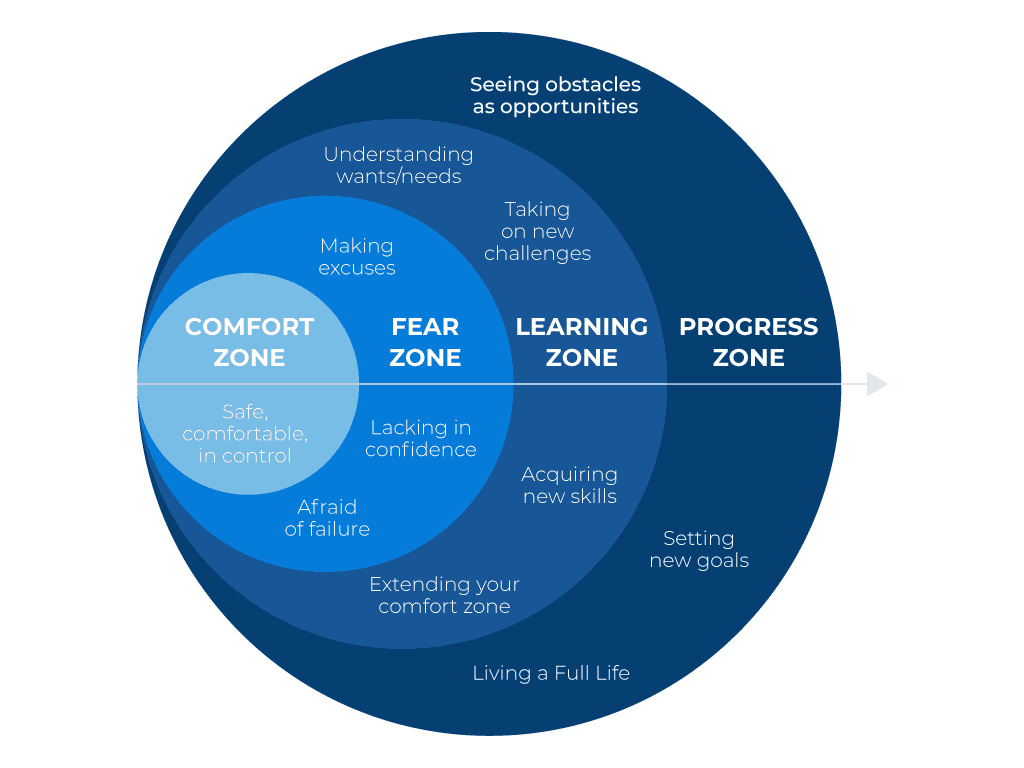 This will require that you do some deep inner work, like shifting your limiting beliefs, breaking bad habits, and learning how to make friends with stress.
Let's face it... nobody is excited to face their "stuff," but it's an integral step on the road to becoming a resilient person.
“The secret of change is to focus all of your energy, not on fighting the old, but on building the new.” - Socrates
Final Thoughts
The next time that life throws you a curveball, trust that you are strong enough to stay in the game. Adversity may bend you, but don’t let it break you.It doesn’t matter how many times you fall. All that matters is that you get back up again and keep moving forward.