
It is easy, in the onrush of life, to become a reactor – to respond to everything that comes up, the moment it comes up, and give it your undivided attention until the next thing comes up.
This is, of course, a recipe for madness. The feeling of loss of control over what you do and when is enough to drive you over the edge, and if that doesn’t get you, the wreckage of unfinished projects you leave in your wake will surely catch up with you.
Having an inbox and processing it in a systematic way can help you gain back some of that control. But once you’ve processed out your inbox and listed all the tasks you need to get cracking on, you still have to figure out what to do the very next instant. On which of those tasks will your time best be spent, and which ones can wait?
When we don’t set priorities, we tend to follow the path of least resistance. (And following the path of least resistance, as the late, great Utah Phillips reminded us, is what makes the river crooked!) That is, we’ll pick and sort through the things we need to do and work on the easiest ones – leaving the more difficult and less fun tasks for a “later” that, in many cases, never comes – or, worse, comes just before the action needs to be finished, throwing us into a whirlwind of activity, stress, and regret.
This is why setting priorities is so important.
Popularized in Brian Tracy’s book Eat That Frog!, the idea here is that you tackle the biggest, hardest, and least appealing task first thing every day, so you can move through the rest of the day knowing that the worst has already passed.
When you’ve got a fat old frog on your plate, you’ve really got to knuckle down. Another old saying says that when you’ve got to eat a frog, don’t spend too much time looking at it! It pays to keep this in mind if you’re the kind of person that procrastinates by “planning your attack” and “psyching yourself up” for half the day. Just open wide and chomp that frog, buddy! Otherwise, you’ll almost surely talk yourself out of doing anything at all.
You need the wisdom of the pickle jar. Take a pickle jar and fill it up with sand. Now try to put a handful of rocks in there. You can’t, right? There’s no room.
If it’s important to put the rocks in the jar, you’ve got to put the rocks in first. Fill the jar with rocks, now try pouring in some pebbles. See how they roll in and fill up the available space? Now throw in a couple handfuls of gravel. Again, it slides right into the cracks. Finally, pour in some sand.
For the metaphorically impaired, the pickle jar is all the time you have in a day. You can fill it up with meaningless little busy-work tasks, leaving no room for the big stuff, or you can do the big stuff first, then the smaller stuff, and finally fill in the spare moments with the useless stuff.
To put it into practice, sit down tonight before you go to bed and write down the three most important tasks you have to get done tomorrow. Don’t try to fit everything you need, or think you need, to do, just the three most important ones.
In the morning, take out your list and attack the first “Big Rock”. Work on it until it’s done or you can’t make any further progress. Then move on to the second, and then the third. Once you’ve finished them all, you can start in with the little stuff, knowing you’ve made good progress on all the big stuff. And if you don’t get to the little stuff? You’ll have the satisfaction of knowing that you accomplished three big things. At the end of the day, nobody’s ever wished they’d spent more time arranging their pencil drawer instead of writing their novel, or printing mailing labels instead of landing a big client.
Covey suggests you divide a piece of paper into four sections, drawing a line across and a line from top to bottom. Into each of those quadrants, you put your tasks according to whether they are: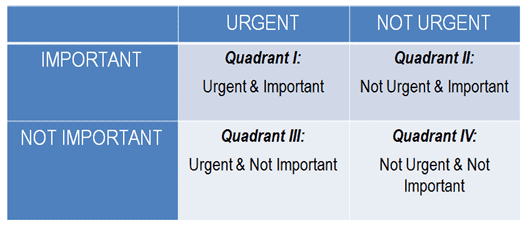
The quadrant III and IV stuff is where we get bogged down in the trivial: phone calls, interruptions, meetings (QIII) and busy work, shooting the breeze, and other time wasters (QIV). Although some of this stuff might have some social value, if it interferes with your ability to do the things that are important to you, they need to go.
Quadrant I and II are the tasks that are important to us. QI are crises, impending deadlines, and other work that needs to be done right now or terrible things will happen. If you’re really on top of your time management, you can minimize Q1 tasks, but you can never eliminate them – a car accident, someone getting ill, a natural disaster, these things all demand immediate action and are rarely planned for.
You’d like to spend as much time as possible in Quadrant II, plugging away at tasks that are important with plenty of time to really get into them and do the best possible job. This is the stuff that the QIII and QIV stuff takes time away from, so after you’ve plotted out your tasks on the Covey quadrant grid, according to your own sense of what’s important and what isn’t, work as much as possible on items in Quadrant II (and Quadrant I tasks when they arise).
In the end, setting priorities is an exercise in self-knowledge. You need to know what tasks you’ll treat as a pleasure and which ones like torture, what tasks lead to your objectives and which ones lead you astray or, at best, have you spinning your wheels and going nowhere.
These three are the best-known and most time-tested strategies out there, but maybe you’ve got a different idea you’d like to share? Tell us how you set your priorities in the comments.
This is, of course, a recipe for madness. The feeling of loss of control over what you do and when is enough to drive you over the edge, and if that doesn’t get you, the wreckage of unfinished projects you leave in your wake will surely catch up with you.
Having an inbox and processing it in a systematic way can help you gain back some of that control. But once you’ve processed out your inbox and listed all the tasks you need to get cracking on, you still have to figure out what to do the very next instant. On which of those tasks will your time best be spent, and which ones can wait?
When we don’t set priorities, we tend to follow the path of least resistance. (And following the path of least resistance, as the late, great Utah Phillips reminded us, is what makes the river crooked!) That is, we’ll pick and sort through the things we need to do and work on the easiest ones – leaving the more difficult and less fun tasks for a “later” that, in many cases, never comes – or, worse, comes just before the action needs to be finished, throwing us into a whirlwind of activity, stress, and regret.
This is why setting priorities is so important.
3 Effective Approaches to Set Priorities
There are three basic approaches to setting priorities, each of which probably suits different kinds of personalities. The first is for procrastinators, people who put off unpleasant tasks. The second is for people who thrive on accomplishment, who need a stream of small victories to get through the day. And the third is for the more analytic types, who need to know that they’re working on the objectively most important thing possible at this moment. In order, then, they are:1. Eat a Frog
There’s an old saying to the effect that if you wake up in the morning and eat a live frog, you can go through the day knowing that the worst thing that can possibly happen to you that day has already passed. In other words, the day can only get better!Popularized in Brian Tracy’s book Eat That Frog!, the idea here is that you tackle the biggest, hardest, and least appealing task first thing every day, so you can move through the rest of the day knowing that the worst has already passed.
When you’ve got a fat old frog on your plate, you’ve really got to knuckle down. Another old saying says that when you’ve got to eat a frog, don’t spend too much time looking at it! It pays to keep this in mind if you’re the kind of person that procrastinates by “planning your attack” and “psyching yourself up” for half the day. Just open wide and chomp that frog, buddy! Otherwise, you’ll almost surely talk yourself out of doing anything at all.
2. Move Big Rocks
Maybe you’re not a procrastinator so much as a fiddler, someone who fills her or his time fussing over little tasks. You’re busy busy busy all the time, but somehow, nothing important ever seems to get done.You need the wisdom of the pickle jar. Take a pickle jar and fill it up with sand. Now try to put a handful of rocks in there. You can’t, right? There’s no room.
If it’s important to put the rocks in the jar, you’ve got to put the rocks in first. Fill the jar with rocks, now try pouring in some pebbles. See how they roll in and fill up the available space? Now throw in a couple handfuls of gravel. Again, it slides right into the cracks. Finally, pour in some sand.
For the metaphorically impaired, the pickle jar is all the time you have in a day. You can fill it up with meaningless little busy-work tasks, leaving no room for the big stuff, or you can do the big stuff first, then the smaller stuff, and finally fill in the spare moments with the useless stuff.
To put it into practice, sit down tonight before you go to bed and write down the three most important tasks you have to get done tomorrow. Don’t try to fit everything you need, or think you need, to do, just the three most important ones.
In the morning, take out your list and attack the first “Big Rock”. Work on it until it’s done or you can’t make any further progress. Then move on to the second, and then the third. Once you’ve finished them all, you can start in with the little stuff, knowing you’ve made good progress on all the big stuff. And if you don’t get to the little stuff? You’ll have the satisfaction of knowing that you accomplished three big things. At the end of the day, nobody’s ever wished they’d spent more time arranging their pencil drawer instead of writing their novel, or printing mailing labels instead of landing a big client.
3. Covey Quadrants
If you just can’t relax unless you absolutely know you’re working on the most important thing you could be working on at every instant, Stephen Covey’s quadrant system as written in The 7 Habits of Highly Effective People: Powerful Lessons in Personal Change might be for you.Covey suggests you divide a piece of paper into four sections, drawing a line across and a line from top to bottom. Into each of those quadrants, you put your tasks according to whether they are:
- Important and Urgent
- Important and Not Urgent
- Not Important but Urgent
- Not Important and Not Urgent
The quadrant III and IV stuff is where we get bogged down in the trivial: phone calls, interruptions, meetings (QIII) and busy work, shooting the breeze, and other time wasters (QIV). Although some of this stuff might have some social value, if it interferes with your ability to do the things that are important to you, they need to go.
Quadrant I and II are the tasks that are important to us. QI are crises, impending deadlines, and other work that needs to be done right now or terrible things will happen. If you’re really on top of your time management, you can minimize Q1 tasks, but you can never eliminate them – a car accident, someone getting ill, a natural disaster, these things all demand immediate action and are rarely planned for.
You’d like to spend as much time as possible in Quadrant II, plugging away at tasks that are important with plenty of time to really get into them and do the best possible job. This is the stuff that the QIII and QIV stuff takes time away from, so after you’ve plotted out your tasks on the Covey quadrant grid, according to your own sense of what’s important and what isn’t, work as much as possible on items in Quadrant II (and Quadrant I tasks when they arise).
Getting to Know You
Spend some time trying each of these approaches on for size. It’s hard to say what might work best for any given person – what fits one like a glove will be too binding and restrictive for another, and too loose and unstructured for a third. You’ll find you also need to spend some time figuring out what makes something important to you – what goals are your actions intended to move you towards.In the end, setting priorities is an exercise in self-knowledge. You need to know what tasks you’ll treat as a pleasure and which ones like torture, what tasks lead to your objectives and which ones lead you astray or, at best, have you spinning your wheels and going nowhere.
These three are the best-known and most time-tested strategies out there, but maybe you’ve got a different idea you’d like to share? Tell us how you set your priorities in the comments.