
“Much of our activity these days is nothing more than a cheap anesthetic to deaden the pain of an empty life.” - Unknown
“The things you own end up owning you.” - Tyler Durden in Fight Club
Beyond a minimum threshold of poverty, money doesn’t buy happiness. Wealth may seem like a solution to your problems, but often it simply replaces the ones it solves. As paychecks increase, lifestyles usually match those increases. This results in the same financial worries and budgeting problems, just with more stuff.
A preoccupation with owning things is a poor attempt to fill a vacuum. Occasionally stuff can fill that vacuum. Buying that new computer or fancy car might temporarily shrink the hole. But quickly you adapt to the new upgrades and the hole grows, enslaving you to earn higher and higher paychecks with no way out.
The Problem Isn’t Out There
Stuff isn’t really the problem. I’m not a monk living in a temple, forsaking all consumer goods and taking a vow of poverty. I work to earn money and I have a fair number of possessions. Not owning things is not better than owning things, since they simply different manifestations of the same crisis.
That crisis is the dualistic reasoning that says you can own stuff. My car, my clothes, my girlfriend, my husband, my friends, my anything. By knifing the world into what you have and what you do not, you commit a fatal error in understanding.
Ownership is an invention. It’s something that doesn’t exist in nature, but a societal construct. In some ways it is a very useful construct. It allows groups to function and interact with each other. The error happens when you focus on this myth so much that it becomes real, and you can’t see any alternative.
The Lonely Man and the Myth of Ownership
Pretend you were the only person on earth. You were born from unknown origins and have always lived alone. Let’s say that you are also completely self-sufficient and can survive complete isolation.
Now tell me, what would you own?
You wouldn’t be able to answer that because the concept doesn’t make sense to you. Without other people to compare, trade, boast and compete with ownership is an illusion. There is no stuff that is yours and not yours, just the world.
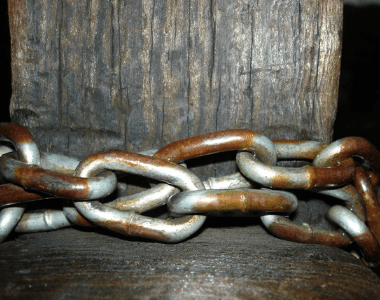
This is why forsaking all goods doesn’t free you from the tight chains of consumerism. You are falling for the myth of ownership and fighting against it. But the person truly free of this grasp will realize you can’t fight something that doesn’texist. Canceling the dualistic reasoning of mine and not mine, is the first step.
Replacing Consumerism
You can’t simply deny ownership. There is a mental space that the concept of ownership fills in the human mind. This is a space that can’t contain a vacuum. You can’t simply remove the consumerism and expect that something good will automatically fill its place.
Some people, in the fight against our preoccupation with stuff, say that this void should be filled with spirituality, people or principles. This is where I disagree. All of those things are great, but they are specific answers for a general problem.
An equivalent piece of advice might be to tell a man to play the violin after retirement when he has more free time. The advice may work, but it is too specific to be meaningful for everyone. The man might not like the violin, or may not want to play it all the time. Better advice would be a general recipe such as finding a hobby.
Constructing the Inner World of the Mind
The general solution to the consumerism abyss is building a stable inner world. Spirituality, relationships, philosophy, learning, ethics are all facets of this bigger idea. This inner world isn’t entirely detached from the material one, instead it’s a new lens for viewing what happens in it.
A person with a solid inner world won’t obsess over buying things or forsake the objects she owns. Instead she can view it as a person playing a game would look at the tokens on the board. Seeing past the ownership illusion, she can put all her effort into experiencing the game.
How do you build this inner world? Throughout time people have come up with many different answers to this question. I think that the answer is so difficult to arrive upon not because it is too hard or complicated. But because of it’s simplicity and intangibility, it is tricky to communicate.
Simply I believe the answer is learning. Not just the sub-branch of activities that has to do with education, but actually improving your understanding. This comes from a combination of experience, education and thought.
Experience builds this mental world most directly by showing you reality upfront and unaltered. Education constructs the inner world by expanding the capacity of your thoughts. Finally, thinking sculpts the basic forms presented in experience and education.
This sculpted internal world is difficult to describe. Many great philosophical thinkers have touched upon it but only from a passing glance rather than direct contact. I don’t believe I’ve managed to describe it directly either, but the idea remains the same. The way to break the bonds of consumerism and see past the mirage of ownership is in building a mind capable of doing this.