
How to Avoid Being Enslaved by Consumerism
“It is preoccupation with possessions, more than anything else, that prevents us from living freely and nobly.” - Henry David Thoreau
“Much of our activity these days is nothing more than a cheap anesthetic to deaden the pain of an empty life.” – Unknown
“The things you own end up owning you.” - Tyler Durden in Fight Club
Beyond a minimum threshold of poverty, money doesn’t buy happiness. Wealth may seem like a solution to your problems, but often it simply replaces the ones it solves. As paychecks increase, lifestyles usually match those increases. This results in the same financial worries and budgeting problems, just with more stuff.
A preoccupation with owning things is a poor attempt to fill a vacuum. Occasionally stuff can fill that vacuum. Buying that new computer or fancy car might temporarily shrink the hole. But quickly you adapt to the new upgrades and the hole grows, enslaving you to earn higher and higher paychecks with no way out.
The Problem Isn’t Out There
Stuff isn’t really the problem. I’m not a monk living in a temple, forsaking all consumer goods and taking a vow of poverty. I work to earn money and I have a fair number of possessions. Not owning things is not better than owning things, since they simply different manifestations of the same crisis.
That crisis is the dualistic reasoning that says you can own stuff. My car, my clothes, my girlfriend, my husband, my friends, my anything. By knifing the world into what you have and what you do not, you commit a fatal error in understanding.
Ownership is an invention. It’s something that doesn’t exist in nature, but a societal construct. In some ways it is a very useful construct. It allows groups to function and interact with each other. The error happens when you focus on this myth so much that it becomes real, and you can’t see any alternative.
The Lonely Man and the Myth of Ownership
Pretend you were the only person on earth. You were born from unknown origins and have always lived alone. Let’s say that you are also completely self-sufficient and can survive complete isolation.
Now tell me, what would you own?
You wouldn’t be able to answer that because the concept doesn’t make sense to you. Without other people to compare, trade, boast and compete with ownership is an illusion. There is no stuff that is yours and not yours, just the world.
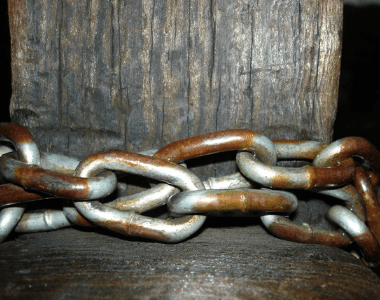
This is why forsaking all goods doesn’t free you from the tight chains of consumerism. You are falling for the myth of ownership and fighting against it. But the person truly free of this grasp will realize you can’t fight something that doesn’texist. Canceling the dualistic reasoning of mine and not mine, is the first step.
Replacing Consumerism
You can’t simply deny ownership. There is a mental space that the concept of ownership fills in the human mind. This is a space that can’t contain a vacuum. You can’t simply remove the consumerism and expect that something good will automatically fill its place.
Some people, in the fight against our preoccupation with stuff, say that this void should be filled with spirituality, people or principles. This is where I disagree. All of those things are great, but they are specific answers for a general problem.
An equivalent piece of advice might be to tell a man to play the violin after retirement when he has more free time. The advice may work, but it is too specific to be meaningful for everyone. The man might not like the violin, or may not want to play it all the time. Better advice would be a general recipe such as finding a hobby.
Constructing the Inner World of the Mind
The general solution to the consumerism abyss is building a stable inner world. Spirituality, relationships, philosophy, learning, ethics are all facets of this bigger idea. This inner world isn’t entirely detached from the material one, instead it’s a new lens for viewing what happens in it.
A person with a solid inner world won’t obsess over buying things or forsake the objects she owns. Instead she can view it as a person playing a game would look at the tokens on the board. Seeing past the ownership illusion, she can put all her effort into experiencing the game.
How do you build this inner world? Throughout time people have come up with many different answers to this question. I think that the answer is so difficult to arrive upon not because it is too hard or complicated. But because of it’s simplicity and intangibility, it is tricky to communicate.
Simply I believe the answer is learning. Not just the sub-branch of activities that has to do with education, but actually improving your understanding. This comes from a combination of experience, education and thought.
Experience builds this mental world most directly by showing you reality upfront and unaltered. Education constructs the inner world by expanding the capacity of your thoughts. Finally, thinking sculpts the basic forms presented in experience and education.
This sculpted internal world is difficult to describe. Many great philosophical thinkers have touched upon it but only from a passing glance rather than direct contact. I don’t believe I’ve managed to describe it directly either, but the idea remains the same. The way to break the bonds of consumerism and see past the mirage of ownership is in building a mind capable of doing this.


Comments
Matt Emery says on September 20th, 2007 at 11:23 am
Thanks Scott, for an excellent article.
I have come to similar conclusions, and I believe that “Constructing the Inner World of the Mind” is deeply connected with getting in touch with nature, and more precisely; “being true to your biology”.
I’ve learnt that self-actualisation requires mother nature. I’ve noticed many times whilst hiking a sense of calm or “contentment”. I believe this happens because our bodies “understand” at a very deep level that it is in it’s natural eco-system, the very thing it is made for.
Conversely, busy cities and unnatural environments tend to make me feel a little anxious (although it’s hard to detect). And I find that ownership (consumerism) carries a subtle undercurrent of fear i.e. I must protect this, or I will lose it etc.
It gets a bit complicated at this point. I think “being true to our biology” answers a lot of questions though, and provides a direction for self actualisation to occur.
There’s much more on my website; http://www.cavemanpower.com
Thanks again for an insightful (and somewhat cathartic) article. :)
Marc says on September 20th, 2007 at 11:36 am
The claim that property rights were instituted out of a need to compare oneself with other people will come as a surprise to most economists and political philosophers.
David says on September 20th, 2007 at 11:56 am
I think you overstate your case. If your motivation fo acquiring wealth and possessions is to fill a void, then yes, that obviously is a poor life strategy. But it does not lead to the conclusioin that your life must be ascetic, or to think in binary terms. It is not an either/or situation, in other words. You can have possessions and wealth and at the same time have a rich inner life.
Incidentally, I disagree that taking up a hobby is a good way to replace a void. Who wants to look back at a life consumed building toy trains?
So what’s the solution? Become engaged in everything you do, especially work. Get into a flow at work, so that time passes effortlessly. You will get possessions along the way, but just limit them to a certain percentage of your income and allocate the rest to necessities and savings. Pretty simple, really.
WILL says on September 20th, 2007 at 12:13 pm
Family, not things make life.
Things can be usefull but at any point they interfere with Family, then you have lost focus.
PS: Family isn’t necasarily biological, your friends for example are part of your family.
If you spend 60 hrs a week aquiring crap, you will be working to lose your family.
If you spend as little 30 hours a week housing and feeding your Family, then you got it about as good as it gets.
Seth says on September 20th, 2007 at 1:53 pm
In the end, possessions are just stuff. You can’t take it with you, but things can be extremely useful while we are here.
Do they make the “experience” better? Sometimes.
There is a certain amount of jealously that often surrounds an object of wealth, say, a super-expensive sportscar, for example.
When I’m with my girlfriend and she sees a man driving a sports car like that she usually says that the driver is making up for the fact that he is not very well endowed. While her tone is in jest, she honestly believes that there is a certain degree of honesty to her statement.
I agree with you in that possessions can’t replace what’s really missing. That’s why parents who are disengaged from their children can’t get closer to them by buying them the latest, greatest toy.
If you can make millions of dollars doing something that you do not entirely agree with ethically, there are not enough possessions in the world that will make you feel good. If your motivation for doing that work and doing it well is simply more possessions, that’s definitely a bad cycle in my opinion.
Do no harm. Do good where you can. The rest will work itself out along the way. And if along the way you can make tons of money, and go to sleep every night without feeling bad about what you do for a living, then more power to you!
Jeff Rice says on September 20th, 2007 at 3:28 pm
I recently quit my extremely stressful and uninteresting engineering procurement job to start my own company doing work I find really fun and interesting. I also now have enough free time to pursue interests like reading, writing, and (’rithmetic?) learning other languages. I’m hanging out at the library a lot, and generally having fun with my hobbies that don’t require any more investment. I don’t have as much money, but I don’t feel the need to spend it because I’m just way happier and more intellectually fulfilled. I’ve filled the void in a way money couldn’t.
Recruiting Animal says on September 20th, 2007 at 3:29 pm
“Ownership is an invention. It’s something that doesn’t exist in nature, but a societal construct.”
This is totally moronic. So is your dentist. And your doctor.
How many people do you know who are really extravagant? Most just want to pay for the modern basics. Give me some examples before you start preaching.
Seamus says on September 20th, 2007 at 4:23 pm
Great article, and I think that more people need to grasp this concept. For so long, as humans, we have struggled with what is mine, and we so often don’t look past ourselves to see that their are other people in this world that would use the things that we have a lot better.
You have a great blog, keep up the good work.
Michael says on September 20th, 2007 at 5:14 pm
Wonderful piece. I was discussing the idea of buying and making with my friends for months. We both believe in the intangible and enriching values the act of making provides. We also discussed how a friend of ours is a superficial, empty, and everything is just for show person. It is critical for him to dress nice, look nice, have the fastest computer, fastest car…etc. There is no internal grow because he can’t show that off. To avoid him from slipping in to this abyss, we were discussing some plans for an intervention. This great article helps. Thanks.
Shari says on September 20th, 2007 at 8:16 pm
One could argue that the concept of possession does exist in nature. Animals are territorial, will not share food sources with just any other animal (even of the same type) and have mates which other animals are not permitted to mate with (at least not without a fight). This is the same sort of possession as humans – my property, my wife/husband, my food.
The main problem is that civilization cannot function without notions of “mine” and “not mine” because resources are not infinite and access is not equal. People also tend to take as much as they can when it is offered freely rather than take only what they need so a boundary has to be drawn so that everyone has “enough”.If you don’t have a concept of ownership, greedy people will take everything. The native Americans learned this lesson well.
Notions of possession draw boundaries between people that promote social harmony and public peace. Without them, we cannot live in complex societies. If we all lived in small, tribal cultures with well-understood, unwritten but orally shared social rules, we may not need notions of possession but such ideas don’t work in the world we live in (nor would they have worked in the world we lived in hundreds or even a thousand years ago).
That is not to say that people shouldn’t be less obsessed with possessions and indulge in comparative materialistic thinking. I agree wholeheartedly with that notion but I don’t agree with the logic of this piece. Still, it was interesting and thought-provoking so well done!
June says on September 20th, 2007 at 8:23 pm
“Give me some examples before you start preaching.”
here:
“Pretend you were the only person on earth. You were born from unknown origins and have always lived alone. Let’s say that you are also completely self-sufficient and can survive complete isolation. Now tell me, what would you own?”
Try reading the article before replying
Personally, This makes a lot of sense. Money isn’t possession in itself. it’s only a tool of trust that circulates among people.
Who owns land? who owns the North Pole? As previously mentioned in the article, ownership is an invention.
Jim says on September 20th, 2007 at 9:12 pm
“Ownership is an invention. It’s something that doesn’t exist in nature, but a societal construct.”
To some extent I think thats not true. Animals do tend to claim territory, food, and even man made objects.
I would like to see anyone try to take my dogs favorite toy from him, without losing a hand. :)
Mike says on September 24th, 2007 at 4:39 pm
I like the point of view Shari has on this. I would build on this by adding the following:
We are like vessels. Where and how we spend our lives determines what fills the vessel. I will state up front that we are all individuals and the effect varies from person to person and subject matter to subject matter. Two different people will absorb any particular thing at different rates.
For some people, when they don’t take the time to fill or surround themselves with X (be it a hobby, family, a job they are not at ethical odds with, etc.) they are open to the bombardment of advertising we live with. This state of being is so prevalent now it is normal. Some people are OK living in this state of being while others feel the void. Most of us are somewhere in the middle but run the risk of looking back at our lives and being surprised at how we have spent it.
I find that it helps to make a list of my priorities and then periodically look at the choices I am making and how they help me (or hurt me) from meeting my priorities. Sometimes this has me change my list but more often it helps me make better choices. The closer I get, the more satisfaction I feel. Notice I didn’t say happiness or harmony. I have a friend who is a social worker and another who is a cop and both do those jobs because, for them, it is the right thing to do and gets them closest to their list. At the same time both experience disappointment and frustration with their careers but still wouldn’t have it any other way.
I know I went off on a tangent there but I hope it illustrates the concept. For the people looking to do an intervention – DON’T. That person may be where they want to be and for them it works. Just because their values are different from yours is no reason to impose yours on them (any more that it would be for them to do it to you). We are all on a journey and trying to find what will work for us. Be happy that you have found something you can take from here that will make your life a little better but accept that what works for you may be exactly the wrong thing for someone else.
Thanks for reading this.
Chuk Baldock says on October 12th, 2007 at 1:26 am
PROPERTY IS THEFT
Anti-Copyright 2005 Chuk Baldock
All Rites Reversed
Bertrand Russell once wrote that, “The fact that an opinion has been widely held is no evidence that it is not totally absurd; indeed in view of the silliness of the majority of mankind, a widespread belief is more often likely to be foolish than sensible.”
So, check this out: You can’t own a thing. It’s its own thing. It just is. And so are you.
These aren’t my pants. They’re just pants. They just happen to be covering my ass right now.
You see, I can own my own ass, but not the pants. Nobody else is going to take care of my ass… anymore. Thanks, Mom, but these used to be someone else’s pants. Somebody else used to take care of these pants and wash them, and fold them, and cover their ass with them. And when I am gone, I hope these pants will continue to cover cold booties for many generations to come.
So, these are not my pants. They’re just pants. They’re going to do what they’re going to do. They could get lost in a laundry mat somewhere and never see me again. How can I own something like that?
Your clothes do not define you. You are not what you own, because you can’t really own a thing; it’s its own thing.
This shirt will survive me. It will be here long after I am gone. A history student who grew up on the Moon will find this shirt in a 2nd-hand FreeBox in a hippy-dippy cafe’ somewhere on Mars and use it in their doctoral thesis to prove that people used to actually wear clothes when it wasn’t even cold outside.
Now, how can I own something like that?
OK, so maybe you’re saying, “But I like my stuff!” I know you love your stuff. I’ve got some pretty neat books and records in my collection of stuff that I keep behind a locked door too. Stuff is cool. More stuff, please! I like my radio. But it’s not my radio. It’s just a radio. You can’t own a radio. It’s its own radio. It does not define who you are. You’re you. It’s a radio.
Of course, it would be cool if nobody breaks the window and moves the radio to a place I can’t hear it anymore, but what am I going to do if that happens? Cry about it? Get angry? Ask some guys who ride around in shiny shiny pimpmobiles, wear silly haircuts and carry guns to chase down the radio-mover and lock him up in a cage, and all that, simply because he was hungry enough, or strung out far enough, to take my radio?
It’s not even my radio. It’s a radio. It just is. I am not my radio. My radio does not define me. I am what I am and that’s all I am.
Why not drop the charade and throw a parade? How about that? Why not feed the poor radio-mover, treat his situation with compassion rather than derision, and give the pimpin’ gun nuts a permanent vacation?
Why? Because, you can’t own a gun. It’s its own gun. Anyone can pick it up and move their finger half an inch. Even little kids. It’s its own gun. It’s going to do what it’s going to do.
Now, how can you own a thing like that? Like a car…
You can’t own a car. It’s its own car.
(Actually, even if you allow for the concept of property it probably isn’t your car anyway. It’s the bank’s car. At least the bank believes this wholeheartedly. Don’t believe me? Just miss a few car payments.)
You can put gas in it. You can turn the key half an inch, and drive it around, wash it, change the oil, and put environmentally aware stickers above the tailpipe, but you can’t really own it. You’re just holding onto it for awhile. You’re just working at least twenty hours a week for the privilege of convenient transportation to and from work, until you get another car and another car payment, and make another trip to Hell, I mean the DMV.
Besides all that, a car is bigger than you! How can you own a thing like that? It’s its own car. It will be rusting in a junkyard long after you’re worm food.
But seriously, you can’t own an elephant. Zoos might capture an elephant and feed it and put it in a cage like a radio-mover, but you can not own an elephant. It is its own elephant. No, really, it is.
It might stick around for the food, but I have a sneaking suspicion that it has more to do with that whole cage thing. Same goes for your cat.